100+ Trivia Questions for 10 Year Olds Fun & Smart Picks
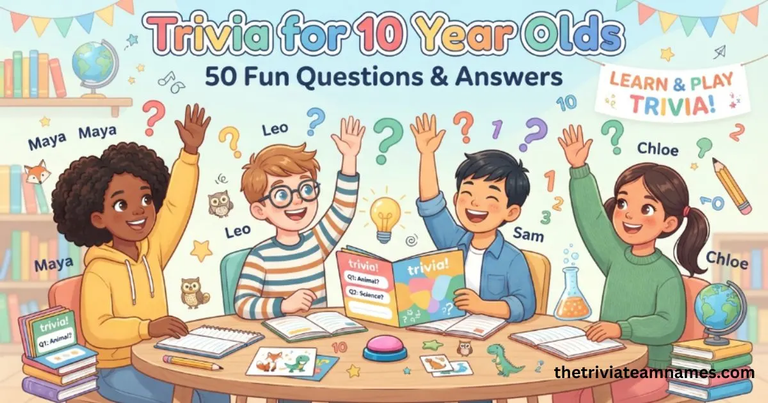
The best trivia questions for 10 year olds mix fun facts, science, animals, geography, history, movies, sports, and everyday knowledge at just the right difficulty. After reviewing current kids’ quiz resources, one pattern is clear: children stay engaged when questions feel playful, familiar, and challenging without becoming frustrating.
Whether you’re a parent planning a family game night, a teacher looking for a classroom warm-up, or someone preparing a birthday-party quiz, the goal is the same: make kids excited to answer. A well-balanced quiz can encourage memory, curiosity, discussion, teamwork, confidence, and learning while still feeling like a game rather than another assignment.
Trivia for 10 Year Olds Types of Trivia
The strongest trivia for 10-year-olds doesn’t stay inside one subject. A balanced quiz can move from general knowledge and science to history, geography, animals, space, and pop culture, allowing different children to shine. This variety also prevents the game from becoming repetitive or feeling like a school test.
Think about a group of fourth graders playing together. One child might know every planet, another may remember world capitals, while another knows every character from a favorite movie. Mixing school knowledge, entertainment, nature, and everyday facts gives everyone a chance to experience that satisfying moment: “I know this one!”
General Knowledge Questions
General knowledge questions introduce children to countries, famous people, everyday facts, literature, culture, and the world around them. They are excellent opening questions because they provide accessible wins before the quiz becomes more challenging. Clear wording and familiar examples make this category especially suitable for mixed-ability groups.
Science Questions
Science trivia can turn ordinary curiosity into a mini discovery session. Questions about space, animals, plants, weather, gravity, the human body, electricity, and Earth work especially well at this age. WonderPods’ current age-10 collection similarly emphasizes science topics such as Jupiter, oxygen, evaporation, plants, animals, and simple machines.
History Questions
History questions help children connect people, places, inventions, and major events to a larger timeline. Instead of overwhelming children with obscure dates, focus on recognizable figures and events. Questions about George Washington, Ancient Egypt, famous explorers, U.S. history, or the first Moon landing can make the past feel like a story.
Geography Questions
Geography trivia gives kids an opportunity to explore the world without leaving the room. Countries, capitals, continents, oceans, mountains, rivers, landmarks, and maps create natural quiz material. A question about the largest ocean can quickly lead to conversations about marine life, continents, climate, exploration, and the world’s geography.
Pop Culture Questions
Pop culture questions can provide some of the biggest laughs because children often have surprisingly detailed knowledge of their favorite movies, characters, books, games, and shows. Keep this section age-appropriate and current for your audience. Familiar franchises can make a quiz feel personal rather than purely academic.
Trivia for 10 Year Olds Crafting Trivia Questions
Creating strong trivia questions for 10 year olds isn’t simply about taking adult questions and making them shorter. The wording, subject, difficulty, and expected knowledge all matter. Current competitor research repeatedly emphasizes age-appropriate language, familiar context, subject diversity, and a balance between easy questions and challenges.
A good quiz should create several small victories while still giving children a few moments that make them stop and think. If every question is obvious, the game becomes boring. If every question is difficult, children can lose confidence. The sweet spot is a playful mixture that rewards both knowledge and curiosity.
Making Questions Age-Appropriate
Age-appropriate questions should use language a typical 10-year-old can understand without unnecessary jargon. Questions can still introduce new vocabulary or ideas, but the challenge should come from the knowledge being tested rather than confusing sentence structure. Familiar examples make difficult concepts easier to approach.
Incorporating Various Subjects
Subject variety makes a quiz more inclusive. Combine science, geography, history, literature, art, animals, sports, movies, and general knowledge so children with different interests can contribute. Competitor research specifically supports diverse subject coverage because it encourages curiosity while preventing one academic area from dominating the game.
Trivia for 10 Year Olds Sample Trivia Questions
Below is a ready-to-play collection of trivia questions for 10 year olds with answers. The questions deliberately move across multiple subjects, making them suitable for family game nights, classrooms, birthday parties, road trips, youth groups, and casual quizzes. They also mix straightforward recall with questions that require a little extra thought.
General Knowledge Questions
- How many continents are there?
Answer: Seven - What is the capital of France?
Answer: Paris - How many sides does a hexagon have?
Answer: Six - What is the largest ocean on Earth?
Answer: Pacific Ocean - What language is primarily spoken in Brazil?
Answer: Portuguese - How many days are in a leap year?
Answer: 366 - What do you call a baby cat?
Answer: Kitten - How many colors are traditionally found in a rainbow?
Answer: Seven - What is the name of our planet?
Answer: Earth - How many minutes are in one hour?
Answer: 60
Science Questions
- Which planet is known as the Red Planet?
Answer: Mars - What force pulls objects toward Earth?
Answer: Gravity - What gas do humans need to breathe?
Answer: Oxygen - What is the largest planet in our solar system?
Answer: Jupiter - What do bees collect from flowers to help make honey?
Answer: Nectar - What do we call water when it changes into a gas?
Answer: Water vapor - Which organ pumps blood around the human body?
Answer: Heart - What star is closest to Earth?
Answer: The Sun - What do plants use sunlight to help make?
Answer: Food - What is the frozen form of water called?
Answer: Ice
History Questions
- Who was the first president of the United States?
Answer: George Washington - Who was the first person to walk on the Moon?
Answer: Neil Armstrong - Which ancient civilization built the pyramids at Giza?
Answer: Ancient Egyptians - What famous ship sank after hitting an iceberg in 1912?
Answer: Titanic - Which U.S. holiday celebrates independence from Great Britain?
Answer: Independence Day - What ancient city was buried by Mount Vesuvius?
Answer: Pompeii - Who wrote the Declaration of Independence?
Answer: Thomas Jefferson is generally credited as its principal author. - What invention allows people to see distant objects in the sky?
Answer: Telescope - What was the name of the ship on which the Pilgrims traveled to North America in 1620?
Answer: Mayflower - Which famous civil rights leader gave the “I Have a Dream” speech?
Answer: Martin Luther King Jr.
Geography Questions
- What is the largest continent?
Answer: Asia - What is the capital of Japan?
Answer: Tokyo - Which country is often described as being shaped like a boot?
Answer: Italy - What is the highest mountain above sea level?
Answer: Mount Everest - Which ocean lies between Africa and Australia?
Answer: Indian Ocean - What is the capital of the United States?
Answer: Washington, D.C. - Which continent is the Sahara Desert located in?
Answer: Africa - What is the smallest country in the world?
Answer: Vatican City - Which country is famous for the Great Wall?
Answer: China - How many oceans are commonly recognized on Earth?
Answer: Five
Pop Culture Questions
- What is the name of the snowman in Frozen?
Answer: Olaf - What is the name of the cowboy in Toy Story?
Answer: Woody - Who is Peter Parker better known as?
Answer: Spider-Man - What is the name of Harry Potter’s school?
Answer: Hogwarts - What kind of creature is Pikachu?
Answer: A Pokémon - What is the name of the lion cub who becomes king in The Lion King?
Answer: Simba - Which superhero carries a shield with a star?
Answer: Captain America - What color is the main character Sonic?
Answer: Blue - What is the name of the fairy in Peter Pan?
Answer: Tinker Bell - Which movie features the character Buzz Lightyear?
Answer: Toy Story
Trivia for 10 Year Olds Engaging with Trivia
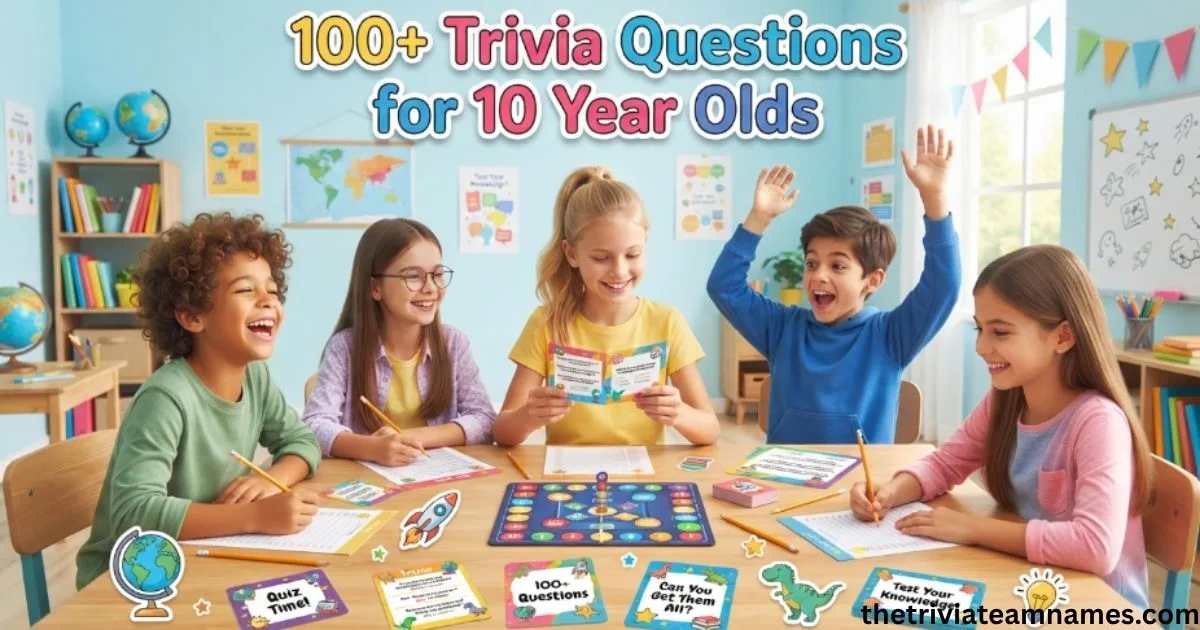
Trivia becomes much more memorable when children can talk, cooperate, laugh, and celebrate answers together. Instead of making every question an individual test, create small teams and let children explain their thinking. This turns a simple quiz into a social activity involving communication, recall, friendly competition, and shared discovery.
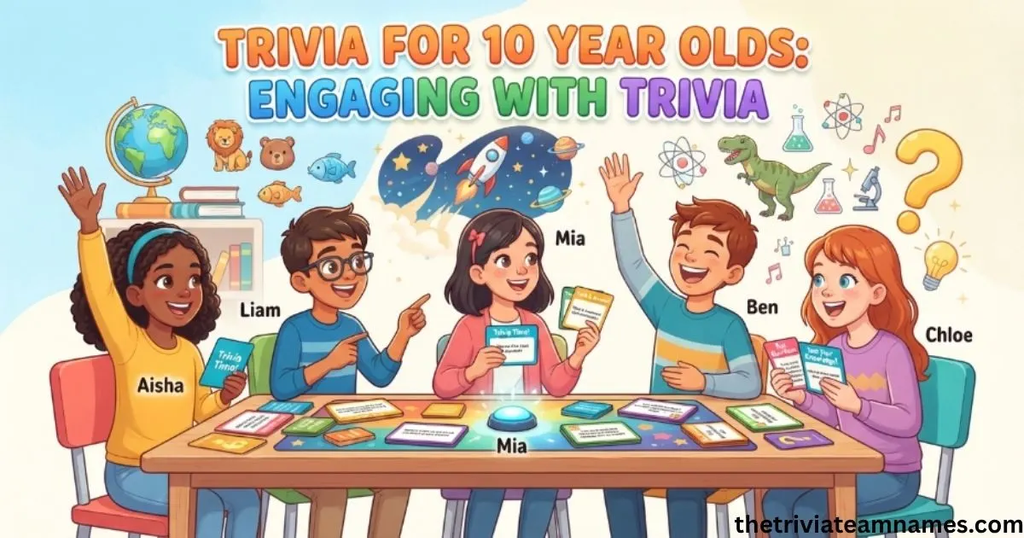
For a family game night, give each team paper and a pencil. For a classroom, display one question at a time and allow a short discussion period. At a birthday party, use themed rounds and small prizes. The format can change, but the principle remains the same: children should feel involved rather than pressured.
Trivia as a Group Activity
Group trivia works especially well because different children bring different strengths. One teammate might know science, another geography, and another movies. Encourage children to explain why they selected an answer instead of simply announcing whether it was right. That small conversation can turn a single question into a memorable learning moment.
Trivia for 10 Year Olds Benefits of Trivia for Ten Year Olds
The value of trivia questions for 10 year olds extends beyond getting a high score. Educational competitors connect well-designed trivia with recall, curiosity, confidence, concentration, social interaction, teamwork, and knowledge reinforcement.
Trivia can also change a child’s relationship with mistakes. When the atmosphere is playful, an incorrect answer doesn’t necessarily feel like failure it becomes a reason to discover something new. That emotional shift matters. A child who misses a question about space may remember the correct answer because they were genuinely curious about it.
| Trivia format | Best for | Main strength |
| Family quiz | Home | Bonding |
| Classroom trivia | School | Knowledge review |
| Team quiz | Groups | Teamwork |
| Birthday quiz | Parties | Entertainment |
| Road-trip trivia | Travel | Screen-free fun |
| Online quiz | Remote groups | Instant interaction |
The strongest approach is to treat trivia as a supplement to learning, not a replacement for it. Reading, conversation, hands-on activities, school lessons, outdoor play, and creative projects remain important. Trivia simply adds another playful way to retrieve information and become curious about unfamiliar subjects.
Final Thoughts
The best trivia questions for 10 year olds feel like a game before they feel like a lesson. Science, animals, geography, history, general knowledge, sports, books, movies, and pop culture can all work when the wording is clear and the difficulty is balanced. Current competitors consistently support variety and age-appropriate challenges as key ingredients.
Whether you’re planning a classroom activity, family quiz, birthday challenge, or road-trip game, start with questions children can confidently understand, then gradually introduce harder ones. Most importantly, celebrate curiosity not just correct answers. The best quiz may end with a child saying, “I didn’t know that. Can we do another one?”
FAQ Section
What are good trivia questions for 10-year-olds?
Good questions cover science, animals, geography, history, general knowledge, sports, books, movies, and age-appropriate pop culture. A strong quiz mixes easier questions with moderate challenges so children can experience both confidence and discovery.
How hard should trivia be for a 10-year-old?
Use mixed difficulty. Start with several accessible questions, introduce medium questions, and finish with a few tougher challenges. Avoid making every question extremely easy or obscure because either extreme can reduce engagement.
What subjects are best for 10-year-old trivia?
Science, nature, animals, geography, history, space, general knowledge, sports, literature, movies, and age-appropriate pop culture are excellent categories. Current resources specifically emphasize science, nature, history, geography, and general knowledge.
Can trivia help children learn?
Yes. Trivia gives children repeated opportunities to recall information, discuss answers, make connections, and discover new facts. It can support curiosity and knowledge reinforcement, although it works best alongside normal reading, instruction, play, and conversation.
How many trivia questions should a 10-year-old quiz have?
For a short activity, 10–15 questions can work well. For a longer family or classroom game, around 20–30 questions provides more variety without necessarily becoming exhausting. The right number depends on attention span, group size, and whether you’re using multiple rounds.
Can trivia questions be used in a classroom?
Absolutely. Teachers can use them as warm-ups, review activities, team challenges, or end-of-class games. Science, history, geography, math, and general knowledge questions can reinforce topics students have already encountered.
What is the best way to play trivia with 10-year-olds?
Small teams are often effective because children can combine different areas of knowledge. Give each team an answer sheet, read questions aloud, allow brief discussion, reveal answers, and keep scoring simple. A small prize or bonus round can add excitement without making winning the only goal.

Helping trivia lovers discover funny, clever, and unforgettable team names for every quiz night.