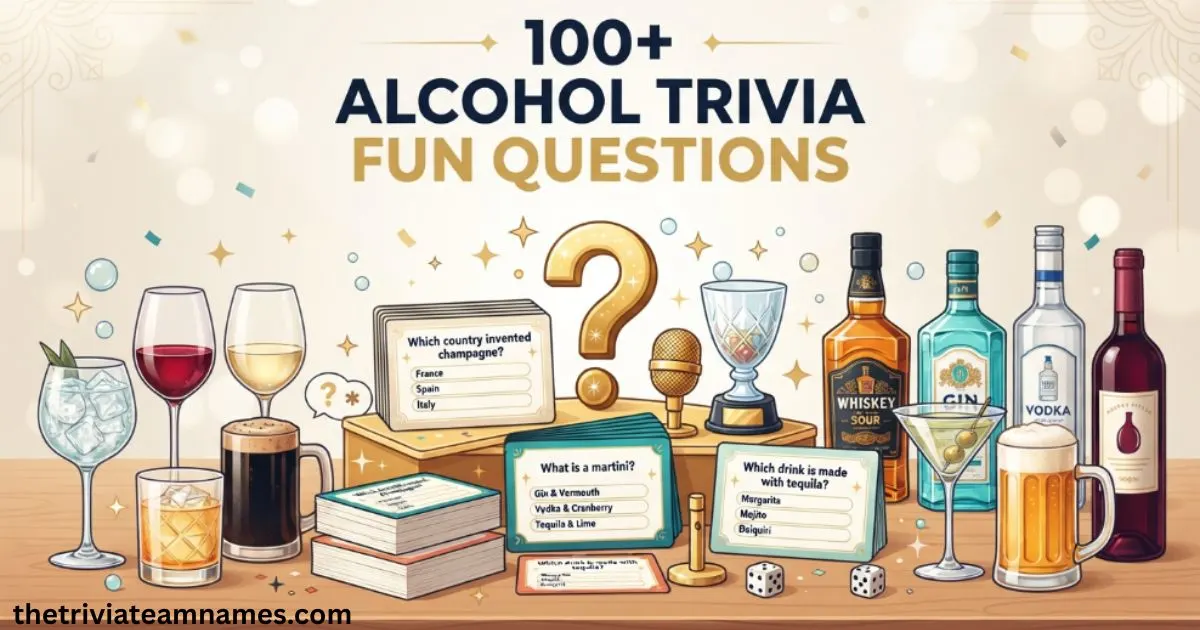
100+ Alcohol Trivia Fun Questions and Answers
Alcohol trivia is a fun way to test your knowledge of cocktails, beer, wine, spirits, mixology, drinking history, brands, and bar culture. Whether you’re building a pub quiz, planning a trivia night, or simply settling a friendly argument, these questions mix easy wins with genuinely tricky facts.
After researching leading alcohol quiz formats, I built this collection to go beyond repetitive “name a drink” prompts. You’ll encounter bourbon, tequila, gin, whiskey, Champagne, beer styles, wine regions, famous cocktails, bartending terms, movies, music, and international drinking traditions with answers included so the game keeps moving.
One accuracy note matters: alcohol facts can be surprisingly nuanced. For example, in the United States, a standard drink contains about 14 grams (0.6 fluid ounces) of pure alcohol, whether that comes from 12 ounces of 5% beer, 5 ounces of 12% wine, or 1.5 ounces of 40% distilled spirits.
So grab your quiz sheet, divide into teams, and see how many you can get right.
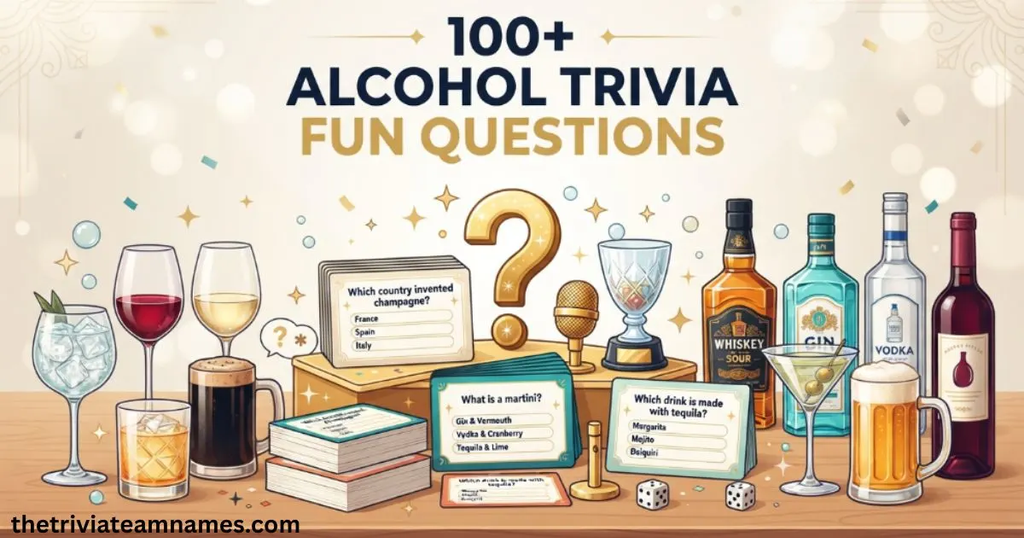
Alcohol Trivia: General Knowledge
The general-knowledge round is where most teams find their rhythm. You’ll move between alcohol terminology, beverage history, spirits, cocktails, wine, beer, proof, fermentation, and drinking culture. Some answers look obvious until one small detail changes everything.
These questions are designed for mixed groups, so expect a few easy points followed by questions that reward genuine knowledge. A good team doesn’t need one expert; someone who knows wine, another who follows cocktails, and another who remembers history can work surprisingly well together.
1. What type of alcohol is found in alcoholic beverages?
Answer: Ethanol.
2. What does ABV stand for?
Answer: Alcohol by volume.
3. In the United States, how much pure alcohol is in one standard drink?
Answer: About 14 grams, or 0.6 fluid ounces.
4. What does 80-proof liquor contain approximately?
Answer: 40% alcohol by volume.
5. What process converts sugars into alcohol?
Answer: Fermentation.
6. What microorganism is primarily responsible for alcoholic fermentation?
Answer: Yeast.
7. What spirit is traditionally associated with juniper berries?
Answer: Gin.
8. What spirit is made from sugarcane products such as molasses?
Answer: Rum.
9. What fruit is traditionally used to make cider?
Answer: Apples.
10. What is a sommelier?
Answer: A wine professional specializing in wine service and knowledge.
11. What is an aperitif?
Answer: A drink traditionally served before a meal.
12. What is a digestif?
Answer: A drink traditionally served after a meal.
13. What does “neat” mean when ordering a spirit?
Answer: Served by itself, without ice or a mixer.
14. What does “on the rocks” mean?
Answer: Served over ice.
15. What is a highball?
Answer: A spirit served with a larger amount of mixer, typically in a tall glass.
16. What is the traditional base spirit of a Margarita?
Answer: Tequila.
17. What is the classic garnish for a Martini?
Answer: An olive or lemon twist.
18. What country is strongly associated with tequila production?
Answer: Mexico.
19. What U.S. state is especially associated with bourbon?
Answer: Kentucky.
20. What is the name of the Greek god of wine?
Answer: Dionysus.
Alcohol Trivia: Types of Alcohol
Understanding beverage categories makes alcohol trivia much easier. Spirits, wine, beer, cider, liqueurs, fortified wines, tequila, bourbon, brandy, rum, and whiskey each have different production traditions and defining characteristics.
This round also highlights why terminology matters. A beverage’s raw material, fermentation method, distillation process, aging requirements, and geographic identity can all determine what category it belongs to. Bourbon, for example, isn’t simply “American whiskey”; U.S. regulations establish specific production requirements.
21. What are vodka, gin, rum, tequila and whiskey examples of?
Answer: Distilled spirits.
22. What plant is used to make tequila?
Answer: Blue Weber agave.
23. What grain is central to traditional bourbon production?
Answer: Corn.
24. What is the minimum corn content required for bourbon’s mash bill under U.S. standards?
Answer: At least 51% corn.
25. What type of spirit is Cognac?
Answer: Brandy.
26. Cognac is produced in which country?
Answer: France.
27. Pisco is what type of spirit?
Answer: Grape brandy.
28. Which two South American countries are especially associated with pisco?
Answer: Peru and Chile.
29. What is mead made from?
Answer: Fermented honey and water.
30. What type of beverage is sake?
Answer: A fermented alcoholic beverage made primarily from rice.
31. What is Jägermeister?
Answer: An herbal liqueur.
32. What is vermouth?
Answer: A fortified, aromatized wine.
33. What is a fortified wine?
Answer: Wine to which distilled spirit has been added.
34. Name two famous fortified wines.
Answer: Port and sherry.
35. What is brandy generally distilled from?
Answer: Wine or fermented fruit juice.
36. What spirit is traditionally made from fermented sugarcane products?
Answer: Rum.
37. What is bourbon classified as?
Answer: American whiskey.
38. What is Scotch whisky?
Answer: Whisky produced in Scotland under Scotch whisky regulations.
39. What is a liqueur?
Answer: A sweetened, flavored alcoholic beverage, usually based on distilled spirits.
40. What is absinthe traditionally flavored with?
Answer: Botanicals including wormwood, anise, and fennel.
Alcohol Trivia Guess The Drink
Now comes the round where ingredient recognition becomes your secret weapon. Cocktail names, base spirits, mixers, garnishes, syrups, bitters, fruit juices, and glassware all provide clues.
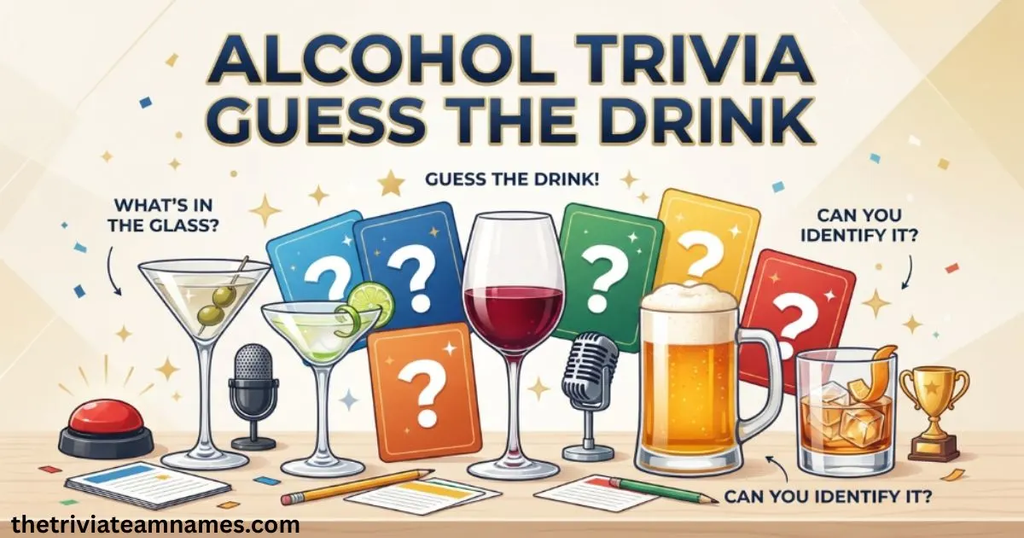
This is also one of the most entertaining formats for a party because players often recognize a cocktail from one ingredient but forget the actual name. Give teams a few seconds to think before revealing each answer.
41. Vodka, tomato juice, spices and celery garnish describe which cocktail?
Answer: Bloody Mary.
42. Bourbon, sugar, bitters and citrus traditionally make which cocktail?
Answer: Old Fashioned.
43. Vodka, ginger beer and lime juice make which cocktail?
Answer: Moscow Mule.
44. Gin, Campari and sweet vermouth make which cocktail?
Answer: Negroni.
45. Tequila, triple sec and lime juice make which classic cocktail?
Answer: Margarita.
46. Vodka, coffee liqueur and cream make which cocktail?
Answer: White Russian.
47. Prosecco and peach purée make which cocktail?
Answer: Bellini.
48. Rum, coconut cream and pineapple juice make which tropical cocktail?
Answer: Piña Colada.
49. Rum, mint, lime, sugar and soda water make which cocktail?
Answer: Mojito.
50. Gin, tonic water and lime are the core ingredients of which classic drink?
Answer: Gin and Tonic.
51. Pisco, lime or lemon juice, syrup and egg white make which cocktail?
Answer: Pisco Sour.
52. Bourbon, mint, sugar and water are associated with which Kentucky classic?
Answer: Mint Julep.
53. What cocktail is made with coffee, Irish whiskey, sugar and cream?
Answer: Irish Coffee.
54. What cocktail combines gin, sweet vermouth and orange bitters in a classic preparation?
Answer: Martini variations commonly use these elements; the exact recipe depends on style.
55. What cocktail is traditionally made with rye whiskey, sugar and bitters?
Answer: Old Fashioned.
56. What cocktail is strongly associated with New Orleans and Peychaud’s bitters?
Answer: Sazerac.
57. What cocktail is made with tequila, lime juice and orange liqueur?
Answer: Margarita.
58. What cocktail is famously associated with the phrase “shaken, not stirred”?
Answer: Martini, specifically James Bond’s preferred variation.
59. What drink is traditionally made with red or white wine, fruit and other flavorings?
Answer: Sangria.
60. What cocktail is known for combining rum, fruit juices and grenadine?
Answer: Zombie.
The Sazerac is especially interesting historically: Smithsonian’s cocktail-history reporting identifies New Orleans as the home of this particular cocktail, while noting that the broader claim that New Orleans invented the cocktail is more complicated.
Alcohol Trivia: All About Beer
Beer brings its own vocabulary to the game: malt, hops, yeast, lager, ale, stout, IPA, pilsner, fermentation, breweries, tap service, and beer festivals. This category can quickly separate casual drinkers from genuine beer enthusiasts.
One useful distinction is between ales and lagers. Their production involves different yeast strains and fermentation traditions, which is why “beer” isn’t one single flavor profile. Geography matters too, with distinctive brewing traditions developing across Belgium, Germany, the Czech Republic, Britain, Japan, Mexico, and the United States.
61. What is the main grain traditionally used in beer production?
Answer: Barley.
62. What ingredient provides much of beer’s bitterness and aroma?
Answer: Hops.
63. What microorganism ferments the sugars in beer?
Answer: Yeast.
64. What does IPA stand for?
Answer: India Pale Ale.
65. What is a stout?
Answer: A typically dark, roasted beer style.
66. What is a lager?
Answer: A beer traditionally fermented with lager yeast at cooler temperatures.
67. What is a pilsner?
Answer: A pale lager style originating in the Czech lands.
68. Which country is associated with witbier?
Answer: Belgium.
69. What Japanese beer brand is associated with Sapporo?
Answer: Sapporo.
70. What Mexican beer is famously served with a lime wedge in many U.S. settings?
Answer: Corona.
71. What Jamaican beer is recognized internationally by its distinctive branding?
Answer: Red Stripe.
72. What beer festival is held in Munich?
Answer: Oktoberfest.
73. What does “dry hopping” mean?
Answer: Adding hops during or after fermentation primarily to enhance aroma.
74. What is malted barley?
Answer: Barley that has been germinated and then dried as part of the brewing process.
75. Which beer style is especially associated with strong hop bitterness?
Answer: IPA.
Alcohol Trivia: All About Wine
Wine trivia opens the door to grapes, vineyards, fermentation, regions, sparkling wine, fortified wine, red wine, white wine, rosé, Champagne, Riesling, Chianti, Napa Valley, and Bordeaux.
Wine questions are particularly good for mixed-difficulty quiz nights because the basic questions are approachable while regional terminology can become extremely challenging. The biggest trick is remembering that a wine name may refer to a grape, a region, a style, or a legally defined geographic designation.
76. What fruit is primarily used to make wine?
Answer: Grapes.
77. What is a vineyard?
Answer: Land where grapevines are cultivated.
78. Which U.S. state is home to Napa Valley?
Answer: California.
79. Chianti is associated with which Italian region?
Answer: Tuscany.
80. Which French region is famous for Champagne?
Answer: Champagne.
81. What type of wine is made by fermenting grapes with their skins?
Answer: Red wine.
82. What is rosé?
Answer: A wine with a pink color produced through methods that limit grape-skin contact compared with typical red-wine production.
83. What does “spumante” generally indicate?
Answer: Sparkling wine.
84. Which grape is strongly associated with Germany and high-acid wines?
Answer: Riesling.
85. Which grape is central to Beaujolais Nouveau?
Answer: Gamay.
86. What is ice wine?
Answer: Wine made from grapes harvested while naturally frozen under qualifying conditions.
87. What is Champagne?
Answer: A sparkling wine produced in France’s Champagne region under its appellation rules.
88. What is Syrah also commonly called in Australia?
Answer: Shiraz.
89. What is a sommelier?
Answer: A trained wine professional specializing in wine selection, service and knowledge.
90. What is an oenophile?
Answer: A person who has a strong interest in wine.
Alcohol Trivia: Pop Culture
Alcohol has become deeply connected with movies, television, music, celebrities, fictional characters, advertising, and popular culture. That makes this section especially accessible because you don’t have to be a bartender or wine expert to score points.
The best pop-culture questions don’t simply ask whether a drink appears in a movie. They connect a recognizable character, actor, song, brand, or fictional location with the beverage itself. That creates the satisfying “I knew that!” moment that keeps a trivia crowd engaged.
91. Which fictional character is famous for ordering a Martini “shaken, not stirred”?
Answer: James Bond.
92. Which film features The Dude drinking White Russians?
Answer: The Big Lebowski.
93. Which actor played The Dude?
Answer: Jeff Bridges.
94. Which film famously features Jack Torrance ordering bourbon?
Answer: The Shining.
95. Which actor is associated with the tequila brand Casamigos?
Answer: George Clooney was a co-founder.
96. Which actor associated with Deadpool launched Aviation American Gin?
Answer: Ryan Reynolds.
97. What tequila brand is associated with Dwayne “The Rock” Johnson?
Answer: Teremana.
98. Which television show features MacLaren’s Pub?
Answer: How I Met Your Mother.
99. What movie centers on a disastrous bachelor-party trip to Las Vegas?
Answer: The Hangover.
100. What fictional character famously enjoys Scotch in Anchorman?
Answer: Ron Burgundy.
Alcohol Trivia: The Art of Mixology
Mixology turns simple drink knowledge into a technical vocabulary lesson. Bitters, vermouth, cocktail shakers, muddling, garnishes, glassware, mixers, ice, syrup, soda water, and presentation all influence how a cocktail is prepared and served.
This is where a trivia night can become surprisingly educational. A person may know a Margarita by taste but not know what triple sec does, why a cocktail is stirred rather than shaken, or what “neat” actually means.
101. What is mixology?
Answer: The art and practice of creating cocktails by combining spirits, mixers, flavorings and other ingredients.
102. What are bitters used for?
Answer: They add concentrated aromatic flavor and complexity to cocktails.
103. What is muddling?
Answer: Gently crushing ingredients such as herbs or fruit to release flavor.
104. What is a cocktail shaker used for?
Answer: Mixing and chilling ingredients, often with ice.
105. What is a Boston shaker?
Answer: A two-part cocktail shaker typically consisting of a metal tin and a glass or second tin.
106. What does “neat” mean?
Answer: A spirit served without ice or mixer.
107. What does “on the rocks” mean?
Answer: Served over ice.
108. What is a garnish?
Answer: An edible or decorative ingredient added to finish a drink.
109. What is grenadine traditionally associated with?
Answer: Sweet red cocktail syrup traditionally made from pomegranate, although modern commercial products vary.
110. What is triple sec?
Answer: An orange-flavored liqueur commonly used in cocktails such as Margaritas.
111. What is vermouth?
Answer: Aromatized fortified wine.
112. What are the two broad vermouth styles commonly used in cocktails?
Answer: Sweet and dry.
113. What type of glass is commonly associated with a Martini?
Answer: A Martini or cocktail glass.
114. What glass is commonly associated with drinks served over ice?
Answer: A rocks or Old Fashioned glass.
115. What cocktail commonly uses ginger beer?
Answer: Moscow Mule.
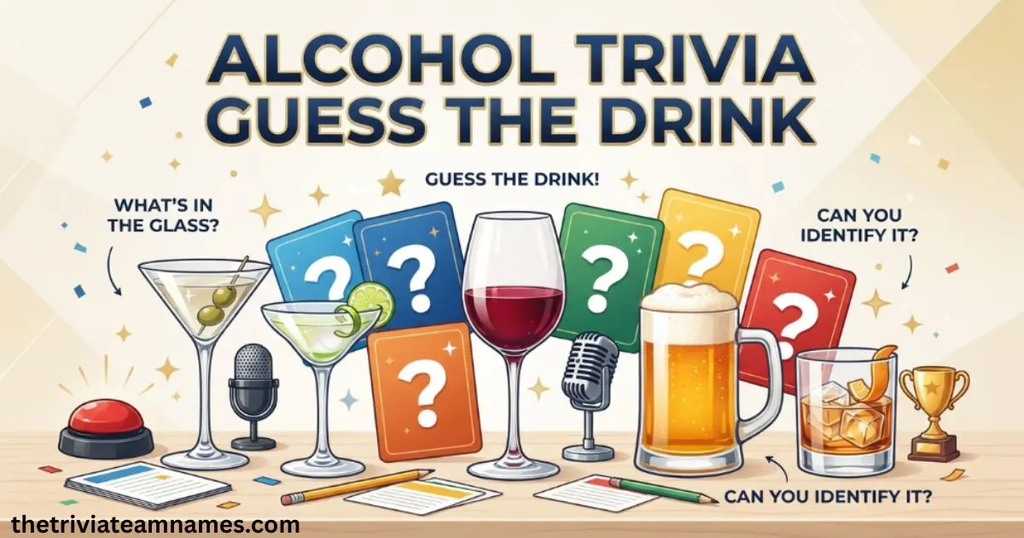
Alcohol Trivia Hard Alcohol Trivia Questions
Ready for the deep end? These questions move beyond basic beer, wine, cocktails, and spirits into history, terminology, geography, production, and obscure beverage knowledge.
A hard round works best when the answer is difficult but defensible. The goal isn’t to trick players with obscure wording; it is to reward teams that have genuinely absorbed the details. For factual questions involving alcohol regulations or health, use authoritative sources rather than relying on old trivia lists.
116. What is the alcohol in alcoholic beverages called chemically?
Answer: Ethanol.
117. What is 100-proof liquor approximately in ABV under the U.S. proof convention?
Answer: 50% ABV.
118. What is the standard U.S. drink equivalent of 1.5 ounces of 80-proof distilled spirits?
Answer: About one standard drink.
119. What is the standard U.S. drink equivalent of a 5-ounce glass of 12% wine?
Answer: About one standard drink.
120. What is the standard U.S. drink equivalent of a 12-ounce beer at 5% ABV?
Answer: About one standard drink.
121. What does BAC stand for?
Answer: Blood alcohol concentration.
122. According to NIAAA, what BAC threshold defines binge drinking?
Answer: A pattern of drinking that brings BAC to 0.08% or higher; for a typical adult, this generally corresponds to about five drinks for men or four for women in roughly two hours.
123. Which U.S. city is strongly associated with the Sazerac?
Answer: New Orleans.
124. Who was Antoine Peychaud?
Answer: A New Orleans apothecary associated with Peychaud’s bitters and the history of the Sazerac.
125. What cocktail is often described as America’s first cocktail?
Answer: The Sazerac is often described that way, although cocktail-history claims depend on how “first cocktail” is defined.
126. What is the world’s largest famous beer festival held in Munich?
Answer: Oktoberfest.
127. Which country is famous for the traditional spirit ouzo?
Answer: Greece.
128. Which country is strongly associated with Armagnac?
Answer: France.
129. What is the primary raw material of traditional tequila?
Answer: Blue Weber agave.
130. What is the main distinction between fermentation and distillation?
Answer: Fermentation uses microorganisms to convert sugars into alcohol, while distillation separates and concentrates components based on differences in volatility.
Conclusion
This collection shows why alcohol trivia is much broader than memorizing cocktail names. The best questions connect spirits, beer, wine, mixology, geography, history, science, brands, movies, music, and drinking culture into one searchable knowledge network.
If you’re hosting a quiz night, start with the easier general-knowledge questions, move into beer and wine, then use cocktails and pop culture to keep everyone involved. Save the hard questions for the final round so teams have a chance to build momentum before the serious brain-benders arrive.
And remember that some alcohol facts especially standard-drink definitions, health information, and regulations can change or require context. For U.S. health-related facts, NIAAA is a much stronger authority than recycled trivia lists.
The result is a better alcohol trivia experience: entertaining enough for a party, varied enough for a pub quiz, and accurate enough to teach players something they didn’t know.
FAQ Section
What are some good alcohol trivia questions?
Good questions cover cocktails, beer, wine, spirits, alcohol history, geography, famous brands, mixology, and pop culture. Mixing easy identification questions with harder production and historical questions keeps a trivia night accessible while still challenging experienced players.
What is the most popular type of alcohol trivia?
Cocktail, beer, wine, and general alcohol knowledge questions are especially common because they appeal to different audiences. Competitor pages repeatedly use these categories, alongside multiple-choice, true/false, geography, travel, food, and picture rounds.
What is one standard drink in the United States?
A U.S. standard drink contains approximately 14 grams or 0.6 fluid ounces of pure alcohol. That’s roughly equivalent to 12 ounces of 5% beer, 5 ounces of 12% wine, or 1.5 ounces of 40% distilled spirits.
What does 100 proof mean?
Under the U.S. proof convention used for distilled spirits, 100 proof corresponds to approximately 50% alcohol by volume.
What alcohol is used in a Margarita?
A classic Margarita is based on tequila, typically combined with orange liqueur and lime juice.
What is the difference between beer and spirits?
Beer is produced through brewing and fermentation, while spirits are distilled alcoholic beverages. Distillation generally concentrates alcohol beyond the level found in typical fermented beverages.
What is the hardest alcohol trivia question?
There isn’t one universally hardest question. A genuinely difficult question usually involves obscure historical details, regional production rules, lesser-known spirits, technical distillation terminology, or specific cocktail history.
Is alcohol trivia appropriate for a family trivia night?
For a general audience, it is better to keep alcohol-related trivia educational and age-appropriate. If children or teens are participating, consider using a broader food-and-drink quiz rather than a drinking-focused round.

Helping trivia lovers discover funny, clever, and unforgettable team names for every quiz night.