3rd Grade Trivia Questions 100+ Fun Questions With Answers
3rd grade trivia questions are a fun way to turn everyday learning into an exciting challenge for kids, families, teachers, and classrooms. The best questions for third graders combine general knowledge with age-appropriate topics such as math, science, reading, geography, U.S. history, animals, space, and everyday facts. Instead of feeling like another worksheet, a good trivia game gives children a chance to think, remember, guess, laugh, and learn something new.
Whether you’re planning a classroom quiz, family game night, homeschool activity, road-trip challenge, or school review session, having a large collection of fun 3rd grade trivia questions with answers makes preparation much easier. This collection brings together easy questions, moderate challenges, academic topics, general knowledge, and mixed trivia so children with different strengths can participate and enjoy the game.
General 3rd Grade Trivia Questions and Answers
General knowledge is a great place to begin because it gives children a chance to warm up before moving into more specific subjects. These questions include animals, geography, space, famous people, U.S. facts, landmarks, sports, books, nature, and everyday knowledge.
A good third-grade quiz should not make every question feel like a test. Some questions should be easy enough to build confidence, while others should make kids stop and think. That combination creates a more enjoyable experience and gives children opportunities to discover how much they already know.
1–20 General Knowledge Questions
- What is the largest planet in our solar system?
Answer: Jupiter. - How many days are there in one week?
Answer: Seven. - What is the capital of the United States?
Answer: Washington, D.C. - Which animal is the fastest land animal?
Answer: The cheetah. - What do bees make?
Answer: Honey. - Which planet is known as the Red Planet?
Answer: Mars. - How many continents are there on Earth?
Answer: Seven. - What is the largest ocean on Earth?
Answer: The Pacific Ocean. - What is Earth’s natural satellite called?
Answer: The Moon. - What is a baby dog called?
Answer: A puppy. - Which bird is a national symbol of the United States?
Answer: The bald eagle. - What is the tallest animal in the world?
Answer: The giraffe. - How many legs does a spider have?
Answer: Eight. - What is frozen water called?
Answer: Ice. - Which sport uses a bat, ball, and bases?
Answer: Baseball. - What is the largest mammal on Earth?
Answer: The blue whale. - Which city is famous for the Golden Gate Bridge?
Answer: San Francisco. - Who painted the Mona Lisa?
Answer: Leonardo da Vinci. - How many months are in a year?
Answer: Twelve. - What color do you get when you mix blue and yellow?
Answer: Green.
More General Knowledge for Curious Kids
- What is the name of our galaxy?
Answer: The Milky Way. - Which animal is often called man’s best friend?
Answer: The dog. - What do you call a group of stars forming a recognizable pattern?
Answer: A constellation. - Which season comes after summer?
Answer: Fall, or autumn. - What is the opposite of hot?
Answer: Cold. - How many hours are in one day?
Answer: 24. - Which animal has a long trunk?
Answer: An elephant. - What do we use to tell time?
Answer: A clock or watch. - Which direction is opposite to north?
Answer: South. - What is the name of the star closest to Earth?
Answer: The Sun. - What do caterpillars eventually become?
Answer: Butterflies or moths, depending on the species. - Which animal is known for having black and white stripes?
Answer: A zebra. - What is the largest continent?
Answer: Asia. - What is the smallest continent by land area?
Answer: Australia. - How many legs does an insect have?
Answer: Six. - Which animal is famous for carrying its home on its back?
Answer: A turtle or tortoise. - What do plants need from the Sun?
Answer: Light energy. - What is the name of the place where books are borrowed?
Answer: A library. - Which sense do you use with your ears?
Answer: Hearing. - What is the opposite of day?
Answer: Night.
General knowledge questions work especially well at the beginning of a quiz because they encourage participation. A child may not remember a multiplication fact immediately, but that same child might know the largest planet, the number of continents, or the animal with the longest neck. Starting with accessible questions helps everyone feel included.
Mathematics 3rd Grade Trivia Questions and Answers
Math is one of the most useful subjects to include in a third-grade trivia game because many children are developing stronger confidence with multiplication, division, fractions, place value, measurement, geometry, patterns, money, area, and perimeter.
The trick is to make math questions feel like challenges rather than worksheets. Short calculations, number puzzles, shape questions, and everyday math situations can make children think quickly while still reinforcing skills commonly encountered during third grade.
41–60 Math Questions
- What is 7 × 8?
Answer: 56. - What is 9 × 6?
Answer: 54. - What is 63 ÷ 9?
Answer: 7. - What is 81 ÷ 9?
Answer: 9. - What is 125 + 75?
Answer: 200. - What is 500 − 275?
Answer: 225. - What is the value of the 6 in 462?
Answer: 60. - What number comes next: 5, 10, 15, 20, ___?
Answer: 25. - How many sides does a hexagon have?
Answer: Six. - What is half of 18?
Answer: 9. - Which is greater: 1/2 or 1/4?
Answer: 1/2. - What is 4 × 7?
Answer: 28. - What is the perimeter of a square with four sides measuring 5 inches each?
Answer: 20 inches. - What is 300 + 450?
Answer: 750. - What is 1,000 − 400?
Answer: 600. - How many quarters make one dollar?
Answer: Four. - What is 3/4 of 12?
Answer: 9. - How many minutes are in one hour?
Answer: 60. - What shape has three sides?
Answer: A triangle. - If six children each have four pencils, how many pencils do they have altogether?
Answer: 24.
61–80 More Math Trivia Questions
- What is 5 × 9?
Answer: 45. - What is 72 ÷ 8?
Answer: 9. - What is 250 + 250?
Answer: 500. - What is 900 − 100?
Answer: 800. - How many sides does a pentagon have?
Answer: Five. - What fraction represents one whole?
Answer: 1 whole, or 1/1. - What is 10 × 10?
Answer: 100. - What is 36 ÷ 6?
Answer: 6. - How many inches are in one foot?
Answer: 12. - How many cents are in one dollar?
Answer: 100. - What is the value of the 7 in 7,245?
Answer: 7,000. - What is 8 × 8?
Answer: 64. - What is 45 ÷ 5?
Answer: 9. - How many degrees are in a right angle?
Answer: 90 degrees. - What shape has four equal sides?
Answer: A square. - What is 6 × 6?
Answer: 36. - What is 100 ÷ 10?
Answer: 10. - If you have three groups of five apples, how many apples do you have?
Answer: 15. - What number comes next: 100, 90, 80, 70, ?
Answer: 60. - What is the area of a rectangle that is 3 units long and 4 units wide?
Answer: 12 square units.
Math trivia becomes more engaging when children can connect numbers to real life. Counting money, measuring objects, sharing items equally, calculating time, and recognizing shapes all show that mathematics is not confined to a textbook. It appears at the grocery store, on a clock, in a kitchen, on a playground, and even while planning a trip.
Science 3rd Grade Trivia Questions and Answers
Science questions are especially effective for third graders because children at this age are naturally curious about animals, plants, weather, Earth, space, energy, motion, ecosystems, life cycles, and the human body.
A strong science trivia round should encourage curiosity instead of requiring children to memorize complicated terminology. Questions should connect classroom ideas with observations children can make in the real world.
81–100 Science Questions
- What process do green plants use to make food using sunlight?
Answer: Photosynthesis. - What gas do humans need to breathe?
Answer: Oxygen. - What is at the center of our solar system?
Answer: The Sun. - What force pulls objects toward Earth?
Answer: Gravity. - What is the solid form of water?
Answer: Ice. - What instrument measures temperature?
Answer: A thermometer. - What is water falling from clouds called?
Answer: Precipitation. - Which planet is closest to the Sun?
Answer: Mercury. - What part of a plant usually absorbs water from the soil?
Answer: The roots. - What do we call animals that eat only plants?
Answer: Herbivores. - What do we call animals that eat other animals?
Answer: Carnivores. - What organ pumps blood around the body?
Answer: The heart. - What is Earth’s layer of air called?
Answer: The atmosphere. - What happens to water when it freezes?
Answer: It changes from a liquid to a solid. - Which planet is famous for its large rings?
Answer: Saturn. - What do we call the repeating stages of growth in an organism?
Answer: A life cycle. - What is an animal without a backbone called?
Answer: An invertebrate. - What is the habitat of a polar bear?
Answer: The Arctic. - What natural object gives Earth most of its light and heat?
Answer: The Sun. - What do we call moving air?
Answer: Wind.
101–120 More Science Trivia Questions
- What gas do plants take in from the air during photosynthesis?
Answer: Carbon dioxide. - What is the name for water changing from liquid to gas?
Answer: Evaporation. - What is the name for water changing from gas to liquid?
Answer: Condensation. - Which part of the body helps you think and control many body functions?
Answer: The brain. - What do fish use to breathe underwater?
Answer: Gills. - What is the natural satellite of Earth?
Answer: The Moon. - Which planet is known as the Red Planet?
Answer: Mars. - What kind of energy comes from the Sun?
Answer: Solar energy. - What do we call a place where an organism lives?
Answer: A habitat. - What is the largest organ of the human body?
Answer: The skin. - What do bees collect from flowers?
Answer: Nectar and pollen. - What is the process by which a seed begins to grow?
Answer: Germination. - What are animals that eat both plants and animals called?
Answer: Omnivores. - Which state of matter has a definite shape?
Answer: Solid. - Which state of matter takes the shape of its container but keeps its volume?
Answer: Liquid. - What causes day and night on Earth?
Answer: Earth’s rotation. - What is a scientist who studies weather called?
Answer: A meteorologist. - What do we call a large body of salt water?
Answer: An ocean or sea, depending on the specific body of water. - What natural phenomenon can include thunder and lightning?
Answer: A thunderstorm. - What do roots, stems, leaves, and flowers belong to?
Answer: A plant.
Science trivia is particularly powerful because the answer often leads to another question. A child who learns that plants need sunlight may ask how plants make food. A question about the Moon can lead to a discussion about planets. A question about weather can lead to clouds, precipitation, climate, and the water cycle.
That is exactly what makes good trivia valuable: the answer doesn’t have to be the end of learning. It can be the beginning of curiosity.
Social Studies 3rd Grade Trivia Questions and Answers
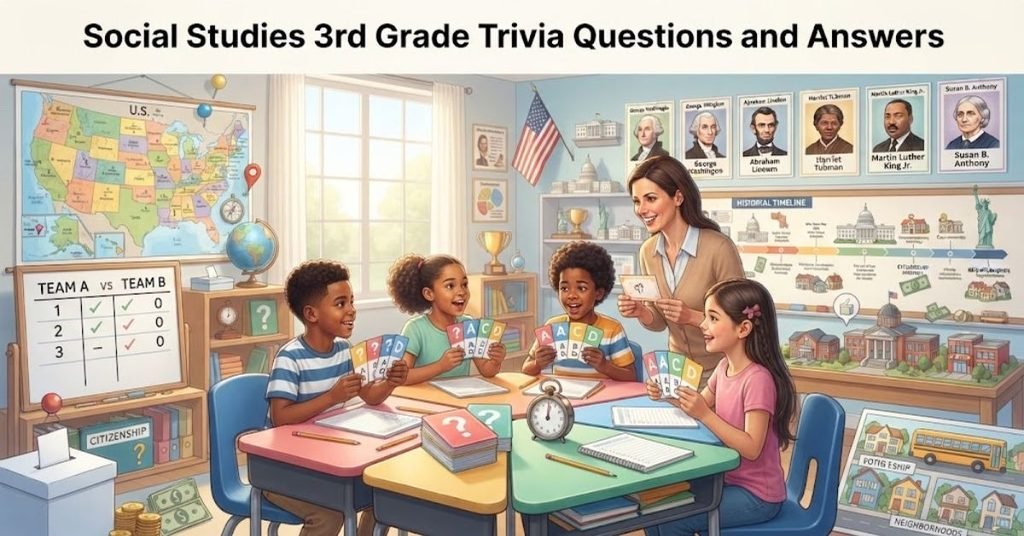
Social studies questions introduce children to the world around them through U.S. history, geography, government, communities, states, national symbols, important people, landmarks, and civic ideas.
For a U.S. audience, these questions are particularly useful because they combine basic American knowledge with geography and citizenship. They can be used in classrooms, family games, review activities, and school trivia competitions.
121–140 Social Studies Questions
- Who was the first president of the United States?
Answer: George Washington. - Who was the 16th president of the United States?
Answer: Abraham Lincoln. - What document begins with “We the People”?
Answer: The U.S. Constitution. - How many states are in the United States?
Answer: 50. - What is the largest U.S. state by area?
Answer: Alaska. - Which state is known as the Aloha State?
Answer: Hawaii. - Where is the Statue of Liberty located?
Answer: New York Harbor, New York. - What is the U.S. national legislature called?
Answer: Congress. - What are the three branches of the U.S. federal government?
Answer: Legislative, executive, and judicial. - What is the capital of Texas?
Answer: Austin. - Which state is home to the Grand Canyon?
Answer: Arizona. - What is a community?
Answer: A group of people who live, work, or interact in the same area. - Who gave the famous “I Have a Dream” speech?
Answer: Martin Luther King Jr. - What is the capital of California?
Answer: Sacramento. - Which ocean borders the eastern coast of the United States?
Answer: The Atlantic Ocean. - Which ocean borders the western coast of the United States?
Answer: The Pacific Ocean. - What is the name of the U.S. national anthem?
Answer: “The Star-Spangled Banner.” - What does a map legend explain?
Answer: The symbols used on a map. - What holiday is celebrated on July 4 in the United States?
Answer: Independence Day. - What famous landmark in South Dakota shows the faces of four U.S. presidents?
Answer: Mount Rushmore.
141–160 More Social Studies Trivia Questions
- What is the capital of the United States?
Answer: Washington, D.C. - Which U.S. state is shaped like a mitten?
Answer: Michigan. - What is the capital of Florida?
Answer: Tallahassee. - Which state is known as the Empire State?
Answer: New York. - What is the capital of Illinois?
Answer: Springfield. - Which U.S. state is famous for the Liberty Bell?
Answer: Pennsylvania. - What is the capital of Massachusetts?
Answer: Boston. - What do we call a person who is a member of a country?
Answer: A citizen. - What do maps help us understand?
Answer: Locations, places, distances, directions, and geographic relationships. - What direction is opposite east?
Answer: West. - Which U.S. state is famous for Yellowstone National Park?
Answer: Wyoming. - What is the capital of Colorado?
Answer: Denver. - Which U.S. holiday honors people who served in the military?
Answer: Veterans Day. - Which holiday honors the birthday of Martin Luther King Jr.?
Answer: Martin Luther King Jr. Day. - What is the name of the river that forms part of the border between Texas and Mexico?
Answer: The Rio Grande. - What is the capital of New York State?
Answer: Albany. - Which U.S. state is known for the Grand Canyon?
Answer: Arizona. - What is the capital of Pennsylvania?
Answer: Harrisburg. - What is the capital of Georgia?
Answer: Atlanta. - What is the capital of Ohio?
Answer: Columbus.
Social studies trivia can also encourage children to ask questions about how communities work. A question about a mayor can lead to government. A question about a map can lead to geography. A question about a historical person can lead to a discussion about the time period in which that person lived.
That makes this type of quiz especially useful for teachers because trivia can act as a starting point for a much larger classroom conversation.
Text Comprehension 3rd Grade Trivia Questions and Answers
Third grade is an important stage for developing stronger reading comprehension and language skills. Children encounter longer stories, new vocabulary, more complex sentences, and different types of writing.
Trivia can support those skills through questions about synonyms, antonyms, vocabulary, punctuation, grammar, characters, setting, theme, sentence structure, and literary concepts.
161–180 Reading and Language Questions
- What is a word that means nearly the same as another word called?
Answer: A synonym. - What is a word that means the opposite of another word called?
Answer: An antonym. - What punctuation mark usually ends a question?
Answer: A question mark. - What punctuation mark shows strong emotion?
Answer: An exclamation mark. - What do we call the people or animals in a story?
Answer: Characters. - What is the setting of a story?
Answer: The time and place where the story happens. - What is the main message or lesson of a story called?
Answer: The theme. - What is a word that describes a noun called?
Answer: An adjective. - What is the shortened form of “do not”?
Answer: Don’t. - What are words that sound alike but can have different meanings or spellings called?
Answer: Homophones. - What is the plural of “child”?
Answer: Children. - What is the opposite of “early”?
Answer: Late. - What is the opposite of “ancient”?
Answer: Modern. - What is the noun in the sentence “The dog chased the ball”?
Answer: Dog or ball, depending on which noun is being identified. - What punctuation mark separates items in a simple list?
Answer: A comma. - What is a sentence that asks something called?
Answer: An interrogative sentence, or question. - What is a sentence that gives a command called?
Answer: An imperative sentence. - What is a sentence that makes a statement called?
Answer: A declarative sentence. - What is the main character in a story sometimes called?
Answer: The protagonist. - What do we call the problem or struggle faced by characters in a story?
Answer: The conflict.
181–200 More Reading and Language Questions
- What is the opposite of “strong”?
Answer: Weak. - What is a synonym for “happy”?
Answer: Glad, joyful, or cheerful. - What is a synonym for “large”?
Answer: Big or huge. - What is the opposite of “noisy”?
Answer: Quiet. - What is the past tense of “jump”?
Answer: Jumped. - What is the past tense of “run”?
Answer: Ran. - What is the plural of “mouse”?
Answer: Mice. - What is the plural of “leaf”?
Answer: Leaves. - Which word is an adjective: blue, quickly, or jump?
Answer: Blue. - Which word is a verb: swim, happy, or yellow?
Answer: Swim. - Which word is a noun: teacher, quickly, or bright?
Answer: Teacher. - What is the main idea of a nonfiction passage?
Answer: The most important point or message the passage communicates. - What do headings in nonfiction text help readers do?
Answer: Understand and organize the information. - What does a glossary explain?
Answer: Important or specialized words in a book or text. - What does an index help readers find?
Answer: Specific topics or information and the pages where they appear. - What is a fictional story?
Answer: A story created from imagination rather than presented as factual history. - What is nonfiction?
Answer: Writing based on factual information. - What is a character’s point of view?
Answer: The perspective from which the story is told or experienced. - What does “predict” mean while reading?
Answer: To make a reasonable guess about what may happen next. - What does “summarize” mean?
Answer: To give the main points of something in a shorter form.
Reading trivia becomes even more useful when children explain their answers. Instead of asking only, “What is a synonym for happy?” a teacher can ask, “Can you use your synonym in a sentence?” That second step transforms a simple trivia question into vocabulary practice.
More 3rd Grade Trivia Questions Video Quiz
A mixed round is an excellent way to finish because children no longer know which subject will appear next. The answer could involve math, animals, geography, science, history, language, space, sports, or everyday knowledge.
This type of round works particularly well for teams. One child may know the science answer while another remembers the geography fact. The result is more collaborative and gives children a chance to learn from one another.
201–220 Mixed Quiz Questions
- Which planet is known as the Red Planet?
Answer: Mars. - What is 12 × 5?
Answer: 60. - What is the largest continent?
Answer: Asia. - How many sides does an octagon have?
Answer: Eight. - What animal is known for changing its color to blend with its surroundings?
Answer: A chameleon. - What is the capital of New York State?
Answer: Albany. - What is the process by which liquid water changes into water vapor?
Answer: Evaporation. - What is the name of the fairy-tale character who loses a glass slipper?
Answer: Cinderella. - Which instrument has black and white keys?
Answer: Piano. - What is the capital of Ohio?
Answer: Columbus. - How many planets are in our solar system?
Answer: Eight. - What is 15 × 4?
Answer: 60. - Which ocean is the largest?
Answer: The Pacific Ocean. - What do we call a scientist who studies weather?
Answer: A meteorologist. - What is the opposite of “empty”?
Answer: Full. - Who was the first president of the United States?
Answer: George Washington. - What is 100 ÷ 10?
Answer: 10. - What is the name of Earth’s natural satellite?
Answer: The Moon. - How many legs does an insect have?
Answer: Six. - Which famous ancient structure is located near Cairo, Egypt?
Answer: The Great Pyramid of Giza.
Quick Score Guide
If you’re using these questions for a classroom or family competition, keep scoring simple. The purpose is to make children feel challenged without making the experience stressful.
| Score | Fun Result |
| 200–220 | Trivia Champion |
| 175–199 | Amazing Knowledge |
| 150–174 | Excellent Quiz Skills |
| 125–149 | Great Job |
| 100–124 | Strong Effort |
| 75–99 | Nice WorkKeep Learning |
| Under 75 | Keep Playing and Discovering |
A score is only one part of the experience. Some children have stronger math knowledge, while others excel in reading, science, history, or general knowledge. A mixed trivia game gives everyone a chance to contribute.
How to Make 3rd Grade Trivia More Fun
A trivia game becomes much more exciting when children have something to look forward to between questions.
Try dividing the class or family into small teams. Give each team a few seconds to discuss an answer before revealing it. This encourages communication and gives quieter children an opportunity to participate.
You can also introduce themed rounds. For example, one round might be animals, another might be math, and another could focus entirely on U.S. history. Children quickly learn that each round requires a slightly different kind of thinking.
Another simple idea is the bonus question. After a child answers correctly, ask a related question for an extra point.
For example:
Question: Which planet is called the Red Planet?
Answer: Mars.
Bonus: Is Mars closer to the Sun than Earth?
Answer: Yes.
This turns a single trivia fact into a short learning conversation.
How Teachers Can Use These Questions
Teachers can use 3rd grade trivia questions in several ways without turning the activity into a formal test.
A five-question quiz can be used as a morning warm-up. Ten questions can become a Friday review. Twenty questions can work as a team competition.
Trivia is also useful after completing a unit. After a science lesson on ecosystems, for example, the teacher can ask several questions about habitats, food chains, animals, plants, and environmental relationships.
For reading, teachers can use vocabulary and comprehension questions to reinforce recently learned words.
For math, quick questions involving multiplication, division, fractions, shapes, and measurement can provide low-pressure practice.
The key is to keep the atmosphere positive. When a child answers incorrectly, explain the answer rather than simply marking it wrong.
How Parents Can Use 3rd Grade Trivia at Home
Parents don’t need special equipment to turn these questions into a game.
You can ask five questions at breakfast, use ten during a car ride, or create a family competition after dinner.
A simple points system works well:
- Correct answer = 1 point
- Difficult bonus = 2 points
- Explain the answer = bonus point
- Team answer = shared point
You can even let children become the quizmaster. Once they know the answers, ask them to write five questions of their own. Creating questions requires them to think about facts, wording, difficulty, and possible answers.
That is a learning activity hidden inside another learning activity.
Why Mixed-Subject Trivia Works for Third Graders
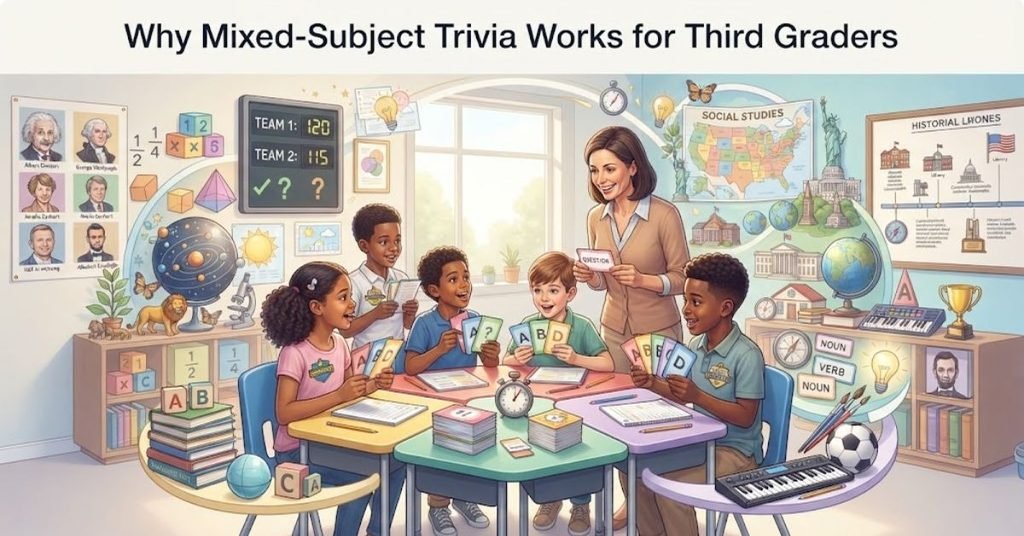
Third graders are learning across multiple subject areas at the same time. They may move from mathematics to reading, then science, then social studies during a normal school day.
A mixed trivia game mirrors that experience.
One moment they are calculating a multiplication fact. The next they are identifying a planet. Then they may have to remember a U.S. state or identify an antonym.
This variety keeps the brain engaged and prevents the activity from becoming repetitive.
It also reveals something useful: children do not all learn in exactly the same way.
One child may quickly answer geography questions. Another may dominate the math round. Another may remember every animal fact.
That makes team trivia especially effective because different strengths can work together.
Tips for Choosing Age-Appropriate Questions
When creating your own questions, think about the child rather than simply choosing the hardest facts you can find.
A good third-grade question should usually be understandable without a complicated explanation.
Avoid unnecessarily difficult vocabulary unless the vocabulary itself is being tested.
Keep calculations reasonable.
Use familiar examples.
Mix recall with simple reasoning.
Include subjects children actually encounter.
And don’t be afraid to include fun questions that are not directly tied to a textbook.
A question such as “What animal has eight legs?” may be simple, but it can still create excitement when children are competing to answer first.
The best trivia collection usually includes a range of difficulty:
Easy → Moderate → Challenging → Fun surprise
That progression keeps children interested without making them feel overwhelmed.
Why Answers Matter as Much as Questions
When creating a trivia page for children, answers should be clear and easy to verify.
A question should ideally have one obvious expected answer unless multiple answers are genuinely acceptable.
For example:
What is the largest planet in our solar system?
The answer is clearly Jupiter.
But questions such as “What is the best animal?” do not have a factual answer and therefore belong in a different kind of game.
Good educational trivia separates opinion from fact.
That distinction helps children understand that some questions have evidence-based answers while others are matters of preference.
A Final Bonus Round
If you want a short bonus round after the 220 questions above, try these ten:
- What is 11 × 11?
Answer: 121. - Which planet is closest to the Sun?
Answer: Mercury. - What is the capital of Florida?
Answer: Tallahassee. - What is a baby cat called?
Answer: A kitten. - How many quarters equal $1?
Answer: Four. - What is the opposite of “ancient”?
Answer: Modern. - What force keeps us on the ground?
Answer: Gravity. - Who was the 16th U.S. president?
Answer: Abraham Lincoln. - What is 64 ÷ 8?
Answer: 8. - What is the largest mammal on Earth?
Answer: The blue whale.
Conclusion
The best 3rd grade trivia questions do more than test whether a child remembers a fact. They create small moments of discovery. A multiplication question can reinforce math skills, a science question can trigger curiosity about nature, a history question can open the door to a conversation about the past, and a vocabulary question can make a new word easier to remember.
With more than 200 questions covering general knowledge, mathematics, science, social studies, reading, language, geography, history, animals, space, and everyday facts, this collection can work for classrooms, families, homeschoolers, teachers, parents, road trips, parties, and school review sessions.
Most importantly, don’t worry if a child doesn’t know every answer. Trivia works best when an incorrect answer becomes a learning moment rather than a disappointment. The real victory is when a child hears an answer and thinks, “Now I know something I didn’t know before.”
That is what makes a great quiz memorable and that is why well-designed 3rd grade trivia questions can be both entertaining and genuinely educational.
FAQs
What are good 3rd grade trivia questions?
Good questions for third graders combine age-appropriate general knowledge with topics such as math, science, reading, geography, U.S. history, animals, space, and everyday life. A balanced set should include both easy questions and questions that require simple reasoning.
How many questions should a third-grade trivia game have?
A short classroom activity can use 10–20 questions, while a family game or larger competition can use 50–100 or more. For a longer event, divide the questions into subject-based rounds so children get opportunities to use different skills.
What subjects should be included in third-grade trivia?
Math, science, social studies, reading, language arts, geography, history, animals, space, sports, and general knowledge all work well. Mixing subjects keeps the quiz interesting and gives children with different strengths an opportunity to succeed.
Are these questions suitable for 8-year-olds?
Many third graders are around eight or nine years old, although children’s abilities naturally vary. Questions should therefore be adjusted to match the child’s reading level, prior knowledge, and classroom curriculum.
How can teachers use trivia in the classroom?
Teachers can use trivia as a warm-up, review exercise, team competition, end-of-week activity, early-finisher task, or informal knowledge check. Questions can also be connected to a current unit of study.
How can parents make trivia educational?
After revealing an answer, ask one additional question about it. For example, if the answer is “Jupiter,” ask what makes Jupiter different from Earth. This encourages children to move beyond memorization and explain what they know.
Should third-grade trivia questions be easy or difficult?
A combination works best. Easy questions build confidence, moderate questions maintain engagement, and a smaller number of challenging questions create excitement. Making every question difficult can turn a fun game into a frustrating experience.
Can third-grade trivia be used for homeschooling?
Yes. Trivia can provide an informal way to review material from mathematics, science, history, geography, reading, and vocabulary. It can also provide a fun transition between more structured lessons.
What makes a trivia question good for children?
A strong children’s trivia question is clear, age-appropriate, fact-based, and interesting. It should not depend on obscure information that children have no reasonable opportunity to know unless the goal is specifically to introduce a surprising new fact.
How can I make a third-grade quiz more competitive?
Create teams, use a timer, introduce bonus questions, create themed rounds, award points for explanations, or allow each team one “double points” question. Keep competition friendly and make learning more important than the final score.

Helping trivia lovers discover funny, clever, and unforgettable team names for every quiz night.