Trivia Questions for 1st Graders 100+ Fun Questions & Answers
Trivia questions for 1st graders work best when they feel like a game rather than a test. Simple math, animals, science, reading, colors, space, geography, and everyday facts give young learners plenty of chances to think, answer, laugh, and learn. In my experience developing educational trivia content, the sweet spot is familiar vocabulary, short questions, clear answers, and just enough surprise to make a child say, “I knew that!” These questions are designed for parents, teachers, classrooms, family game nights, and read-aloud activities where participation matters more than pressure.
A good first-grade quiz should also respect how young children learn. Questions about numbers, shapes, animal facts, letters, rhyming, seasons, Earth, the Sun, and everyday objects connect naturally with skills children encounter during the school year. First-grade literacy resources emphasize sound awareness, phonics, decoding, and early reading, while first-grade science includes topics such as light, sound, plants, animals, and patterns in the sky.
First Grade Trivia Questions: Trivia Questions for 1st Graders with Answers
These trivia questions are designed around familiar subjects, simple wording, and quick answers. They can be read aloud without requiring children to read every question themselves, which makes them useful for classroom warm-ups, family quizzes, road trips, indoor activities, and game nights. The goal is curiosity, participation, and confidence—not pressure.
For the best experience, begin with easier animal, number, color, and everyday questions before moving toward space, geography, or mixed-topic questions. A five-question round can fill a few spare minutes, while ten or twenty questions can become a complete activity. Give children time to think, celebrate correct answers, and treat mistakes as opportunities to discover something new.
First Grade Trivia Questions: Animal Facts
Animals are an especially friendly starting point for young learners because many children already know pets, farm animals, birds, and familiar wild animals. Questions about sounds, baby animals, body features, and simple behaviors build vocabulary while keeping the quiz playful. Competitor pages repeatedly use animal facts as an opening category.
- What animal says “meow”? Answer: Cat
- What animal says “moo”? Answer: Cow
- Which animal has a very long neck? Answer: Giraffe
- Which animal has black-and-white stripes? Answer: Zebra
- What is a baby dog called? Answer: Puppy
- What is a baby cat called? Answer: Kitten
- Which animal has a long trunk? Answer: Elephant
- Which bird cannot fly but can swim? Answer: Penguin
- Which animal carries its baby in a pouch? Answer: Kangaroo
- What do bees make? Answer: Honey
First Grade Trivia Questions: Basic Addition
Basic addition is an easy way to turn number practice into a quick verbal game. First graders commonly work with small quantities, counting, addition, subtraction, and simple shapes. The questions below keep calculations manageable so children can use fingers, objects, drawings, or mental counting instead of feeling as though they are completing a worksheet.
- What is 1 + 1? Answer: 2
- What is 2 + 3? Answer: 5
- What is 4 + 4? Answer: 8
- What is 5 + 3? Answer: 8
- What is 10 + 0? Answer: 10
- What is 6 + 1? Answer: 7
- What is 2 + 2? Answer: 4
- What is 3 + 3? Answer: 6
- What is 5 + 1? Answer: 6
- What number comes after 7? Answer: 8
First Grade Trivia Questions: Simple Subtraction
Simple subtraction introduces the idea of taking away. Keeping the numbers small makes these questions suitable for a spoken quiz and gives children a chance to explain their thinking. For extra engagement, use real objects such as blocks, crayons, or toy animals to act out the subtraction before revealing the answer.
- What is 5 − 2? Answer: 3
- What is 7 − 4? Answer: 3
- What is 6 − 1? Answer: 5
- What is 9 − 3? Answer: 6
- What is 8 − 1? Answer: 7
- If you have 5 apples and eat 1, how many are left? Answer: 4
- If you have 6 crayons and give away 2, how many remain? Answer: 4
- What is 10 − 5? Answer: 5
- What is 7 − 2? Answer: 5
- What is 4 − 1? Answer: 3
First Grade Trivia Questions Science 1st Grade Trivia
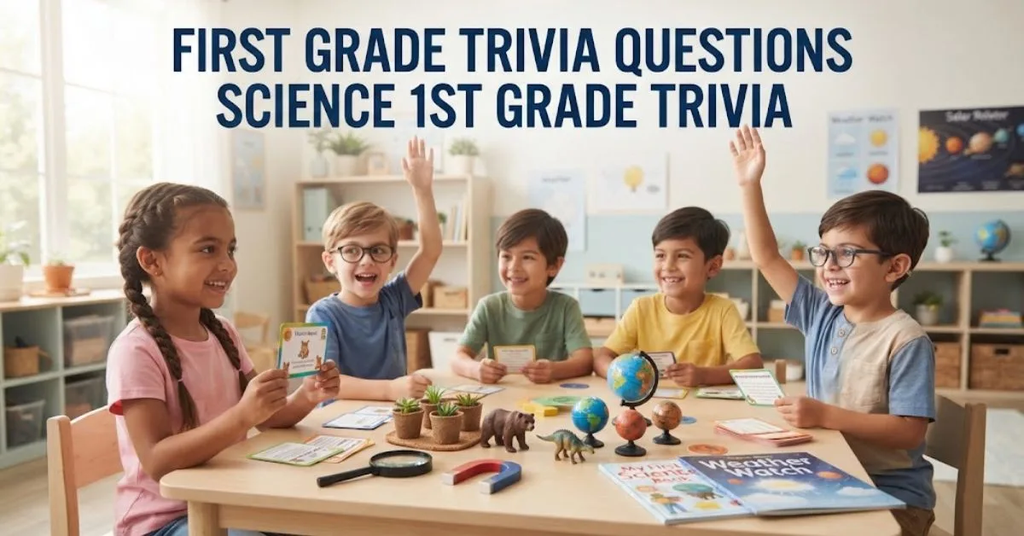
First-grade science is strongest when children can connect a question to something they see in everyday life. Earth, plants, sunlight, weather, animals, light, and simple observations all make good quiz subjects. NGSS first-grade topics include light and sound, plant and animal structures, offspring, and patterns involving objects in the sky.
- What planet do we live on? Answer: Earth
- What star gives Earth light and heat? Answer: The Sun
- What do plants need to grow? Answer: Water and sunlight
- How many legs does an insect have? Answer: Six
- What do humans breathe to stay alive? Answer: Air
- What is frozen water called? Answer: Ice
- What falls from clouds when it rains? Answer: Rain
- What helps us see objects in a dark room? Answer: Light
- What part of a plant usually grows underground? Answer: Roots
- What do bees collect from flowers? Answer: Nectar
First Grade Trivia Questions: Animal Trivia
Animal trivia can move beyond basic sounds and introduce habitats, body parts, insects, mammals, birds, and behaviors. A useful pattern is to start with a fact most children recognize and then include a slightly surprising question. That creates a small discovery moment without making the activity too difficult.
- Which animal is the tallest? Answer: Giraffe
- Which animal is often called the “king of the jungle”? Answer: Lion
- Which animal has eight legs? Answer: Spider
- Which animal lives in a hive? Answer: Bee
- Which animal is famous for black-and-white stripes? Answer: Zebra
- Which animal has a long trunk? Answer: Elephant
- Which animal can hop and has long ears? Answer: Rabbit
- Which bird is famous for saying “hoot”? Answer: Owl
- Which animal is known for spots? Answer: Leopard
- What animal gives us wool? Answer: Sheep
First Grade Trivia Questions: Space Trivia
Space questions give children a chance to connect familiar ideas—Earth, the Moon, the Sun, stars, and planets—with the larger universe. Keep the wording concrete rather than technical. First-grade science standards specifically include patterns and observations involving objects in the sky, making basic astronomy a natural topic for age-appropriate trivia.
- What planet do we live on? Answer: Earth
- What star is closest to Earth? Answer: The Sun
- What orbits Earth? Answer: The Moon
- Which planet is called the Red Planet? Answer: Mars
- Which planet is famous for its rings? Answer: Saturn
- What galaxy contains our solar system? Answer: The Milky Way
- What do astronauts wear in space? Answer: Spacesuits
- What do we see shining in the night sky? Answer: Stars
- What tool helps us look at objects in space? Answer: Telescope
- How many planets are in our solar system? Answer: Eight
First Grade Trivia Questions: Geography Trivia
Geography becomes easier for first graders when questions use recognizable places and simple relationships. U.S. landmarks, continents, oceans, maps, neighboring countries, and directions can gradually build a child’s mental picture of the world. For American audiences, Washington, D.C., Canada, Mexico, and the Pacific Ocean are useful starting points.
- What is the capital of the United States? Answer: Washington, D.C.
- How many continents are commonly taught? Answer: Seven
- What is the largest ocean? Answer: Pacific Ocean
- Which country is famous for kangaroos? Answer: Australia
- Which country has the Eiffel Tower? Answer: France
- Which country is north of the United States? Answer: Canada
- Which country borders the United States to the south? Answer: Mexico
- What imaginary line divides Earth into the Northern and Southern Hemispheres? Answer: The Equator
- What do we use to show where places are located? Answer: A map
- What is a large body of salt water called? Answer: An ocean
First Grade Trivia Questions: General Knowledge Trivia
General knowledge creates a flexible mixed category because it connects school, family, time, shapes, objects, food, and everyday experiences. It can be especially useful when several children have different strengths: one child may know a math answer while another immediately recognizes a household object or calendar fact.
- How many days are in a week? Answer: Seven
- How many months are in a year? Answer: Twelve
- How many hours are in a day? Answer: Twenty-four
- What day comes after Saturday? Answer: Sunday
- What day comes after Monday? Answer: Tuesday
- What shape is a stop sign? Answer: Octagon
- What do you use to write? Answer: Pencil
- What do you wear on your feet? Answer: Shoes
- What do you use to brush your teeth? Answer: Toothbrush
- How many seasons are there? Answer: Four
First Grade Trivia Questions Sports Trivia
Sports trivia adds movement and familiar equipment to a children’s quiz. For this age group, basic gameplay and equipment are generally more accessible than professional statistics. A child can answer a question about a bat, puck, racket, hoop, or ball even if they have never memorized a player’s name.
- What sport uses a bat and ball? Answer: Baseball
- What sport uses a hoop and ball? Answer: Basketball
- What sport uses a racket and ball? Answer: Tennis
- What sport uses a puck? Answer: Hockey
- What sport is played with a soccer ball? Answer: Soccer
- What sport is played over a net with a ball? Answer: Volleyball
- What sport uses a club and a small ball? Answer: Golf
- What sport involves swimming? Answer: Swimming
- What sport is played on ice with sticks and a puck? Answer: Hockey
- What sport uses a racket and a shuttlecock? Answer: Badminton
Animal Facts
Animal facts are particularly effective as quick warm-ups because they require little setup. Instead of making every question a test of school knowledge, use familiar animals to invite conversation. After answering, ask children what their favorite animal is or whether they have ever seen one at a zoo, farm, aquarium, or nature center.
- Which animal has a pouch for carrying its baby? Answer: Kangaroo
- Which animal has a shell and moves slowly? Answer: Turtle
- Which animal has a long neck and eats leaves? Answer: Giraffe
- Which animal is known for changing color to blend in? Answer: Chameleon
- Which animal has black-and-white stripes and resembles a horse? Answer: Zebra
- Which animal says “quack”? Answer: Duck
- Which animal has whiskers and often purrs? Answer: Cat
- Which animal is known for building dams? Answer: Beaver
- Which animal has a long, sticky tongue and eats insects? Answer: Anteater
- Which animal is famous for carrying its home on its back? Answer: Snail
Space Wonders
Space questions can turn an ordinary quiz into a miniature journey. Children often recognize the Moon and Sun long before they understand astronomy, so begin with visible objects and gradually introduce planets, galaxies, astronauts, and telescopes. This approach supports curiosity without requiring advanced scientific vocabulary.
- What is Earth’s natural satellite? Answer: The Moon
- What is the star at the center of our solar system? Answer: The Sun
- Which planet is known for its red appearance? Answer: Mars
- Which planet is famous for its large ring system? Answer: Saturn
- What do astronauts travel in to reach space? Answer: A spacecraft or rocket
- What do we call a person who travels into space? Answer: Astronaut
- What is the name of our galaxy? Answer: Milky Way
- What do we see in the sky at night? Answer: Stars
- What instrument can help people observe distant objects in space? Answer: Telescope
- How many planets orbit the Sun in our solar system? Answer: Eight
Colors 1st Grade Trivia Questions
Colors provide quick, visual questions that children can often answer without writing anything down. They also create opportunities for simple observation and experimentation. Asking what happens when colors mix can turn a trivia round into a conversation about paint, crayons, art projects, and the world children see every day.
- What color is grass usually? Answer: Green
- What color is a ripe banana usually? Answer: Yellow
- What color is an orange fruit usually? Answer: Orange
- What color are many strawberries? Answer: Red
- What color is the sky on a clear day? Answer: Blue
- What color do red and blue make when mixed with paint? Answer: Purple
- What color do blue and yellow make when mixed with paint? Answer: Green
- What color is a flamingo commonly shown as? Answer: Pink
- How many colors are traditionally taught in a rainbow? Answer: Seven
- What color are many clouds on a bright day? Answer: White
Fun Facts Trivia
Fun-fact questions are useful when you want a quiz to feel less like formal schoolwork. Everyday objects, transformations, holidays, simple observations, and familiar tools create easy entry points. The strongest questions often produce a follow-up conversation: “Why?” “How?” or “Have you ever seen that?”
- How many wheels does a bicycle usually have? Answer: Two
- What does a caterpillar become after metamorphosis? Answer: A butterfly or moth, depending on the species
- What is a baby cat called? Answer: Kitten
- What do you wear on your feet outside? Answer: Shoes
- What do you use to write on paper? Answer: Pencil
- What do you need to see clearly in a dark room? Answer: Light
- What do you use to brush your teeth? Answer: Toothbrush
- What flies through the sky and can carry passengers? Answer: Airplane
- What do you use to tell time? Answer: Clock
- What do you use to cut paper safely in a classroom? Answer: Scissors
Seasons Trivia
Seasons connect naturally with children’s daily lives: weather, clothing, holidays, leaves, snow, flowers, and outdoor activities. These questions can work particularly well during calendar time or a morning meeting because children can compare the current season with what they see outside.
- Which season is usually the hottest? Answer: Summer
- Which season is usually the coldest? Answer: Winter
- What season comes after winter? Answer: Spring
- What season comes after summer? Answer: Fall
- During which season do many trees lose their leaves? Answer: Fall
- During which season can snow commonly fall? Answer: Winter
- In which month is Christmas celebrated? Answer: December
- Which holiday is associated with costumes and trick-or-treating? Answer: Halloween
- During which season does Thanksgiving occur in the United States? Answer: Fall
- In which season do many flowers begin blooming? Answer: Spring
Body Parts 1st Grade Trivia
Body-part questions connect trivia with everyday observation. They are easy to demonstrate, making them useful for younger children and read-aloud groups. You can turn several of these into movement questions by asking children to point to the body part after answering, creating a more active classroom or family game.
- What do you use to smell? Answer: Nose
- What do you use to hear? Answer: Ears
- What do you use to see? Answer: Eyes
- What do you use to taste food? Answer: Tongue
- What do you use to hold things? Answer: Hands
- What do you use to run? Answer: Legs
- What do you use to chew food? Answer: Teeth
- What covers most of your body? Answer: Skin
- What do you use to kick a ball? Answer: Feet
- What joint helps your arm bend? Answer: Elbow
Letters, words, and first reading
First-grade trivia can support early literacy when questions focus on letters, sounds, rhymes, opposites, and simple sentence concepts. Reading Rockets notes that first-grade learners develop phonological awareness, phonics, decoding, and letter-sound knowledge, making short oral word games a natural companion to early reading practice.
- What letter does the word “apple” start with? Answer: A
- How many letters are in the English alphabet? Answer: 26
- What word rhymes with “dog”: log or dot? Answer: Log
- Is the letter M a vowel or consonant? Answer: Consonant
- What is the opposite of “big”? Answer: Small
- What letter does the word “sun” start with? Answer: S
- What punctuation mark usually ends a statement? Answer: Period
- What is the opposite of “up”? Answer: Down
- Which letter comes after B? Answer: C
- What do we call the pictures in a storybook? Answer: Illustrations
Quick Mixed Round

A mixed round is often the easiest way to finish because children cannot predict the next category. The questions can jump from colors to animals, numbers, school objects, space, and everyday knowledge. This variety keeps the activity lively while giving different children opportunities to shine.
- What color is grass? Answer: Green
- How many toes are on both feet together? Answer: Ten
- What animal can hop and has long ears? Answer: Rabbit
- What day comes after Sunday? Answer: Monday
- What tool helps you draw a straight line? Answer: Ruler
- What is the last letter of the alphabet? Answer: Z
- What flies in the sky and lands at airports? Answer: Airplane
- What shape has four equal sides? Answer: Square
- What animal says “quack”? Answer: Duck
- How many legs does a chicken have? Answer: Two
- What shines in the night sky besides the Moon? Answer: Stars
- What might you wear on your head when it is cold? Answer: Hat
- What pet often purrs? Answer: Cat
- How many colors are traditionally taught in a rainbow? Answer: Seven
- What do you use to drink water? Answer: Cup
- What is a house made from snow or ice commonly called? Answer: Igloo
- Which animal is famous for swinging through trees? Answer: Monkey
- Who teaches students at school? Answer: Teacher
- What is 2 + 2? Answer: Four
- Which planet is called the Red Planet? Answer: Mars
Conclusion
Trivia questions for 1st graders can turn ordinary learning moments into something children genuinely look forward to. The strongest activities combine easy wins with small discoveries, using animals, math, science, reading, colors, seasons, space, geography, sports, and everyday knowledge to keep young minds involved.
For parents and teachers, the goal does not have to be a perfect score. A child thinking carefully, asking a follow-up question, laughing at a surprising fact, or proudly explaining an answer is already part of the learning experience. Keep the questions short, read them aloud when needed, give children time to think, and let curiosity lead the game.
The academic connection is also meaningful: first-grade literacy includes phonological awareness, decoding, and letter-sound relationships, while first-grade science includes topics such as light, sound, plants, animals, and sky patterns. Trivia can complement those learning experiences when it remains age-appropriate and playful.
FAQ Section
What are some fun trivia questions for 1st graders?
Good questions for first graders usually involve familiar subjects such as animals, colors, simple addition, shapes, seasons, school objects, Earth, space, and everyday life. The questions should use short wording and give children a realistic chance to answer successfully.
How can trivia help 1st graders learn?
Trivia can turn recall and discussion into a playful activity. It can encourage children to retrieve information, explain answers, listen to others, and stay curious. It works best as a supplement to normal learning rather than as a replacement for classroom instruction.
What subjects are best for first-grade trivia?
The strongest categories include basic math, science, animals, geography, colors, seasons, space, sports, body parts, general knowledge, and early literacy. These areas also appear repeatedly across current first-grade trivia resources.
Can first graders play trivia if they cannot read every question yet?
Yes. An adult can read the questions aloud and let children answer verbally. This is especially useful for animal, science, math, and everyday-knowledge questions because children can participate without needing to decode every word on the page.
How many questions should a first-grade trivia round have?
A short round of five to ten questions is usually easier to manage than a very long session. If children are still engaged, you can continue with another category rather than requiring them to complete a fixed number.
Are these questions suitable for classroom use?
Yes. They can work as morning-meeting questions, warm-ups, indoor activities, transition activities, review games, or short end-of-day challenges. Teachers can also divide children into small groups and let teams discuss answers before responding.
Should first-grade trivia questions be easy?
Most should be accessible, with a few slightly more challenging questions mixed in. If every question is difficult, children may become frustrated. If every question is extremely obvious, they may lose interest. A mixture of confidence-building and curiosity-provoking questions works well.
Can trivia questions support early reading?
They can complement early literacy activities when they include letters, beginning sounds, rhyming, opposites, vocabulary, and simple sentence concepts. First-grade literacy resources specifically emphasize phonological awareness, phonics, decoding, and letter-sound relationships.
Can parents use first-grade trivia at home?
Absolutely. Parents can use a few questions during breakfast, after school, during a family game night, on a road trip, or before bedtime. The easiest approach is to make the activity conversational rather than treating it like a test.
How do you make trivia more fun for first graders?
Use short rounds, familiar subjects, silly surprises, encouragement, and opportunities to explain answers. You can also let children choose the next category or create their own question for everyone else.

Helping trivia lovers discover funny, clever, and unforgettable team names for every quiz night.