4th Grade Trivia Questions and Answers
Fourth grade trivia questions give kids a fun way to practice math facts, science knowledge, U.S. history, geography, animals, language arts, sports, and general knowledge without making every learning moment feel like homework. For parents and teachers, the sweet spot is a quiz that feels achievable but still creates those wonderful “Wait, I know this!” moments. The current U.S. search results consistently center on age-appropriate questions, classroom review, family activities, quiz games, and varied subjects.
After working with trivia-style educational content, I’ve found that the strongest questions are not necessarily the hardest. A good fourth-grade quiz mixes easy warm-ups, school subjects, interesting facts, logical thinking, and challenge questions. That approach helps children participate confidently while still learning something new. The collection below is designed around that balance, with original wording and answers suitable for U.S. fourth-grade audiences.
General Knowledge
General knowledge questions are an ideal way to open a fourth-grade quiz because they move naturally between science, geography, animals, space, American facts, landmarks, and everyday knowledge. Starting with familiar subjects helps children settle into the game before the questions become more specialized.
| # | Question | Answer |
| 1 | What is the capital of the United States? | Washington, D.C. |
| 2 | How many states are in the United States? | 50 |
| 3 | How many continents are there? | Seven |
| 4 | Which planet is the largest in our solar system? | Jupiter |
| 5 | What is the smallest planet in our solar system? | Mercury |
| 6 | What is Earth’s natural satellite? | The Moon |
| 7 | How many legs does a spider have? | Eight |
| 8 | What do bees make? | Honey |
| 9 | What is the largest ocean on Earth? | Pacific Ocean |
| 10 | What is the fastest land animal? | Cheetah |
| 11 | What is the largest mammal? | Blue whale |
| 12 | What is a baby frog called? | A tadpole |
| 13 | Which star is closest to Earth? | The Sun |
| 14 | What is frozen water called? | Ice |
| 15 | What is the national bird of the United States? | Bald eagle |
| 16 | Which city is famous for the Eiffel Tower? | Paris |
| 17 | What is the largest continent? | Asia |
| 18 | How many days are in a week? | Seven |
| 19 | What shape has three sides? | Triangle |
| 20 | What color do you get by mixing blue and yellow? | Green |
These questions work particularly well as an opening round because they require different kinds of recall. A child who does not know one answer can quickly regain confidence with the next. That matters in children’s trivia: curiosity and participation should remain more important than eliminating players.
Math 4th Grade Trivia Questions
Fourth-grade math naturally lends itself to quiz questions because multiplication, division, fractions, decimals, geometry, measurement, and place value can all be turned into short challenges. The key is to test understanding as well as memorization, so a good round should mix calculations with concepts.
| # | Question | Answer |
| 21 | What is 8 × 7? | 56 |
| 22 | What is 144 ÷ 12? | 12 |
| 23 | What is half of 100? | 50 |
| 24 | What is 25 + 47? | 72 |
| 25 | What is 100 − 37? | 63 |
| 26 | What is 9 × 9? | 81 |
| 27 | What is 84 ÷ 7? | 12 |
| 28 | How many sides does a pentagon have? | Five |
| 29 | How many sides does a hexagon have? | Six |
| 30 | How many inches are in one foot? | 12 |
| 31 | How many cents are in one dollar? | 100 |
| 32 | How many quarters equal one dollar? | Four |
| 33 | What is the smallest prime number? | 2 |
| 34 | What is 3/4 written as a decimal? | 0.75 |
| 35 | What is 1/2 written as a decimal? | 0.5 |
| 36 | What is the place value of 6 in 6,421? | Thousands |
| 37 | What is the perimeter of a square with four-inch sides? | 16 inches |
| 38 | What is 12 × 5? | 60 |
| 39 | What is 96 ÷ 8? | 12 |
| 40 | What number comes next: 2, 4, 8, 16, __? | 32 |
For a classroom game, math questions become more enjoyable when children can explain their thinking. For example, after answering 0.75 for three-fourths, ask how they know. That tiny follow-up turns a trivia fact into a mathematical conversation and supports deeper understanding rather than simple answer collecting.
Science 4th Grade Trivia Questions
Science is one of the richest areas for fourth grade trivia because children can explore Earth science, life science, physical science, ecosystems, energy, weather, plants, animals, and space. Strong questions should make children curious enough to ask what happens next.
| # | Question | Answer |
| 41 | What force pulls objects toward Earth? | Gravity |
| 42 | What process allows plants to make food using sunlight? | Photosynthesis |
| 43 | What gas do humans need to breathe? | Oxygen |
| 44 | What gas do plants take in during photosynthesis? | Carbon dioxide |
| 45 | What is H₂O commonly called? | Water |
| 46 | What planet is known as the Red Planet? | Mars |
| 47 | What planet is famous for its rings? | Saturn |
| 48 | What is the main source of energy for life on Earth? | The Sun |
| 49 | What do we call an animal that eats only plants? | Herbivore |
| 50 | What do we call an animal that eats both plants and animals? | Omnivore |
| 51 | What are the three common states of matter? | Solid, liquid, gas |
| 52 | What is water falling from clouds called? | Precipitation |
| 53 | What causes day and night? | Earth’s rotation |
| 54 | What is the center of an atom called? | Nucleus |
| 55 | What organ pumps blood through the body? | Heart |
| 56 | What is the largest organ of the human body? | Skin |
| 57 | What do we call animals without backbones? | Invertebrates |
| 58 | What is the process of liquid water becoming water vapor? | Evaporation |
| 59 | What is stored energy called? | Potential energy |
| 60 | What type of energy does a moving object have? | Kinetic energy |
A useful trick is to follow surprising answers with one short explanation. If the answer is kinetic energy, for example, children can connect it to a rolling ball, running person, or moving bicycle. Those everyday examples make scientific vocabulary easier to remember.
English & Grammar
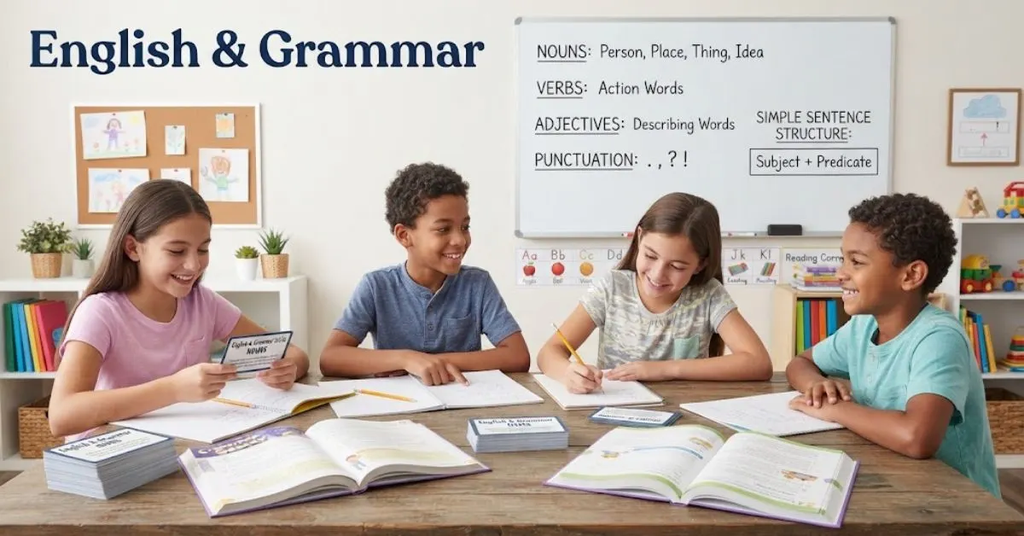
Language arts trivia can reinforce parts of speech, vocabulary, punctuation, sentence structure, prefixes, synonyms, antonyms, and reading comprehension. These questions are especially useful as a change of pace after math or science because they challenge language skills rather than numerical recall.
| # | Question | Answer |
| 61 | What is a noun? | A person, place, thing, or idea |
| 62 | What is a verb? | An action or state-of-being word |
| 63 | What is an adjective? | A word that describes a noun |
| 64 | What is a synonym for “happy”? | Joyful |
| 65 | What is an antonym for “hot”? | Cold |
| 66 | What punctuation mark ends a question? | Question mark |
| 67 | What punctuation mark normally ends a statement? | Period |
| 68 | What is the plural of “mouse” when referring to the animal? | Mice |
| 69 | What is the past tense of “go”? | Went |
| 70 | What are the five traditional vowel letters? | A, E, I, O, U |
| 71 | What does the prefix “un-” usually mean? | Not |
| 72 | What is a group of words expressing a complete thought called? | Sentence |
| 73 | What do we call the person telling a story? | Narrator |
| 74 | What is a comparison using “like” or “as” called? | Simile |
| 75 | What is the main message or central idea of a passage called? | Main idea |
One of the best ways to use these questions is to let children create their own examples. If the answer is simile, for instance, ask them to invent one involving an animal, sport, or favorite object. That turns passive recall into creative language practice.
History of 4th Grade Trivia Questions
U.S. history is an important part of the fourth-grade knowledge landscape, and trivia provides an easy way to connect presidents, founding documents, important dates, historical people, early settlements, and national symbols. Questions should be factually precise while avoiding overly complicated wording.
| # | Question | Answer |
| 76 | Who was the first U.S. president? | George Washington |
| 77 | Who was the 16th U.S. president? | Abraham Lincoln |
| 78 | In what year was the Declaration of Independence adopted? | 1776 |
| 79 | What document begins with “We the People”? | The U.S. Constitution |
| 80 | What ship carried the Pilgrims to Plymouth in 1620? | Mayflower |
| 81 | What war was fought between the Union and Confederacy? | Civil War |
| 82 | Who wrote the Declaration of Independence? | Thomas Jefferson |
| 83 | What famous bell is associated with American independence? | Liberty Bell |
| 84 | Which two states were the last to join the United States? | Alaska and Hawaii |
| 85 | Which state is the largest by land area? | Alaska |
| 86 | Who delivered the “I Have a Dream” speech? | Martin Luther King Jr. |
| 87 | Who was the first person to walk on the Moon? | Neil Armstrong |
| 88 | In what year did the Wright brothers make their famous first powered flight? | 1903 |
| 89 | What was the first permanent English settlement in Virginia? | Jamestown |
| 90 | What are the three branches of the U.S. government? | Legislative, executive, judicial |
Historical trivia works particularly well when it becomes a story rather than a collection of dates. Instead of asking children to memorize 1776 without context, briefly connect it to the Declaration of Independence and the founding of the United States. The fact becomes much easier to remember when it has a narrative around it.
Animals 4th Grade Trivia Questions
Animal trivia is often one of the easiest ways to bring excitement into a children’s quiz. It can cover animal habitats, diets, adaptations, baby animals, mammals, birds, reptiles, insects, and unusual natural behaviors without feeling like traditional schoolwork.
| # | Question | Answer |
| 91 | What is the largest land animal? | African elephant |
| 92 | What is the fastest land animal? | Cheetah |
| 93 | What do pandas mainly eat? | Bamboo |
| 94 | What is a baby frog called? | Tadpole |
| 95 | What is a baby kangaroo called? | Joey |
| 96 | What is a group of wolves called? | Pack |
| 97 | What is a group of lions called? | Pride |
| 98 | Which mammal is capable of true powered flight? | Bat |
| 99 | What bird is famous for flying backward? | Hummingbird |
| 100 | What animal has black-and-white stripes? | Zebra |
| 101 | What is the largest living land mammal? | African elephant |
| 102 | What type of animal is a whale? | Mammal |
| 103 | What do bees collect from flowers? | Nectar |
| 104 | What animal is known for changing from a caterpillar into an adult winged insect? | Butterfly |
| 105 | What animal is famous for carrying its baby in a pouch? | Kangaroo |
Animal questions are also excellent for follow-up learning. A question about a bat can open a conversation about mammals, while a question about a butterfly can lead to metamorphosis. That is one reason trivia can be more than entertainment: one short question can become a doorway into a much larger topic.
Geography 4th Grade Trivia Questions
Geography questions strengthen knowledge of continents, oceans, countries, capitals, landmarks, U.S. states, rivers, mountains, and physical features. For U.S. fourth graders, mixing American geography with world geography creates a balanced round and prevents the questions from becoming too repetitive.
| # | Question | Answer |
| 106 | What is the largest continent? | Asia |
| 107 | What is the largest ocean? | Pacific Ocean |
| 108 | What ocean borders the western United States? | Pacific Ocean |
| 109 | What ocean borders the eastern United States? | Atlantic Ocean |
| 110 | What is the capital of France? | Paris |
| 111 | What is the capital of Japan? | Tokyo |
| 112 | What is the capital of Canada? | Ottawa |
| 113 | What is the capital of Australia? | Canberra |
| 114 | What country is home to the Great Barrier Reef? | Australia |
| 115 | Which river flows through Egypt? | Nile River |
| 116 | What is the largest country by land area? | Russia |
| 117 | What is the largest island in the world? | Greenland |
| 118 | Which U.S. state is known as the Sunshine State? | Florida |
| 119 | Which U.S. state is nicknamed the Last Frontier? | Alaska |
| 120 | What mountain range runs through the eastern United States? | Appalachian Mountains |
A geography round becomes more memorable when children picture the places rather than merely recite names. A map, globe, classroom wall map, or simple drawing can turn a question about the Pacific Ocean or Appalachian Mountains into a visual memory.
Sports 4th Grade Trivia Questions
Sports questions add energy and variety, especially when a group contains children with different academic interests. The safest approach is to use familiar rules, sports vocabulary, famous competitions, and basic scoring rather than relying heavily on obscure statistics.
| # | Question | Answer |
| 121 | How many players from one team are normally on the field in soccer? | 11 |
| 122 | What sport is played at Wimbledon? | Tennis |
| 123 | How many points is a touchdown worth before the extra-point attempt? | Six |
| 124 | What sport uses a bat, ball, and bases? | Baseball |
| 125 | What is a home run in baseball? | A hit that allows the batter to circle the bases and score |
| 126 | What does NBA stand for? | National Basketball Association |
| 127 | How many rings are on the Olympic symbol? | Five |
| 128 | What sport uses a hoop and basketball? | Basketball |
| 129 | What sport uses a puck? | Ice hockey |
| 130 | What event includes a balance beam? | Gymnastics |
Sports trivia can also teach vocabulary naturally. Terms such as touchdown, home run, tennis, basketball, Olympic Games, and gymnastics are familiar entities that children may already know from watching or playing sports, making this section accessible to a wide audience.
Music & Art
Music and art create another useful shift in difficulty because they draw on visual recognition, cultural knowledge, instruments, colors, famous artists, and creative vocabulary. These questions can work especially well for mixed groups because a child does not need to be strongest in math or science to participate.
| # | Question | Answer |
| 131 | How many strings does a standard guitar usually have? | Six |
| 132 | Which instrument has black and white keys? | Piano |
| 133 | Who painted the Mona Lisa? | Leonardo da Vinci |
| 134 | What family does a violin belong to? | String family |
| 135 | What two colors can be mixed to make purple? | Red and blue |
| 136 | What are the traditional primary colors in basic art instruction? | Red, yellow, blue |
| 137 | What do you call a painting of a person? | Portrait |
| 138 | Which instrument is commonly played with a bow and has four strings? | Violin |
| 139 | Who painted Starry Night? | Vincent van Gogh |
| 140 | What do we call a person who creates visual art? | Artist |
The best music-and-art questions encourage recognition rather than obscure memorization. A picture round can make this category even more interactive, provided the images are clearly licensed or original. Visual questions can also complement modern multimodal search behavior, where images increasingly participate in discovery.
Technology & Inventions

Technology questions connect familiar everyday objects with the people, systems, and concepts behind them. For fourth graders, keep explanations straightforward: computers, internet vocabulary, inventions, communication, simple machines, and scientific instruments are accessible subjects.
| # | Question | Answer |
| 141 | What does “www” stand for? | World Wide Web |
| 142 | What do you use to visit websites? | A web browser |
| 143 | What does CPU stand for? | Central Processing Unit |
| 144 | What instrument measures temperature? | Thermometer |
| 145 | What instrument helps scientists view tiny objects? | Microscope |
| 146 | What machine can be programmed to perform tasks automatically? | Robot |
| 147 | Who is commonly associated with developing a practical incandescent light bulb? | Thomas Edison |
| 148 | Who was the first person to walk on the Moon? | Neil Armstrong |
| 149 | What technology lets people send information electronically over networks? | The internet |
| 150 | What device is commonly used to take digital photographs? | Digital camera |
Technology questions should be kept current when they depend on changing facts. Permanent concepts such as CPU, microscope, thermometer, and World Wide Web are more durable than questions based on rapidly changing companies, apps, or current product statistics.
Conclusion
Fourth grade trivia questions are most effective when they feel like a game first and a worksheet second. The strongest collections combine math, science, history, geography, language arts, animals, sports, music, art, technology, and general knowledge so that different children have different opportunities to shine.
A well-designed quiz also respects the way children learn. Start with accessible questions, gradually increase the challenge, explain interesting answers, and let children talk through their reasoning. A missed question does not have to feel like failure; it can become the fact everyone remembers later.
For teachers, these questions can become classroom warm-ups or review rounds. For parents, they can turn an ordinary afternoon or family game night into a shared learning experience. And for children, the best moment is often the simplest one: hearing a question, thinking for a second, and suddenly realizing, “I know this!”
That is the real value of fourth grade trivia questions they make knowledge feel discoverable, memorable, and fun.
FAQs
What are some easy fourth-grade trivia questions?
Examples include questions about the number of U.S. states, the largest planet, the number of legs on a spider, basic multiplication, common animals, and familiar geographic facts. Easy questions work best as warm-up questions.
How can trivia be used for learning?
Trivia can turn recall practice into a game. A teacher or parent can ask a question, allow discussion, reveal the answer, and then give one short explanation. This creates an active learning cycle rather than a simple right-or-wrong test.
Can trivia be used in online learning?
Yes. Questions can be converted into digital quizzes, slides, classroom polls, or interactive activities. Digital formats are particularly useful when children need immediate feedback or when a teacher wants to display questions to the entire class.
What’s a good way to make trivia fun?
Mix subjects and difficulty levels, keep rounds short, allow team discussion, and include surprising questions. A good trivia session should create curiosity, not pressure.

Helping trivia lovers discover funny, clever, and unforgettable team names for every quiz night.