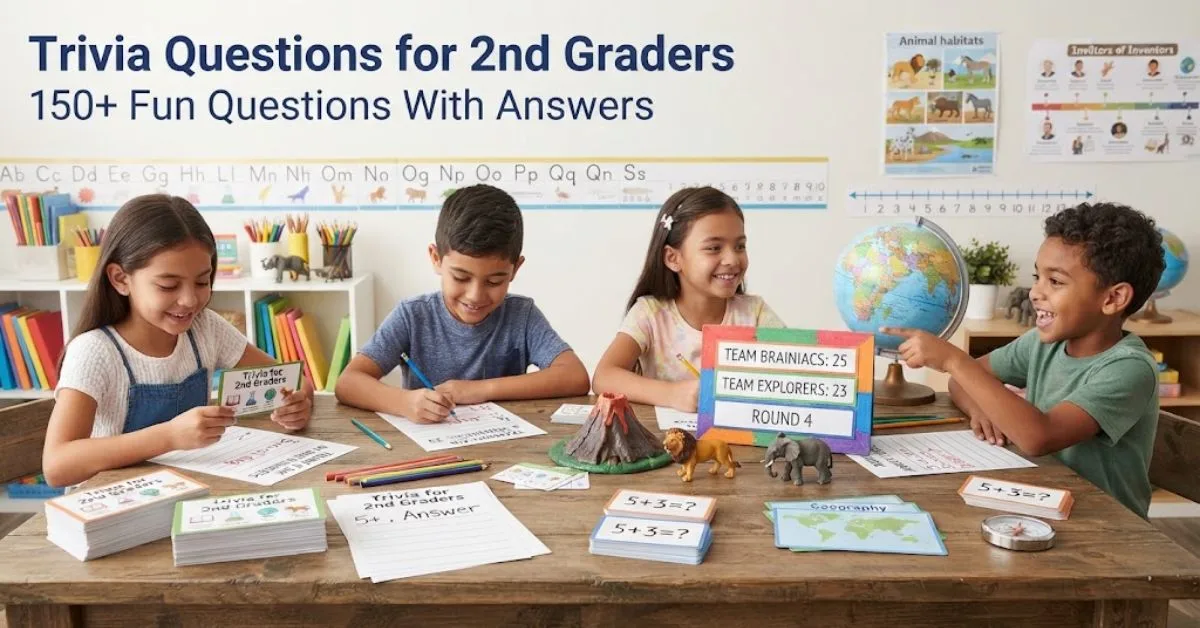
Trivia Questions for 2nd Graders 150+ Fun Questions With Answers
Trivia questions for 2nd graders work best when they feel like a game while quietly reinforcing familiar knowledge from school and everyday life. This collection brings together 150+ age-appropriate questions across animals, science, geography, space, history, language, math, books, and the human body.
For parents, teachers, homeschoolers, and families, the challenge is finding questions that are not so easy that children lose interest and not so difficult that the activity feels like another test. Current second-grade trivia pages commonly organize questions by subject and provide an answer immediately after each question.
95+ Fun 2nd Grade Trivia Questions With Answers
The best trivia questions for this age use familiar vocabulary, one clear idea, and an answer children can understand or explain. The categories below deliberately mix recall with simple reasoning, covering animals, science, geography, space, history, language, math, literature, and everyday knowledge. That broad approach mirrors the current search landscape.
A second-grade quiz can also be adjusted for the setting. Read questions aloud for a group, let children write answers independently, or turn each category into a short round. Grade 2 Common Core mathematics emphasizes number sense, addition and subtraction, measurement, time, money, data, and shapes, while language standards include grammar, vocabulary, punctuation, spelling, and word relationships.
Animal Trivia Questions for 2nd Graders
Animal questions are a natural starting point because children usually recognize many animals from books, school lessons, zoos, family experiences, and nature programs. These questions introduce animal groups, habitats, body features, life cycles, and familiar animal behavior without requiring advanced scientific vocabulary.
- What do we call a baby dog?
Answer: A puppy. - How many legs does a spider have?
Answer: Eight. - What is the largest animal on Earth?
Answer: The blue whale. - What do bees make?
Answer: Honey. - What animal is known for carrying its baby in a pouch?
Answer: A kangaroo. - What do caterpillars become?
Answer: Butterflies or moths. - Which animal is known for having a very long neck?
Answer: A giraffe. - What animal says “moo”?
Answer: A cow. - What animal says “oink”?
Answer: A pig. - What is a baby cat called?
Answer: A kitten. - What animal has black-and-white stripes?
Answer: A zebra. - What animal is famous for building dams?
Answer: A beaver. - How many legs does an insect have?
Answer: Six. - Is a penguin a bird?
Answer: Yes. - What do fish use to breathe underwater?
Answer: Gills. - What animal is sometimes called man’s best friend?
Answer: A dog. - What is a baby sheep called?
Answer: A lamb. - What animal has eight arms?
Answer: An octopus. - What is the fastest land animal?
Answer: The cheetah. - What do frogs usually eat?
Answer: Insects. - Which animal has a hard shell and moves slowly?
Answer: A turtle. - What animal gives us wool?
Answer: A sheep. - Which animal is famous for its trunk?
Answer: An elephant. - What do birds use to fly?
Answer: Wings. - What is a baby horse called?
Answer: A foal.
Science and Nature Trivia Questions
Science questions become especially useful when they connect an everyday observation to a simple explanation. Children can recognize rain, sunlight, ice, plants, magnets, weather, and the human senses long before they know advanced scientific terminology, making these topics excellent material for educational trivia.
- What star is closest to Earth?
Answer: The Sun. - What gas do humans need to breathe?
Answer: Oxygen. - What do plants need to grow?
Answer: Sunlight, water, and suitable soil. - What is frozen water called?
Answer: Ice. - What tool measures temperature?
Answer: A thermometer. - What happens to water when it boils?
Answer: It turns into water vapor or steam. - What do we call water falling from clouds?
Answer: Precipitation. - What causes a rainbow?
Answer: Sunlight interacting with water droplets. - What part of a plant usually takes in water from the soil?
Answer: The roots. - What part of a plant usually makes food using sunlight?
Answer: The leaves. - What force pulls objects toward Earth?
Answer: Gravity. - What do magnets attract strongly, such as many objects made of iron?
Answer: Magnetic materials such as iron. - What layer of gases surrounds Earth?
Answer: The atmosphere. - What do we call an animal that is awake mostly at night?
Answer: Nocturnal. - What season usually comes after summer in the United States?
Answer: Fall, also called autumn. - How many seasons are commonly recognized in a year?
Answer: Four. - What do we call frozen water vapor that forms on a cold surface?
Answer: Frost. - What do we use our ears for?
Answer: Hearing. - What sense helps you identify a sweet taste?
Answer: Taste. - What happens to a shadow when an object blocks light?
Answer: A darker area forms where the light is blocked. - What natural object gives Earth most of its daylight?
Answer: The Sun. - What is the process by which a caterpillar changes into a butterfly called?
Answer: Metamorphosis. - What do we call animals that eat only plants?
Answer: Herbivores. - What do we call animals that eat both plants and animals?
Answer: Omnivores. - What natural event includes flashes of light during a thunderstorm?
Answer: Lightning.
Geography Trivia Questions for Kids
Geography gives second graders a gentle introduction to maps, continents, oceans, countries, landmarks, and directions. U.S.-focused questions are particularly useful for American families and classrooms, while world geography adds variety and helps children connect places, landforms, and cultures to the wider world.
- What country is directly north of the United States?
Answer: Canada. - What country is directly south of the United States?
Answer: Mexico. - What is the capital of the United States?
Answer: Washington, D.C. - How many continents are commonly taught in the United States?
Answer: Seven. - What is the largest ocean on Earth?
Answer: The Pacific Ocean. - Which continent contains the United States?
Answer: North America. - Which continent is mostly covered by ice?
Answer: Antarctica. - What country is also considered a continent?
Answer: Australia. - What imaginary line divides Earth into Northern and Southern Hemispheres?
Answer: The equator. - What is a large area of dry land with little rainfall called?
Answer: A desert. - What do we call land completely surrounded by water?
Answer: An island. - What do we call land surrounded by water on three sides?
Answer: A peninsula. - What is the largest continent by area?
Answer: Asia. - What famous statue stands in New York Harbor?
Answer: The Statue of Liberty. - What ocean is on the east coast of the United States?
Answer: The Atlantic Ocean. - What ocean is on the west coast of the United States?
Answer: The Pacific Ocean. - What do maps help us find?
Answer: Places, locations, distances, and directions. - Which direction is opposite north?
Answer: South. - Which direction is opposite east?
Answer: West. - What do we call a drawing that shows where places are located?
Answer: A map.
Space Trivia Questions for 2nd Graders
Space is one of the strongest themes in children’s trivia because it naturally creates curiosity. The Sun, Moon, planets, astronauts, stars, and our galaxy are familiar enough for young learners while still giving them opportunities to discover something new. The questions below keep astronomy language straightforward and memorable.
- How many planets are in our solar system?
Answer: Eight. - Which planet is called the Red Planet?
Answer: Mars. - Which planet is closest to the Sun?
Answer: Mercury. - Which planet is the largest in our solar system?
Answer: Jupiter. - Which planet is famous for its rings?
Answer: Saturn. - What is Earth’s natural satellite?
Answer: The Moon. - What galaxy contains our solar system?
Answer: The Milky Way. - What do we call a person who travels into space?
Answer: An astronaut. - What do astronauts wear to protect themselves in space?
Answer: Spacesuits. - What gives Earth most of its light and heat?
Answer: The Sun. - Is the Sun a star or a planet?
Answer: A star. - What causes day and night on Earth?
Answer: Earth’s rotation. - What do we call a group of stars that forms a recognizable pattern?
Answer: A constellation. - What is a rocky object from space that reaches Earth’s surface called?
Answer: A meteorite. - What planet do we live on?
Answer: Earth. - What do we call the path an object follows around another object in space?
Answer: An orbit. - Which planet is known for having a Great Red Spot?
Answer: Jupiter. - What bright object do we often see at night that reflects sunlight?
Answer: The Moon. - What is the name of Earth’s atmosphere?
Answer: Earth’s atmosphere. - What do we call a star that appears to make a pattern with other stars?
Answer: A constellation.
History Trivia Questions for Kids
History questions should be simple enough for second graders to understand while introducing recognizable people, places, objects, and events. U.S. history can be especially useful for American classrooms, but questions should avoid turning complicated historical subjects into misleading one-line explanations.
- Who was the first president of the United States?
Answer: George Washington. - What document begins with the words “We the People”?
Answer: The U.S. Constitution. - How many stripes are on the U.S. flag?
Answer: 13. - How many stars are on the U.S. flag?
Answer: 50. - What holiday celebrates the signing of the Declaration of Independence?
Answer: Independence Day. - Who was Rosa Parks?
Answer: A civil rights activist known for challenging segregation on public transportation. - What famous ship is associated with the 1620 voyage of the Pilgrims?
Answer: The Mayflower. - What invention lets people see objects that are very far away in space?
Answer: A telescope. - Who were the Wright brothers?
Answer: Wilbur and Orville Wright, who are credited with developing and flying an early successful powered airplane. - What famous building is home to the U.S. Congress?
Answer: The U.S. Capitol. - What is the name of the U.S. national symbol that appears on many official seals?
Answer: The bald eagle. - What large structure in New York Harbor became a symbol of freedom and welcome?
Answer: The Statue of Liberty. - What do historians study?
Answer: The past. - What do we call objects from the past that help us learn about history?
Answer: Artifacts. - What is a timeline used to show?
Answer: Events in the order they happened.
Language and Reading Trivia Questions
Language questions are especially suitable for second graders because they can turn everyday reading skills into quick challenges. Common Core Grade 2 language standards include grammar, capitalization, punctuation, spelling, vocabulary, and word relationships, while reading standards include understanding characters, events, meaning, and story structure.
- How many letters are in the English alphabet?
Answer: 26. - What do we call A, E, I, O, and U?
Answer: Vowels. - What kind of word names a person, place, animal, or thing?
Answer: A noun. - What kind of word shows an action?
Answer: A verb. - What punctuation mark usually ends a question?
Answer: A question mark. - What punctuation mark usually ends a statement?
Answer: A period. - What punctuation mark can show strong feeling?
Answer: An exclamation point. - What is the opposite of hot?
Answer: Cold. - What is the opposite of up?
Answer: Down. - What word rhymes with cat: hat or dog?
Answer: Hat. - What do we call a word that means the opposite of another word?
Answer: An antonym. - What do we call a word that has a similar meaning to another word?
Answer: A synonym. - Who writes a book?
Answer: An author. - Who draws pictures for a book?
Answer: An illustrator. - What do we call the people or animals in a story?
Answer: Characters. - What do we call where and when a story happens?
Answer: The setting. - What do we call the main events in a story?
Answer: The plot. - What do we call a story that is made up?
Answer: Fiction. - What do we call writing about real facts and events?
Answer: Nonfiction. - What is the first letter of the alphabet?
Answer: A.
Math and Numbers Trivia Questions
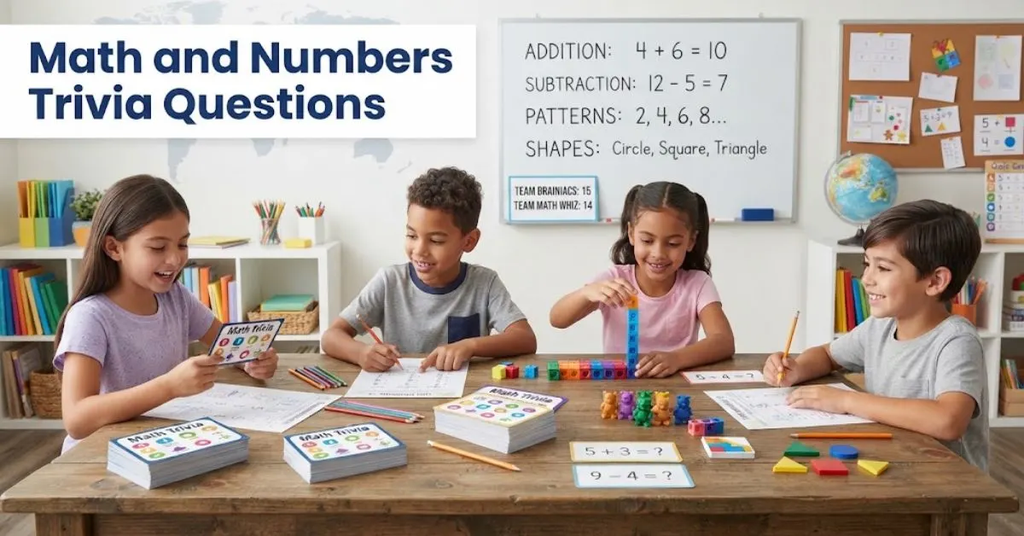
Second-grade math trivia should reinforce concepts without turning the game into a worksheet. Official Grade 2 Common Core guidance includes addition and subtraction, place value, measurement, time, money, data, and shapes. Questions based on those ideas can feel playful while still connecting with school learning.
- What is 7 + 5?
Answer: 12. - What is 15 − 6?
Answer: 9. - What is 10 + 10?
Answer: 20. - What number comes after 99?
Answer: 100. - What is half of 10?
Answer: 5. - How many sides does a triangle have?
Answer: 3. - How many sides does a square have?
Answer: 4. - How many sides does a hexagon have?
Answer: 6. - What is 20 + 30?
Answer: 50. - How many cents are in one dollar?
Answer: 100. - How many cents are in a quarter?
Answer: 25. - How many minutes are in one hour?
Answer: 60. - How many days are in a week?
Answer: 7. - Is 8 even or odd?
Answer: Even. - Is 7 even or odd?
Answer: Odd. - In 46, which digit is in the tens place?
Answer: 4. - Which is greater: 45 or 54?
Answer: 54. - What do we call the answer to an addition problem?
Answer: The sum. - What do we call the answer to a subtraction problem?
Answer: The difference. - How many months are in a year?
Answer: 12.
Books and Pop Culture Trivia Questions
Books and familiar characters give children a chance to connect reading with trivia. The current SERP includes children’s literature and recognizable fictional characters, but a strong page should keep questions understandable and avoid relying too heavily on entertainment knowledge that some children may never have encountered.
- What animal is Curious George?
Answer: A monkey. - What kind of animal is Winnie-the-Pooh?
Answer: A bear. - Who is Dorothy’s dog in The Wizard of Oz?
Answer: Toto. - Who wrote Charlie and the Chocolate Factory?
Answer: Roald Dahl. - What is the name of the girl who wears a glass slipper in a famous fairy tale?
Answer: Cinderella. - What kind of animal is Paddington?
Answer: A bear. - What do we call the person who draws pictures in a book?
Answer: The illustrator. - What do we call the person who writes a book?
Answer: The author. - What is a book of stories often divided into?
Answer: Chapters. - What do we call the name of a book?
Answer: The title.
Human Body Trivia Questions
Human-body trivia works well because children experience these facts every day. Questions about the heart, skin, bones, senses, teeth, and body parts can introduce basic anatomy while remaining accessible. For younger readers, short answers are especially useful because they keep the quiz moving and make oral play easier.
- What organ pumps blood around the body?
Answer: The heart. - What do we use to see?
Answer: Our eyes. - What do we use to hear?
Answer: Our ears. - What do we use to smell?
Answer: Our nose. - What do we use to taste food?
Answer: Our tongue. - What protects the brain?
Answer: The skull. - What covers most of the outside of the human body?
Answer: Skin. - How many bones does an adult human skeleton have?
Answer: About 206. - What helps us chew food?
Answer: Teeth. - What body part connects your hand to your arm?
Answer: The wrist. - What body part connects your foot to your leg?
Answer: The ankle. - What organ helps us breathe?
Answer: The lungs. - What part of the body bends in the middle of your arm?
Answer: The elbow. - What part of the body bends in the middle of your leg?
Answer: The knee. - What do bones help give your body?
Answer: Structure and support.
Tips to Make These 2nd Grade Trivia Questions Even More Fun
A good quiz is more than a long list of questions. Children usually respond better when the activity has variety, a comfortable pace, and opportunities to talk about answers. The current competitor pattern includes team play, multiple-choice options, category rotation, simple rewards, and inviting children to create their own questions.
Use short rounds
Instead of asking all 170 questions at once, create small rounds of five or ten. A classroom might begin with animals, move to space, and finish with math. At home, parents can choose a category based on the child’s interests. Short rounds make the activity easier to pause and restart.
Mix question difficulty
A strong set should contain familiar questions alongside a few that make children think. Start with accessible animal or everyday questions before introducing harder geography, vocabulary, or science concepts. The goal is curiosity and participation, not creating a test where every question feels like a hurdle.
Let children explain an answer
After a child answers correctly, occasionally ask, “How did you know?” This turns simple recall into conversation. For example, a child who answers “roots” can explain that roots take in water from soil. That extra sentence can make a trivia game feel much more like active learning.
Try multiple-choice questions
Multiple-choice questions can make oral quizzes easier for younger readers. Give three clear options and avoid confusing distractors. For example: “Which planet is called the Red Planet: Mars, Earth, or Venus?” The format reduces reading pressure while still testing recognition and knowledge.
Mix subjects instead of repeating one category
A quiz containing only math can feel like homework. A quiz containing only animals may become predictable. Mixing science, space, geography, language, math, history, and fun facts gives different kinds of learners opportunities to shine and keeps the activity moving.
Let children create questions
Once children understand how trivia works, invite them to write their own questions. They can choose an animal, book, sport, place, or science fact and create three answer choices. This turns trivia into a small writing and research exercise rather than only a recall game.
2nd Grade Trivia Questions Quick Scorecard
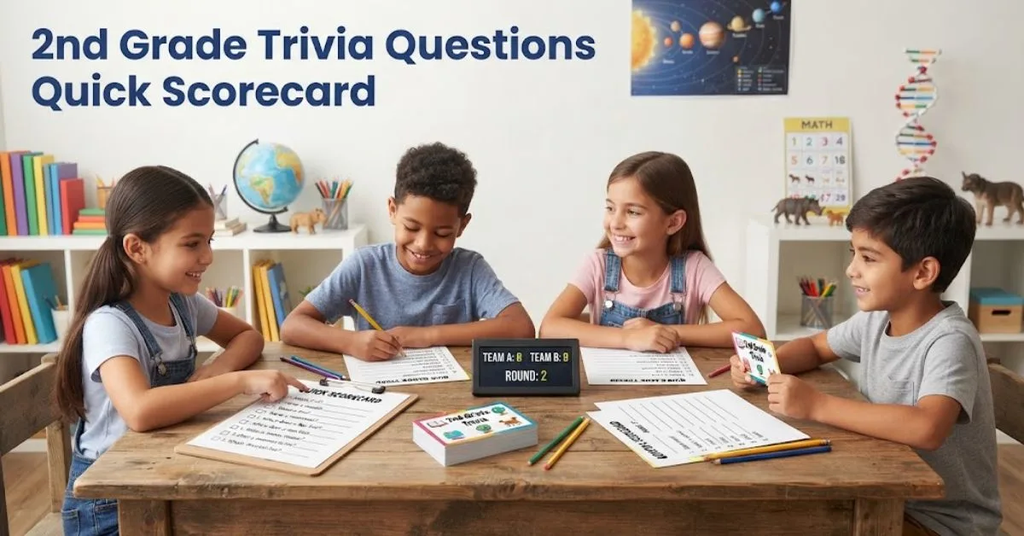
A scorecard can add excitement, but it should remain secondary to the learning experience. A missed question does not mean a child “isn’t smart”; it simply identifies something they did not know yet. The most useful score is one that encourages children to stay curious and celebrate progress.
| Correct Answers | Suggested Game Description |
| 0–20 | Curious Learner |
| 21–40 | Knowledge Explorer |
| 41–60 | Quiz Builder |
| 61–80 | Trivia Fan |
| 81–100 | Question Master |
| 101–130 | Super Quizzer |
| 131–150+ | Trivia Expert |
For younger children, consider giving a small celebration for participation rather than focusing only on the highest score. The purpose of trivia questions for 2nd graders is to encourage curiosity, communication, memory, and enjoyment.
Answers
Keeping answers directly beneath the questions is convenient for parents and teachers, while a separate answer key is useful when the page is printed or projected in a classroom. The current competitor pages use both approaches: some reveal answers directly, while others provide dedicated answer-key sections.
For classroom use, a teacher can read the question first, pause for responses, record team points, and then reveal the answer. At home, parents can hide the answer with a hand or paper and let children make a guess before checking. This simple pause often makes the quiz feel more like a game.
Answer Key: 1–25
- Puppy
- Eight
- Blue whale
- Honey
- Kangaroo
- Butterfly or moth
- Giraffe
- Cow
- Pig
- Kitten
- Zebra
- Beaver
- Six
- Yes
- Gills
- Dog
- Lamb
- Octopus
- Cheetah
- Insects
- Turtle
- Sheep
- Elephant
- Wings
- Foal
Answer Key: 26–50
- Oxygen
- Sunlight, water, and suitable soil
- Ice
- Thermometer
- Water vapor or steam
- Precipitation
- Sunlight interacting with water droplets
- Roots
- Leaves
- Gravity
- Magnetic materials such as iron
- Atmosphere
- Nocturnal
- Fall/autumn
- Four
- Frost
- Hearing
- Taste
- A darker area where light is blocked
- Sun
- Metamorphosis
- Herbivores
- Omnivores
- Lightning
- The blue whale
Answer Key: 51–75
- Canada
- Mexico
- Washington, D.C.
- Seven
- Pacific Ocean
- North America
- Antarctica
- Australia
- Equator
- Desert
- Island
- Peninsula
- Asia
- Statue of Liberty
- Atlantic Ocean
- Pacific Ocean
- Places, locations, distances, and directions
- South
- West
- Map
- Eight
- Mars
- Mercury
- Jupiter
- Saturn
Answer Key: 76–100
- Moon
- Milky Way
- Astronaut
- Spacesuit
- Sun
- Star
- Earth’s rotation
- Constellation
- Meteorite
- Earth
- Orbit
- Jupiter
- Moon
- Earth’s atmosphere
- Constellation
- George Washington
- U.S. Constitution
- 13
- 50
- Independence Day
- Civil rights activist
- Mayflower
- Telescope
- Wilbur and Orville Wright
- U.S. Capitol
Answer Key: 101–125
- Bald eagle
- Statue of Liberty
- The past
- Artifacts
- Timeline
- 26
- Vowels
- Noun
- Verb
- Question mark
- Period
- Exclamation point
- Cold
- Down
- Hat
- Antonym
- Synonym
- Author
- Illustrator
- Characters
- Setting
- Plot
- Fiction
- Nonfiction
- A
Answer Key: 126–150
- 12
- 9
- 20
- 100
- 5
- 3
- 4
- 6
- 50
- 100 cents
- 25 cents
- 60
- 7
- Even
- Odd
- 4
- 54
- Sum
- Difference
- 12
- Monkey
- Bear
- Toto
- Roald Dahl
- Cinderella
Answer Key: 151–170
- Bear
- Illustrator
- Author
- Chapters
- Title
- Heart
- Eyes
- Ears
- Nose
- Tongue
- Skull
- Skin
- About 206
- Teeth
- Wrist
- Ankle
- Lungs
- Elbow
- Knee
- Structure and support
Conclusion
The best trivia questions for 2nd graders turn ordinary facts into moments of curiosity. A child who answers a question about the Moon, explains why a spider is not an insect, solves a quick addition problem, or remembers what a noun is is doing more than collecting points they are connecting ideas in a playful setting.
For teachers, parents, homeschoolers, and families, the 170 questions above provide enough variety for quick warm-ups, classroom games, family quizzes, reading breaks, and longer trivia sessions. The strongest approach is to mix subjects, keep the language clear, adjust difficulty to the children playing, and treat wrong answers as opportunities to discover something new.
The real value of second-grade trivia is not whether a child gets every answer correct. It is the moment when a simple question leads to a follow-up thought: Why? How? What happens next? That curiosity is what can turn a short quiz into a memorable learning experience.
FAQs
What are 10 good 2nd grade trivia questions?
A balanced starter quiz can combine animals, science, math, space, and everyday knowledge. Good examples include asking how many legs a spider has, which planet is called the Red Planet, how many days are in a week, what frozen water is called, and what animal makes honey. Current competitor pages use similarly short, familiar questions.
What are 20 questions for kids easy?
Easy questions for second graders usually have familiar subjects and short answers. Colors, shapes, animals, counting, basic science, simple geography, and everyday objects are good starting points. Avoid unnecessary trick wording because the goal is to test knowledge rather than a child’s ability to decode a complicated sentence.
What are some good questions for kids in 2nd grade?
Good questions can cover basic science, animals, geography, space, math, reading, language, history, and everyday facts. The strongest mix gives children several ways to participate instead of making every question depend on the same school subject.
What are some good trivia questions for 2nd grade kids?
Good trivia questions for 2nd graders should be short, age-appropriate, understandable when read aloud, and built around one clear answer. Animal facts, planets, simple math, U.S. geography, books, weather, and language are especially useful categories for a broad second-grade quiz.
What subjects should 2nd grade trivia cover?
A well-rounded quiz can include animals, science, nature, space, geography, history, math, reading, language, literature, the human body, and general knowledge. This broad approach is consistent with the subject organization found across current ranking pages.
How difficult should 2nd grade trivia be?
Questions should generally be accessible to children around the second-grade level while allowing some room for curiosity. A mixture of easy recall and modestly challenging questions works better than making every item extremely simple or unusually advanced.
How can teachers use 2nd grade trivia?
Teachers can use trivia as a morning warm-up, review activity, transition activity, small-group game, team quiz, or end-of-class activity. Questions can be read aloud, displayed on a board, or placed into short subject-based rounds. Grade 2 speaking and listening standards also emphasize collaborative conversations and explaining ideas.
Can parents use 2nd grade trivia at home?
Yes. Parents can use trivia during family game time, after-school activities, road trips, dinner conversations, or short learning breaks. Reading questions aloud is especially helpful when a child understands the concept but finds longer written questions tiring.
How many questions should a 2nd grade quiz have?
There is no single required number. Ten questions can make a quick activity, while 20–30 questions work for a longer round. A larger collection such as this one allows parents and teachers to select questions according to available time and the child’s interests.
Are trivia questions for 2nd graders educational?
They can be. When questions reinforce vocabulary, math facts, science concepts, geography, reading knowledge, or everyday observations, trivia can provide a playful form of review. The learning value increases when children are encouraged to explain answers rather than simply hear whether they were right or wrong.
Should second-grade trivia include math questions?
Yes. Math can be a strong category when the questions reflect appropriate concepts such as addition, subtraction, place value, time, money, measurement, shapes, and number relationships. These areas are specifically represented in Grade 2 Common Core mathematics.
Should trivia questions for 2nd graders be multiple choice?
They can be, particularly when the quiz is read aloud or used with a group. Three simple choices can reduce reading pressure and make participation easier. However, open-answer questions are also useful because they encourage children to retrieve information independently.

Helping trivia lovers discover funny, clever, and unforgettable team names for every quiz night.