Pickleball Trivia Standard Scoring and Service Sequence
Scoring creates some of the most entertaining pickleball quiz questions because new players often find the traditional doubles score unusual. Side-out scoring and rally-scoring options can also create confusion when players have learned different formats. A good trivia game should identify which scoring system a question describes rather than assuming every match follows one identical format.
For standard recreational questions, 11 points and a two-point winning margin remain familiar reference points. However, current USA Pickleball materials also recognize a provisional rally-scoring option in specified play. That distinction gives advanced trivia players something more interesting than simply memorizing “first to 11.”
31. How many points is a standard game commonly played to?
Answer: 11 points.
The winning side must also lead by at least two points under the standard format.
32. How many points ahead must a team be to win?
Answer: Two points.
A score of 11–10 does not normally finish a standard game.
33. What is the first number in a traditional doubles score?
Answer: The serving team’s score.
The three-number system is a classic pickleball knowledge test.
34. What does the second number represent?
Answer: The receiving team’s score.
The third number in traditional doubles scoring identifies the server.
35. What does the third number identify?
Answer: The server.
It distinguishes which server is serving during a team’s service turn.
36. Why can the opening doubles score be called 0-0-2?
Answer: Because the starting team receives only one service turn before service changes sides.
This is one of the sport’s most recognizable scoring quirks.
37. Which side does the first server use when the team’s score is even?
Answer: The right/even side.
Players use the score to determine their service position.
38. Which side does the server use at an odd score?
Answer: The left/odd side.
The even/odd relationship is a common doubles-scoring trivia clue.
39. What happens after the serving team wins a rally?
Answer: Under traditional side-out scoring, the serving team scores and the server changes service courts before serving again.
The exact procedure depends on the applicable scoring format.
40. Do receiving partners automatically switch sides after every serving-team point?
Answer: No.
Their positions follow the rules governing the rally and service sequence.
41. When does service normally pass to the second doubles server?
Answer: When the first server loses the rally or commits a fault under traditional doubles service sequencing.
42. When does service pass to the opponents?
Answer: After the serving side loses its service opportunity according to the applicable scoring system.
43. How is a singles score commonly announced?
Answer: Server score followed by receiver score.
Singles does not use the traditional third-number doubles identifier.
44. Can pickleball use rally scoring?
Answer: Yes, certain formats can use the provisional rally-scoring option recognized in the rules.
This is an important modern distinction for updated trivia.
45. Why can scoring trivia be confusing for beginners?
Answer: Different recreational, tournament, and rule formats can use different scoring procedures.
A well-written quiz should identify the format before asking a scoring question.
Pickleball Trivia The Two-Bounce Rule and the Kitchen
The two-bounce rule and kitchen are probably the richest subjects for beginner pickleball trivia because they create memorable moments on court. Players must understand when the ball has to bounce, when a volley becomes legal, and how momentum affects the non-volley zone. The kitchen is not simply a place where players are forbidden to stand.
After the required bounces have occurred, players can enter the kitchen when the rules otherwise permit it. The important restriction concerns volleying and momentum. That distinction is exactly why kitchen questions work so well in a quiz: the wording sounds simple until you have to apply it to a real rally.
46. What is the two-bounce rule?
Answer: After the serve, the receiving team must allow the served ball to bounce, and the serving team must allow the return to bounce before volleying.
47. Can the receiver volley the serve before it bounces?
Answer: No.
The served ball must bounce first.
48. Must the serving team let the return bounce?
Answer: Yes.
This creates the second required bounce.
49. When can players begin volleying?
Answer: After the required two-bounce sequence has occurred, assuming the volley is otherwise legal.
50. What is a volley?
Answer: Hitting the ball before it bounces.
The word “volley” appears frequently in pickleball rules and trivia.
51. Can a player stand in the kitchen?
Answer: Yes.
Simply standing in the non-volley zone is not automatically a fault.
52. Can a player enter the kitchen to hit a ball that bounced there?
Answer: Yes.
A player can legally enter the kitchen to play a bounced ball.
53. Can a player volley while standing in the kitchen?
Answer: No.
That is the central restriction behind the non-volley zone.
54. What is a kitchen-line fault?
Answer: A non-volley-zone violation involving an illegal volley or momentum-related contact with the zone.
55. Can momentum cause a kitchen fault?
Answer: Yes.
A player who volleys outside the zone can still fault if momentum carries the player or something connected to the player into the zone.
56. Can a paddle touching the kitchen matter?
Answer: Yes.
If the paddle or another connected item contacts the non-volley zone during the prohibited volley action, it can create a fault.
57. Is the kitchen line itself part of the non-volley zone?
Answer: Yes.
This is why a serve touching that line is treated differently from a normal boundary-line situation.
58. What is a dink?
Answer: A soft shot that generally lands in or near the opponent’s kitchen.
Dinking is associated with control, patience, and soft-touch exchanges.
59. Why is the kitchen important strategically?
Answer: It limits volleys close to the net while encouraging controlled shots and positional strategy.
60. Why is the two-bounce rule important?
Answer: It prevents players from immediately rushing the net and volleying the return.
It helps create the distinctive rhythm of pickleball.
Pickleball Trivia Faults, Line Calls, and Replays
Fault questions are excellent for players who think they already know the basics. Net contact, double bounces, incorrect serves, kitchen violations, line calls, interference, and replays can all test whether someone understands the rule rather than simply recognizing vocabulary. The most useful questions present a situation and ask what should happen next.
Current rules also emphasize fair play and correct line calling. USA Pickleball’s materials explain that players and officials have defined responsibilities, while uncertain calls should not casually be turned into “out” calls. This makes fault trivia useful beyond entertainment because it reinforces good court etiquette.
61. What happens if a served ball lands outside the correct service court?
Answer: It is a fault.
The serving team loses the applicable service opportunity.
62. What happens if a player hits the ball into the net and it does not cross?
Answer: It is a fault.
The rally ends according to the rules.
63. What happens when the ball bounces twice before being returned?
Answer: The player who failed to return it commits a fault.
64. Can touching the net while the ball is live be a fault?
Answer: Yes.
Players must follow the rules governing contact with the net system.
65. Who normally makes line calls in unofficiated play?
Answer: Players make calls on their side according to the applicable rules.
66. What should happen when a player is uncertain whether an opponent’s ball was out?
Answer: The benefit of the doubt should generally go to the opponent.
That principle supports fair recreational play.
67. What makes a ball out?
Answer: For a boundary call, the relevant part of the ball’s contact with the ground must be completely outside the applicable line.
68. Are balls touching a boundary line generally in?
Answer: Yes.
The exception to remember is the non-volley-zone line during a serve.
69. What is a replay?
Answer: A rally played again without awarding the original rally result.
70. Can outside interference cause a replay?
Answer: Yes.
An outside event that affects play can create circumstances for a replay under the applicable rules.
71. What is a hinder?
Answer: A temporary event not caused by a player that affects play.
The rules determine whether the situation justifies a replay.
72. Can a damaged ball matter during a rally?
Answer: Yes.
A cracked or broken ball can create specific rule situations requiring attention.
73. Should an out call be made promptly?
Answer: Yes.
Clear and timely calls reduce confusion during recreational and competitive play.
74. Can spectators automatically make binding line calls?
Answer: Generally no.
Line-calling responsibilities depend on the format and officiating arrangement.
75. Why are fault questions useful for trivia?
Answer: They test whether players can apply a rule to a real situation instead of simply memorizing vocabulary.
Pickleball Trivia Shots, Strategy, and Doubles Positioning
Once players move beyond basic rules, pickleball strategy and shot terminology create a completely different level of trivia. Terms such as third-shot drop, drive, dink, Erne, ATP, lob, reset, stacking, poaching, and speed-up are now part of the sport’s everyday language. They also reveal how much pickleball strategy has developed beyond its simple family-game origins.
For a trivia night, these questions are ideal for separating beginners from regular players. Someone may know that the kitchen is seven feet deep but still hesitate when asked what an ATP shot means. Strategy trivia also gives experienced players a chance to explain the vocabulary behind shots they already use.
76. What is a third-shot drop?
Answer: A soft shot intended to land in the opponent’s kitchen and help the serving team transition forward.
77. What is a third-shot drive?
Answer: A harder attacking shot played as the serving team’s third stroke.
78. What is a dink rally?
Answer: An exchange of soft shots, usually played into the kitchen area.
79. What is an Erne?
Answer: A specialized volley played from outside the sideline near the net.
It is one of pickleball’s most recognizable advanced shots.
80. What does ATP stand for?
Answer: Around the Post.
An ATP shot travels around the outside of the net rather than over it.
81. Does an ATP shot have to travel above the net?
Answer: No.
The defining feature is that the ball travels around the post.
82. What is a lob?
Answer: A high shot intended to travel over an opponent toward the back of the court.
83. What is an overhead?
Answer: A forceful shot struck above the player’s head.
84. What is a reset?
Answer: A soft defensive shot intended to reduce the pace of an attack and regain control.
85. What is the transition zone commonly called?
Answer: No man’s land.
It is the area between the baseline and kitchen line where players can be vulnerable to aggressive shots.
86. What is stacking in doubles?
Answer: A positioning strategy in which partners arrange themselves to preserve preferred court sides or matchups.
87. Why might doubles partners stack?
Answer: They may want to keep a preferred forehand, preserve a particular matchup, or maintain a tactical formation.
88. What is poaching?
Answer: Moving across to intercept a ball intended for a partner.
89. What is a speed-up?
Answer: A sudden attacking shot that increases pace from a slower exchange.
90. Why is kitchen-line positioning strategically important?
Answer: Being close to the kitchen can reduce opponents’ available angles and reaction time while allowing controlled attacks.
Pickleball Trivia How Pickleball Began
The history of pickleball is full of trivia-friendly details because the sport started with a simple family problem: bored children needed something to do. In 1965, Joel Pritchard and Bill Bell returned to Pritchard’s Bainbridge Island home and improvised a game using an existing badminton court, ping-pong paddles, and a perforated plastic ball. Barney McCallum soon joined them.
The name itself remains one of the sport’s most entertaining historical questions. USA Pickleball acknowledges competing stories involving a pickle boat and the family dog Pickles. That makes the name a particularly good trivia question because the most accurate answer is not simply “the dog”the history is more nuanced.
91. In what year was pickleball invented?
Answer: 1965.
The sport began on Bainbridge Island, Washington.
92. Where was pickleball invented?
Answer: Bainbridge Island, Washington.
The island is located near Seattle.
93. Who are credited as pickleball’s three founders?
Answer: Joel Pritchard, Bill Bell, and Barney McCallum.
USA Pickleball identifies all three in its official history.
94. What existing court did the founders use?
Answer: A badminton court.
They used what was already available at Pritchard’s property.
95. What did they initially use as paddles?
Answer: Ping-pong paddles.
The equipment was improvised rather than purpose-built.
96. What kind of ball was originally used?
Answer: A perforated plastic ball.
The early game evolved through experimentation with available equipment.
97. How high was the net at first?
Answer: About 60 inches, the traditional badminton height.
The founders later lowered it after discovering that the ball bounced well on the playing surface.
98. To what height was the net lowered?
Answer: 36 inches at the sidelines.
That height remains part of the standard modern court configuration.
99. What was the original family purpose of the game?
Answer: To create a pastime the whole family could play together.
That family-friendly goal is part of the sport’s origin story.
100. Which sport heavily influenced the first rules?
Answer: Badminton.
The founders used badminton as an important starting point when developing the game’s rules.
101. Why is the origin of the name “pickleball” debated?
Answer: Historical accounts differ between the pickle-boat explanation and the story involving the dog Pickles.
USA Pickleball documents both accounts.
102. Who was Joan Pritchard?
Answer: Joel Pritchard’s wife, who is associated with the pickle-boat explanation of the name.
103. What was the Pritchard family’s dog’s name?
Answer: Pickles.
The dog story is one of the most popular pieces of pickleball trivia.
104. Did Pickles necessarily exist before the game was invented?
Answer: Historical accounts suggest the dog may have arrived after the game began.
This is why the naming story should be presented carefully rather than as an uncontested fact.
105. When was the first official pickleball rulebook published?
Answer: 1984.
USA Pickleball identifies 1984 as the first publication year of its official rulebook.
Pickleball Trivia Organizations, Competition, and Modern Pickleball
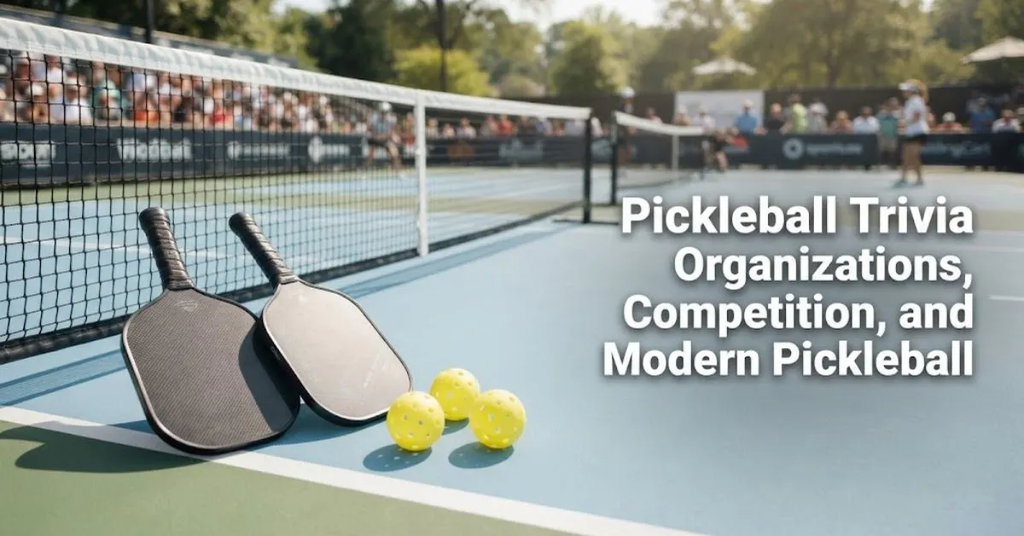
Modern pickleball has grown far beyond the improvised family game created in Washington. Today’s ecosystem includes national governance, equipment certification, player ratings, professional competition, tournaments, wheelchair play, singles, doubles, mixed doubles, and organized competition formats. USA Pickleball maintains the official U.S. rulebook and equipment standards, while competitive play has developed its own terminology and rating systems.
This section is particularly useful for advanced pickleball trivia because it connects everyday recreational play with the organized sport. A good quiz can move from “What is the kitchen?” to “What does DUPR mean?” without feeling disconnected. The questions become progressively more challenging while remaining tied to recognizable pickleball entities.
106. What organization maintains the official U.S. pickleball rulebook?
Answer: USA Pickleball.
It is the U.S. national governing body for the sport.
107. What abbreviation was historically used for USA Pickleball?
Answer: USAPA.
The organization previously used the name United States of America Pickleball Association.
108. What does UTPR stand for?
Answer: USA Pickleball Tournament Player Rating.
It is associated with tournament-based player ratings.
109. What does DUPR stand for?
Answer: Dynamic Universal Pickleball Rating.
It is a separate rating system used within the pickleball ecosystem.
110. What is mixed doubles?
Answer: A doubles format with one male and one female player on each team.
The exact eligibility rules can depend on the competition.
111. How many players are on a singles side?
Answer: One.
Singles places one player on each side of the net.
112. How many players are on a doubles team?
Answer: Two.
Doubles is the most common format for recreational pickleball.
113. What is wheelchair pickleball?
Answer: Pickleball played under rules adapted for wheelchair athletes.
USA Pickleball provides specific wheelchair rules and adaptations.
114. How many bounces can occur under wheelchair-specific rules?
Answer: Wheelchair rules allow an additional bounce compared with standard play, subject to the official wheelchair rules.
Always use the current official rulebook when writing tournament-specific questions.
115. What is a pickleball tournament?
Answer: An organized competitive event conducted under a defined format and set of rules.
Tournaments can use several different competition structures.
116. What is a round-robin format?
Answer: A format in which participants play multiple scheduled opponents within a group or division.
It gives competitors more than one opportunity to play.
117. What is single elimination?
Answer: A format where one loss normally eliminates the player or team.
The remaining competitors continue through successive rounds.
118. What is double elimination?
Answer: A format in which competitors generally have to lose twice before being eliminated.
The precise bracket structure can vary.
119. What document works with the official rulebook to regulate equipment?
Answer: The USA Pickleball Equipment Standards Manual.
The rulebook and equipment standards work together to govern sanctioned equipment.
120. When did the current 2026 USA Pickleball rulebook take effect?
Answer: January 1, 2026.
USA Pickleball provides the 2026 rulebook as the current official rules reference.
Quick Pickleball Trivia Scorecard
| Score | Suggested result |
| 0–30 | New to the game |
| 31–60 | Pickleball learner |
| 61–90 | Regular player |
| 91–105 | Strong pickleball knowledge |
| 106–120 | Serious trivia challenger |
This scorecard is intended as a fun way to play rather than an official player-rating system. Competitive ratings such as UTPR and DUPR are separate concepts.
Pickleball Trivia for a Party or Trivia Night
These questions can easily become a social game. One person can read the question while everyone writes an answer, or players can compete in teams. For a pickleball trivia night, mix easy history questions with rules questions and then finish with terminology such as Erne, ATP, stacking, and third-shot drops.
A good format is to avoid making every question equally difficult. Start with recognizable facts such as 1965, Bainbridge Island, the kitchen, 20-by-44 feet, and 11 points, then gradually introduce service rules and strategy. This keeps beginners involved while giving experienced players a reason to stay engaged.
Pickleball Trivia for Beginners
Beginners usually enjoy questions that teach something immediately. Court dimensions, the kitchen, paddle construction, the perforated ball, the sport’s three founders, and the two-bounce rule are excellent starting points.
The most effective beginner questions also have short answers. Instead of asking someone to explain an entire scoring system, begin with “How many points is a standard game commonly played to?” Then explain the answer afterward. That creates a learning moment without turning trivia into a rulebook exam.
Pickleball Trivia for Experienced Players
Experienced players can handle scenario-based questions. Ask what happens when a serve touches the kitchen line, whether momentum can cause a kitchen fault, what an ATP means, or why doubles teams stack.
Advanced trivia becomes more interesting when the answer requires rule application rather than vocabulary recall. That is where players discover that knowing the term “kitchen” is easy, but correctly applying the non-volley-zone rules during a fast rally requires much deeper understanding.
Pickleball Trivia Printables
A printable version works particularly well for clubs, recreation centers, birthday gatherings, tournaments, and casual pickleball parties. The questions can be divided into rounds such as history, court and equipment, serving, scoring, kitchen rules, strategy, and modern pickleball.
For a printable game, place questions on one page and answers on another. This prevents players from accidentally seeing the answers and makes the same quiz reusable for different groups. Competitor pages also show clear demand for printable trivia and party-oriented formats.
FAQs
What is a good pickleball trivia question?
A good question has a clear answer and connects to something players recognize. Questions about the kitchen, court size, founders, scoring, serving, equipment, and pickleball terminology work particularly well.
What year was pickleball invented?
Pickleball was invented in 1965 on Bainbridge Island, Washington, by Joel Pritchard, Bill Bell, and Barney McCallum.
What is the most famous pickleball trivia fact?
One of the best-known facts is the disputed origin of the sport’s name. Historical accounts connect it with both a pickle boat and the Pritchard family’s dog, Pickles.
How big is a pickleball court?
A standard pickleball court is 20 feet wide by 44 feet long, for both singles and doubles.
What is the kitchen in pickleball?
The kitchen is the common name for the non-volley zone, the seven-foot area extending from the net on each side. Players may stand there, but they cannot legally volley while violating the non-volley-zone rules.
How many points do you need to win pickleball?
A standard game is commonly played to 11 points with a two-point margin, although current rules also recognize other scoring formats for specified play.

Helping trivia lovers discover funny, clever, and unforgettable team names for every quiz night.