4th Grade Trivia 100+ Fun Questions With Answers
4th grade trivia turns learning into a friendly challenge, giving kids a fun way to explore general knowledge, math, science, geography, history, animals, and language arts. For parents, teachers, and quiz hosts, the real challenge is finding questions that are educational without feeling like another worksheet. This collection solves that problem with age-appropriate questions, clear answers, and a broad mix of school subjects and everyday facts.
At the fourth-grade level, children are ready for more than simple recall. They can work with multiplication, fractions, measurement, Earth science, U.S. history, vocabulary, geography, and critical thinking. The goal is to create those satisfying “I know that!” moments while leaving room for a few surprises. Whether you’re planning classroom review, family game night, or a quick quiz competition, these 4th grade trivia questions are ready to use.
General 4th Grade Trivia
General 4th grade trivia works best when it mixes familiar facts with questions that make children stop and think. General knowledge, famous places, everyday facts, animals, space, and geography can create an easy opening round before the difficulty increases. That variety also gives different learners a chance to shine.
For teachers and parents, a good warm-up should feel approachable rather than intimidating. Start with questions children can answer confidently, then gradually introduce problem solving, science facts, math skills, and cultural knowledge. A quick correct answer can build momentum, while an unexpected question encourages curiosity and conversation.
General Knowledge
This general knowledge round combines U.S. geography, space, nature, landmarks, animals, and everyday facts. The questions are intentionally varied so a child who loves planets can compete with someone who knows everything about animals or famous places. Read them aloud, pause briefly, and let the fun begin.
- What is the capital of the United States?
Answer: Washington, D.C. - Which planet is known as the Red Planet?
Answer: Mars. - How many days are in a leap year?
Answer: 366. - What is the largest ocean on Earth?
Answer: The Pacific Ocean. - What is the largest land animal?
Answer: The African elephant. - Which animal is famous for changing its colors to blend with its surroundings?
Answer: The chameleon. - What is the name of Earth’s natural satellite?
Answer: The Moon. - Which U.S. state is known as the Sunshine State?
Answer: Florida. - What is the tallest mountain above sea level on Earth?
Answer: Mount Everest. - How many continents are commonly recognized in the seven-continent model?
Answer: Seven.
Math 4th Grade Trivia Questions
Math trivia can make multiplication, division, fractions, place value, geometry, measurement, and problem solving feel more like a game. These questions fit naturally with Grade 4 mathematics, which emphasizes multi-digit arithmetic, factors and multiples, fractions and decimals, measurement, angles, and geometric classification.
- What is 9 × 7?
Answer: 63. - What is 144 ÷ 12?
Answer: 12. - What is the value of the digit 6 in 6,482?
Answer: 6,000. - What is half of 80?
Answer: 40. - What is 25 + 37?
Answer: 62. - A square has sides that are 5 inches long. What is its perimeter?
Answer: 20 inches. - Which fraction is equivalent to 1/2: 2/4 or 2/3?
Answer: 2/4. - What is 1,000 − 375?
Answer: 625. - How many sides does a hexagon have?
Answer: Six. - What is the smallest whole number greater than 27?
Answer: 28.
4th Grade Science and Geography Trivia
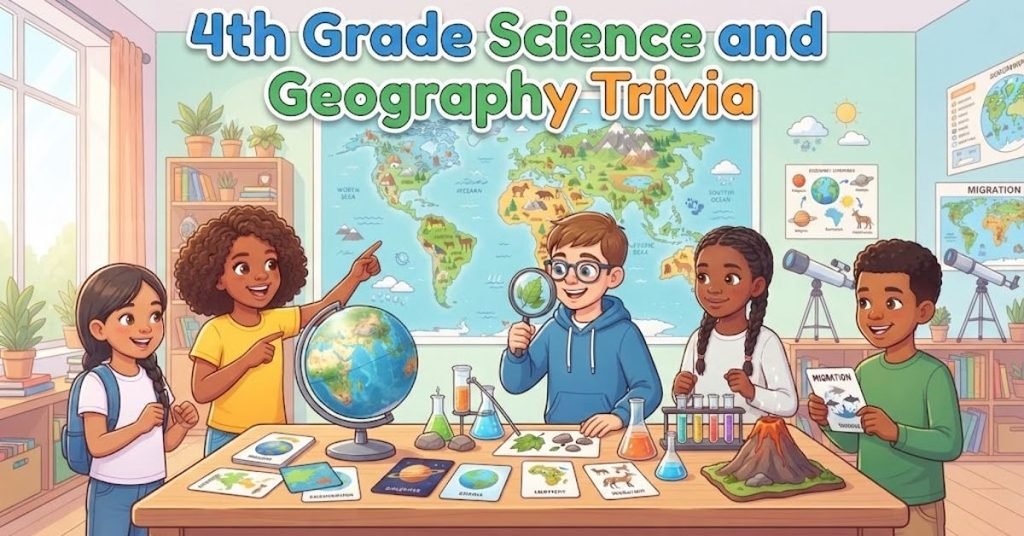
Science and geography naturally connect because both encourage children to look beyond the classroom and understand the world around them. Earth, space, energy, oceans, maps, weathering, landforms, plants, and physical science give a fourth grader plenty of opportunities to discover something surprising.
The current NGSS Grade 4 framework includes energy, waves, organism structures, Earth’s place in the universe, Earth’s systems, natural resources, and processes such as weathering and erosion. Geography questions can reinforce the same habit of observing patterns, interpreting maps, and connecting physical features to places.
Science 4th Grade Trivia Questions
These science questions cover Earth science, astronomy, energy, life science, physical science, and everyday observations. Some are straightforward recall questions, while others ask children to connect a familiar phenomenon with a scientific idea. That balance makes the round useful for both casual games and classroom review.
- What gas do humans need to breathe to stay alive?
Answer: Oxygen. - What process allows green plants to make food using sunlight?
Answer: Photosynthesis. - What force pulls objects toward Earth?
Answer: Gravity. - Which planet is the largest in our solar system?
Answer: Jupiter. - What is water called when it becomes a solid?
Answer: Ice. - What organ pumps blood around the human body?
Answer: The heart. - What is H₂O commonly called?
Answer: Water. - What type of energy comes from the Sun and helps warm Earth?
Answer: Solar energy. - What instrument is commonly used to measure temperature?
Answer: A thermometer. - What process slowly breaks rocks into smaller pieces through natural forces such as water, ice, wind, or living things?
Answer: Weathering.
Geography 4th Grade Trivia Questions
Geography trivia gives children a mental map of the world through continents, oceans, countries, capitals, rivers, deserts, states, and landmarks. It is especially useful when questions move from familiar U.S. places to world geography. The result feels like a journey: one answer can naturally lead to another place worth exploring.
- What is the capital of France?
Answer: Paris. - Which ocean borders the west coast of the United States?
Answer: The Pacific Ocean. - What is the largest continent by land area?
Answer: Asia. - Which continent contains the Sahara Desert?
Answer: Africa. - What is the capital of Canada?
Answer: Ottawa. - Which river flows through Egypt and is one of Africa’s best-known rivers?
Answer: The Nile River. - Which U.S. state is the largest by area?
Answer: Alaska. - On which continent is the Amazon Rainforest primarily located?
Answer: South America. - What country is home to the Great Wall?
Answer: China. - What is the smallest country in the world by area?
Answer: Vatican City.
4th Grade History and Culture Trivia
History and culture trivia gives children a chance to connect names, places, inventions, stories, and events. U.S. history, famous people, landmarks, literature, art, music, and cultural traditions make particularly useful fourth-grade material because each answer can become the starting point for a short conversation.
A strong history round should reward knowledge without turning into a memorization contest. Questions about George Washington, the Constitution, the Mayflower, American symbols, famous artists, books, and cultural figures can help children connect individual facts to larger stories.
History of 4th Grade Trivia Questions
This round focuses on American history, important documents, famous leaders, inventions, and major historical events. The questions are short enough for a fast quiz but meaningful enough to spark follow-up discussion. If a child asks “Why?” after an answer, that is a perfect opportunity to turn trivia into deeper learning.
- Who was the first President of the United States?
Answer: George Washington. - What document begins with the words “We the People”?
Answer: The U.S. Constitution. - What was the name of the ship that carried the Pilgrims to North America in 1620?
Answer: The Mayflower. - Who was the 16th President of the United States?
Answer: Abraham Lincoln. - What U.S. holiday celebrates independence from Great Britain?
Answer: Independence Day, celebrated on July 4. - Who is credited with inventing the telephone?
Answer: Alexander Graham Bell. - Which American symbol is a large bell associated with independence and freedom?
Answer: The Liberty Bell. - Which country gave the Statue of Liberty to the United States?
Answer: France. - Who was the principal author of the Declaration of Independence?
Answer: Thomas Jefferson. - What war was fought between the Union and Confederacy in the United States?
Answer: The American Civil War.
Animals 4th Grade Trivia Questions
Animal questions are often a favorite because they combine science, habitats, adaptations, food chains, and fascinating facts. They also make an excellent confidence-building round. A child who struggles with geography may suddenly become the strongest player when the quiz moves to mammals, birds, insects, or ocean animals.
- What is the fastest land animal?
Answer: The cheetah. - What do pandas primarily eat?
Answer: Bamboo. - What is a baby frog called?
Answer: A tadpole. - What is the largest animal known to live on Earth?
Answer: The blue whale. - What is the only group of mammals capable of true powered flight?
Answer: Bats. - What do bees collect from flowers that helps them make honey?
Answer: Nectar. - What do you call an animal that eats both plants and animals?
Answer: An omnivore. - What is a group of wolves commonly called?
Answer: A pack. - Which bird is famous for its ability to mimic sounds and human speech?
Answer: A parrot. - What is the largest living species of sea turtle?
Answer: The leatherback sea turtle.
Music & Art
Music and art trivia adds a creative break from math, science, geography, and history. Children can identify artists, instruments, colors, musical families, and visual-art terms. This section also works well for mixed-age family games because adults may know the answers while children discover new names and concepts.
- Who painted the Mona Lisa?
Answer: Leonardo da Vinci. - How many strings does a standard guitar usually have?
Answer: Six. - Which instrument has black and white keys and is played with a keyboard?
Answer: The piano. - What three colors are traditionally called the primary colors in basic art instruction?
Answer: Red, yellow, and blue. - What color do red and blue make when mixed in traditional paint?
Answer: Purple. - What family of instruments does the violin belong to?
Answer: The string family. - What do you call a painting or drawing of a person’s face?
Answer: A portrait. - Who composed the famous piano piece “Für Elise”?
Answer: Ludwig van Beethoven. - Which instrument is commonly played by blowing air through a mouthpiece and reed?
Answer: A clarinet. - What is a person who creates sculptures, paintings, or other visual works generally called?
Answer: An artist.
Miscellaneous 4th Grade Trivia
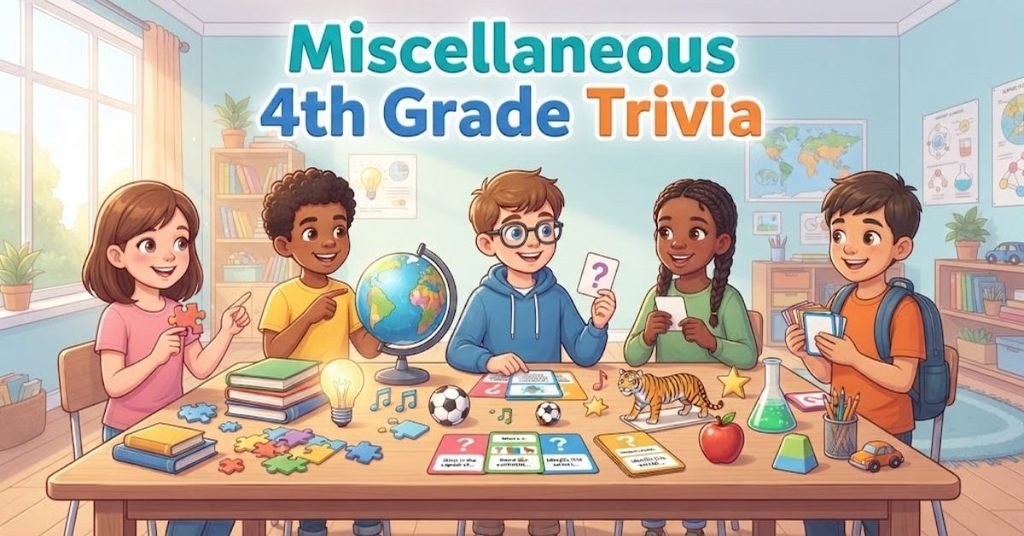
A miscellaneous round is where a quiz can become especially memorable. It allows sports, technology, inventions, everyday science, entertainment, communication, and practical knowledge to sit together. That unpredictability keeps players engaged because nobody knows exactly what subject will appear next.
This section is also useful for family game night. A parent may dominate a history question, while a child takes the lead on technology or sports. That friendly switching of roles is one reason mixed-topic trivia works so well as an informal learning activity.
Sports 4th Grade Trivia Questions
Sports trivia introduces familiar ideas such as teams, scoring, Olympic events, baseball, soccer, basketball, tennis, and bowling. Keep the focus on basic rules and recognizable facts rather than obscure professional statistics. The goal is to test general knowledge, not require children to follow a particular sports league.
- How many players from one team are on the field in soccer during normal play?
Answer: 11. - Which sport is played at Wimbledon?
Answer: Tennis. - How many points is a touchdown worth before any extra-point attempt?
Answer: Six. - What sport uses a bat, bases, and a ball?
Answer: Baseball. - What is the name of the professional basketball league commonly abbreviated NBA?
Answer: National Basketball Association. - How many rings appear on the Olympic symbol?
Answer: Five. - Which sport includes events such as the balance beam and floor exercise?
Answer: Gymnastics. - What do bowlers call three strikes in a row?
Answer: A turkey. - What sport is played with a puck on ice?
Answer: Ice hockey. - What piece of equipment does a baseball player use to hit the ball?
Answer: A bat.
Technology & Inventions
Technology questions connect trivia with the world children interact with every day. Computers, browsers, the internet, robots, microscopes, communication, and inventions provide natural opportunities to explain how tools work. Keep the wording simple, but encourage children to ask what each invention changed and why it matters.
- What does “www” stand for in a web address?
Answer: World Wide Web. - What software do you use to visit websites?
Answer: A web browser. - What does CPU stand for?
Answer: Central Processing Unit. - What machine can be programmed to perform tasks automatically?
Answer: A robot. - What instrument allows scientists to see very small objects in greater detail?
Answer: A microscope. - What device is commonly used to measure temperature?
Answer: A thermometer. - Who is commonly credited with inventing the practical incandescent light bulb?
Answer: Thomas Edison. - What technology allows information to be sent over the internet?
Answer: Computer networking. - What is a smartphone primarily designed to combine with phone communication?
Answer: Computing and communication functions. - What is electricity commonly used to power?
Answer: Electrical devices and machines. - What does GPS help a person determine?
Answer: Location and navigation. - What type of energy powers a flashlight when its battery is working?
Answer: Electrical energy. - What invention lets people communicate with someone far away by voice?
Answer: The telephone. - What device can record or display moving images?
Answer: A camera or video camera. - What is a password mainly used for?
Answer: Protecting access to an account or device. - What does a search engine help people find?
Answer: Information on the internet. - What kind of machine can carry out programmed physical tasks?
Answer: A robot. - What does a calculator help people do?
Answer: Perform mathematical calculations. - What technology is commonly used to connect devices without a physical cable over short distances?
Answer: Bluetooth. - What is a digital map useful for?
Answer: Finding locations, planning routes, and understanding geographic information. - What is the main purpose of a computer keyboard?
Answer: Entering letters, numbers, and commands into a computer.
Conclusion
The best 4th grade trivia doesn’t simply test whether a child remembers a fact. It creates a small moment of discovery: a surprising animal fact, a clever math answer, a historical name, a new place on the map, or a science question that makes someone say, “Wait really?”
With more than 100 questions spanning general knowledge, math, science, geography, history, animals, music, art, sports, and technology, this collection can become a flexible resource for classroom review, homeschool activities, family game nights, or a quick quiz whenever curiosity strikes. Start easy, celebrate effort, and let the questions lead naturally to deeper learning.
FAQs
The FAQ themes below are based on the recurring questions visible in the competing page rather than a claim that Google displayed these exact PAA questions during this search. They address the practical concerns parents, teachers, and quiz hosts are most likely to have: difficulty, learning value, resources, online use, and keeping a quiz enjoyable.
What are some easy 4th-grade trivia questions?
Easy 4th-grade trivia questions usually ask about familiar animals, planets, geography, math facts, U.S. symbols, science, and everyday knowledge. Examples include “How many legs does a spider have?” or “Which planet is known as the Red Planet?” Starting with approachable questions helps children build confidence before harder rounds.
How can trivia help in learning?
Trivia can reinforce recall, vocabulary, math facts, science concepts, geography, and historical knowledge in a low-pressure format. A well-designed quiz also encourages children to explain answers, compare ideas, and stay curious. It works especially well as a short classroom review or a playful family learning activity.
Where can I find more trivia questions?
More questions can be organized around specific topics such as math trivia, science trivia, animal trivia, geography, history, space, or general knowledge. Building topic clusters makes it easier to adjust difficulty for different ages. Teachers can also create rounds based on the concepts students are currently studying.
Can trivia be used in online learning?
Yes. Trivia can work well in digital classrooms, online quizzes, interactive review activities, and virtual game sessions. Questions can be displayed one at a time, answered individually, or played in teams. The most effective format keeps instructions simple and gives students enough time to think before revealing the answer.
What’s a good way to make trivia fun?
Mix easy and challenging questions, rotate subjects, and let players earn points for correct answers. A timer, team format, bonus round, or simple score sheet can add excitement without making the activity stressful. Most importantly, keep the tone encouraging so an incorrect answer becomes a learning moment rather than an embarrassment.

Helping trivia lovers discover funny, clever, and unforgettable team names for every quiz night.