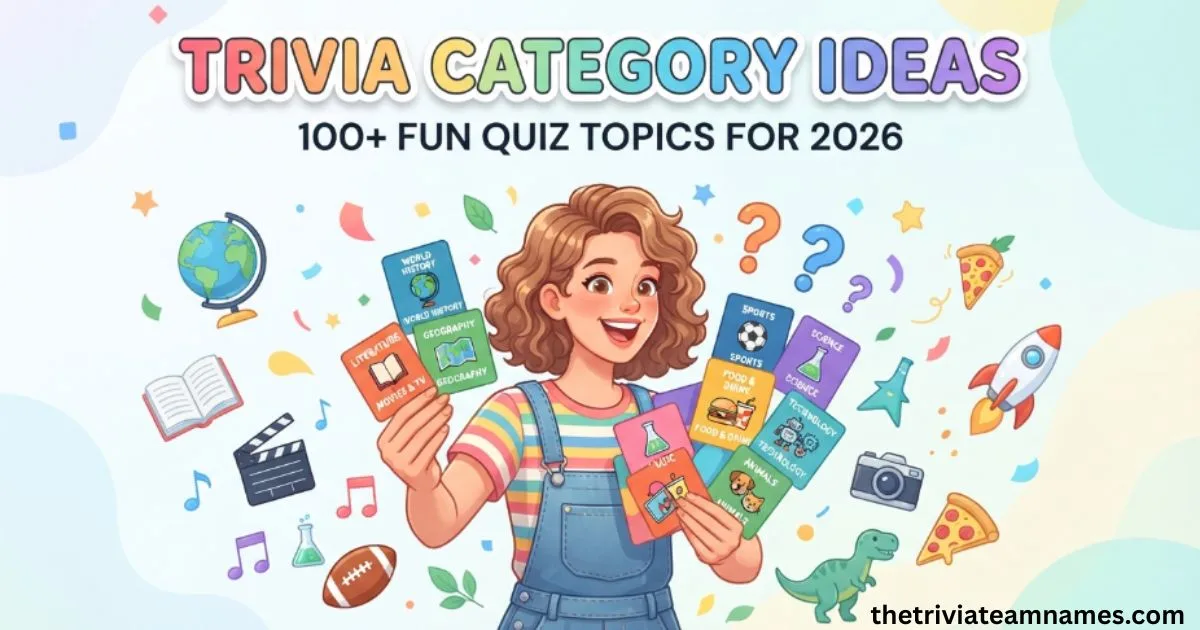
Trivia Category Ideas 100+ Fun Quiz Topics for 2026
The best trivia category ideas give everyone at the table a reason to play. Popular choices include movies, music, sports, history, geography, food, pop culture, science, nostalgia, and themed rounds. The trick is not simply finding more topics; it is building a balanced mix around your audience, difficulty level, and event. Current trivia resources consistently emphasize variety, audience fit, and avoiding overly niche categories.
After researching successful trivia-night formats, one lesson keeps appearing: the round people remember is usually the one that makes them laugh, argue, remember something, or suddenly shout, “I know this!” That is why the strongest quiz categories combine familiar subjects with an unexpected angle. Whether you’re planning a U.S. bar trivia night, classroom activity, family game, fundraiser, or workplace event, the categories below give you a practical starting point.
Trivia Category Ideas 10 Interesting Rabbit-Holes
Some of the most memorable trivia category ideas are hybrids rather than ordinary subjects. Water Cooler Trivia uses combinations such as history with pop culture and science with movies because they force players to connect two different knowledge areas. That creates more interesting questions without requiring an entirely obscure subject.
Think of a hybrid round as a conversation between categories. Instead of asking only about famous films, for example, connect movies with science, geography, history, music, or technology. The result feels fresh while remaining accessible. This approach is especially useful when your regular players already know the standard questions.
Hybrid Categories
Hybrid categories work by joining two familiar subjects into one round. Examples include pop culture and history, science and movies, food and geography, music and mathematics, or sports and business. The semantic connection gives you a clear question-writing framework while making the round feel less predictable.
Pop Culture Meets History
Combine famous people, television, movies, music, and historical events. A question might connect The Beatles to the 1960s or a movie to the historical event that inspired it. This category works particularly well for mixed groups because players can approach the same question through different knowledge paths.
Science in Movies
Ask about scientific concepts shown in famous films, space travel, physics, biology, medicine, or technology. Christopher Nolan’s Interstellar and Stanley Kubrick’s 2001: A Space Odyssey provide obvious starting points, but you can also explore whether fictional science is realistic.
Trivia Category Ideas How To Pick Fun Trivia Categories
Good trivia category ideas should match the people actually playing. Competitor research repeatedly warns against choosing categories that are too niche for a general audience. A strong quiz balances familiar topics with a few specialty rounds, allowing different players to contribute their own strengths.
Before finalizing your quiz, ask who will be in the room. A family gathering may favor Disney, animals, geography, and decades. A workplace group may enjoy general knowledge, technology, pop culture, and company history. A bar audience may respond better to music, movies, sports, and current events.
Audience Fit
Audience fit is one of the simplest ways to improve a quiz. Consider age range, shared interests, location, profession, and experience. If nobody in the room follows professional sports, an entire sports round can become dead time. If everyone loves classic movies, that same category can become the highlight.
Difficulty Balance
Avoid making every category extremely easy or relentlessly difficult. Begin with accessible questions, introduce moderate challenges, and reserve genuinely difficult material for later rounds. A balanced quiz lets casual players contribute while still giving expert players opportunities to shine.
Trivia Category Ideas 20 Fun Categories For Trivia
The most useful trivia category ideas span entertainment, history, sports, food, literature, games, nature, celebrities, and nostalgia. Competitor research specifically highlights subjects such as bank robbers, movie musicals, The Beatles, superheroes, fast-food chains, sports personalities, television sitcoms, national parks, classic video games, and holidays.
Rather than copying the same generic categories every week, give familiar subjects a distinctive angle. “Movies” becomes “Movie Musicals.” “History” becomes “Historic Battles.” “Games” becomes “Nostalgic Board Games.” The narrower framing makes a familiar topic feel like a new experience.
| Category | Best angle |
| Movie Musicals | Songs, actors, characters |
| The Beatles | Band history and music |
| Superheroes | Marvel, DC, characters |
| Fast Food Chains | Logos, origins, slogans |
| Famous Sports Personalities | Athletes and broadcasters |
| Literature Classics | Authors and works |
| TV Sitcoms | Characters and episodes |
| Nostalgic Board Games | Classic games and history |
| Academy Awards | Winners and film history |
| National Parks | Locations and wildlife |
| Classic Video Games | Consoles and arcade history |
| Major Holidays | Traditions and origins |
Movie Musicals
Movie musicals offer an excellent crossover between film and music. Questions can identify songs, actors, characters, directors, famous scenes, or award-winning productions. You can make the category easy for families or considerably harder by focusing on production history and less-famous performers.
The Beatles
A Beatles round can cover albums, songs, band members, recording history, famous performances, cultural influence, and solo careers. The category works particularly well because players can know the music without necessarily knowing the deeper history.
Superheroes
Build questions around Marvel and DC Comics, including characters, actors, comic-book origins, villains, fictional locations, and cinematic adaptations. For a mixed group, use recognizable characters before moving toward deeper comic-book lore.
TV Sitcoms
Classic and modern sitcoms provide endless question possibilities. Focus on characters, actors, catchphrases, fictional locations, relationships, theme songs, or memorable episodes. A sitcom round is strongest when the audience shares at least some familiarity with the shows.
Trivia Category Ideas Best Random Trivia Categories: 5 Honorable Mentions
Random trivia category ideas are useful when your main rounds already cover the standard subjects. Competitor research highlights Flags of the World, Animals A to Z, Advertising Jingles and Slogans, World Geography, and Internet Culture & Memes as unexpected alternatives.
These work because they create a different rhythm. After a serious history round, an advertising-jingle round can make everyone smile. After difficult geography questions, animals can provide a more approachable challenge. Variety keeps the room from feeling like it is taking the same test repeatedly.
Flags of the World
Ask players to identify countries by flags, colors, symbols, shapes, or unusual historical changes. This category becomes particularly effective as a picture round because participants can recognize visual information instead of relying entirely on written questions.
Animals A to Z
Create an alphabet-based animal challenge or focus on strange animal behaviors. You can ask about habitats, diets, scientific names, adaptations, endangered species, or unusual physical characteristics. The category works well for families because animal knowledge crosses age groups.
Advertising Jingles and Slogans
Old commercials and famous slogans create instant nostalgia. Ask players to identify a company from a slogan, finish a famous advertising phrase, or identify the product associated with an old campaign. This category can be especially entertaining for multigenerational groups.
World Geography
Go beyond capitals. Ask about landmarks, borders, languages, unusual geographic features, flags, rivers, mountains, and famous cities. Geography provides enough variety to create easy, medium, and difficult questions within one coherent round.
Internet Culture & Memes
For younger or digitally active groups, internet culture can cover memes, viral moments, early websites, social platforms, online slang, creators, and digital milestones. Because internet culture changes quickly, verify time-sensitive facts before publishing or hosting the round.
Trivia Category Ideas What are the best topics for trivia?
The strongest trivia category ideas usually combine broad appeal with enough variety to prevent repetition. Movies, music, television, pop culture, general knowledge, geography, food, history, science, and sports are dependable foundations, while quirky facts and local material can give the event personality.
For a mixed U.S. audience, avoid building the entire quiz around one generation or fandom unless the event is intentionally themed. A 1980s music round may be brilliant for one crowd and nearly meaningless to another. The best category is the one that fits the room.
Universal Categories
General knowledge, movies, music, geography, food, and broad pop culture are useful because players can approach them from different experiences. These categories should form the foundation of a mixed-audience quiz before you introduce narrower subjects.
Niche Categories
Niche categories are not bad; they simply require the right audience. Star Wars, Harry Potter, one television series, advanced sports statistics, or specialist science can be fantastic at a fan event. They can also lose a general audience quickly.
Trivia Category Ideas Hybrid Categories
One reason hybrid trivia category ideas work so well is that they produce questions with multiple entry points. A player who struggles with history may recognize the movie reference, while another who knows the historical event can use that knowledge to solve the question. That makes the round collaborative rather than exclusionary.
Try combinations such as food + geography, music + history, sports + business, movies + science, technology + nostalgia, or literature + film adaptations. The goal is not to make questions confusing; it is to create meaningful connections between subjects.
Trivia Category Ideas Travel The World
Travel-themed trivia category ideas can combine geography, cuisine, landmarks, languages, customs, cities, and national symbols. Water Cooler Trivia specifically uses cuisines around the globe and landmarks and languages as subtopics, creating a category that feels educational without becoming a textbook exercise.
For example, one question can ask players to identify a dish from ingredients, while another identifies a landmark from a description. This structure lets food lovers, geography enthusiasts, and travelers all contribute during the same round.
Cuisines Around The Globe
Ask players to match foods with countries, identify ingredients, recognize traditional dishes, or connect culinary practices with regions. Food trivia has an advantage that many categories lack: almost everyone has some personal experience with food.
Landmarks & Languages
Combine famous landmarks with languages spoken in their regions. Players might identify a city from a landmark or match a country with an official language. Picture questions work especially well here because recognizable architecture provides an immediate visual clue.
Trivia Category Ideas Tech-Savvy Round
Technology-focused trivia category ideas can cover everything from early computing to the modern internet. Competitor research separates technology into gadgets and gizmos and the internet era, making it possible to include both older technology nostalgia and contemporary digital history.
This is particularly effective for workplace quizzes, classrooms, and younger audiences. To make the round accessible, mix recognizable devices and companies with questions about milestones rather than filling every question with technical jargon.
Gadgets & Gizmos
Cover old and new technology: calculators, game consoles, mobile phones, cameras, computers, household electronics, and unusual inventions. A “then versus now” approach can make the category surprisingly nostalgic for adults who remember floppy disks, VHS tapes, or early mobile phones.
Internet Era
Questions can explore major internet milestones, early websites, online terminology, viral phenomena, search engines, social platforms, and digital culture. Because this topic changes quickly, current facts should be checked shortly before the event.
Trivia Category Ideas The Artistic Touch
Art-focused trivia category ideas can be broader than paintings. Music, literature, famous lines, artists, artistic movements, novels, theater, and cultural history all fit naturally. Water Cooler Trivia’s artistic section specifically combines music mashups with literary lines.
This category works best when it does not assume everyone has studied art formally. Use recognizable artists, books, songs, characters, and quotations before moving toward specialist knowledge.
Music Mashup
Create questions that connect different musical genres and eras. You might ask players to identify artists, match songs to performers, recognize an era, or connect a song with its cultural context. Audio clips can turn this into an energetic bonus round.
Literary Lines
Give players a famous line and ask them to identify the author, book, character, or context. This works beautifully with classic American literature, Shakespeare, modern novels, and popular books.
Trivia Category Ideas For The Love Of Sports
Sports trivia category ideas are strongest when they go beyond championship scores. Competitor research recommends lesser-known facts about athletes, off-field achievements, historical moments, and unusual Olympic events.
For a U.S. audience, consider NFL, NBA, MLB, NHL, college sports, the Olympics, and major American sporting traditions. If your audience is international, soccer and global Olympic history can broaden the category considerably.
Beyond The Field
Ask about athletes’ unusual accomplishments, careers outside sports, records, nicknames, teams, coaches, broadcasters, and historical moments. This gives non-statistical sports fans a chance to participate.
Olympic Oddities
Explore unusual Olympic sports, strange historical events, record-breaking performances, host cities, mascots, and memorable moments. Olympic history is especially useful because it crosses geography, politics, sports, and culture.
Trivia Category Ideas Nature and the Universe
Nature and space trivia category ideas provide a clean break from entertainment. Water Cooler Trivia uses wildlife wonders and stargazing, covering animal behavior, habitats, constellations, missions, and astronomical phenomena.
These subjects also work well for educational quizzes because the questions can teach something even when players miss the answer. Keep the wording straightforward and use surprising facts as the hook.
Wildlife Wonders
Ask about animal behavior, habitats, adaptations, unusual physical characteristics, conservation, and scientific discoveries. Avoid relying entirely on obscure species; recognizable animals can still produce fascinating questions.
Stargazing
Cover planets, constellations, missions, astronauts, telescopes, galaxies, and astronomical events. For current sky events or missions, verify details close to the date of the quiz because space news changes.
Trivia Category Ideas Nostalgia Trip
Nostalgia trivia category ideas can turn a standard quiz into a memory journey. Competitor examples include decade flashbacks and childhood cartoons, while other category lists emphasize nostalgic board games, old-school toys, and classic video games.
The secret is choosing the decade around your audience. A mixed-age group may be better served by several short decade questions than one enormous 1980s-only round. Nostalgia works best when people recognize something immediately and start sharing memories.
Decade Flashback
Choose a decade and mix music, fashion, movies, television, technology, politics, sports, and major events. A decade round can be easy to customize for Baby Boomers, Gen X, Millennials, or a multigenerational family.
Childhood Cartoons
Ask about characters, theme songs, fictional worlds, voice actors, networks, and memorable episodes. Use a mixture of classic and modern animation when the audience spans generations.
Trivia Category Ideas 100 Quick Category Starters
Once you understand the structure behind successful trivia category ideas, you can create hundreds of variations from a relatively small set of semantic themes.
Entertainment
- Classic Movies
- Modern Movies
- TV Sitcoms
- TV Theme Songs
- Movie Quotes
- Disney
- Marvel
- DC Comics
- Star Wars
- Harry Potter
- Academy Awards
- Famous Duos
- Celebrity Birthdays
Music
- The Beatles
- One-Hit Wonders
- 1980s Music
- 1990s Music
- 2000s Music
- Music Mashup
- Finish the Song
- Album Covers
- Billboard Hits
- Music History
History
- U.S. Presidents
- Historic Battles
- Civil Rights History
- American Inventions
- Ancient Civilizations
- Historical Misconceptions
- Famous Leaders
- Decade Flashbacks
- Old Technology
- Major Historical Events
Science & Nature
- Space
- NASA
- Wildlife
- Oceans
- Weather
- Human Body
- Famous Scientists
- Inventions
- Dinosaurs
- Natural Wonders
Food
- Fast Food Chains
- World Cuisines
- Famous Restaurants
- Food Logos
- Desserts
- Candy
- Breakfast Foods
- Spices
- Food Origins
- Weird Foods
Sports
- NFL
- NBA
- MLB
- NHL
- Olympics
- Famous Athletes
- Sports Nicknames
- Historic Sports Moments
- College Sports
- Sports Records
Games & Puzzles
- Classic Board Games
- Classic Video Games
- Riddles
- Math & Logic
- Anagrams
- Picture Trivia
- Audio Trivia
- Name That Logo
- Name That Song
- Mystery Questions
Quirky
- Urban Legends
- Strange Laws
- Advertising Slogans
- Internet Memes
- Unusual Inventions
- Weird Animal Facts
- Celebrity Oddities
- Strange Foods
- Obscure History
- Random Facts
The strongest trivia category ideas are not necessarily the most obscure ones. They are the categories that make the people in the room feel included, curious, and eager to answer the next question. Start with a few broad categories, add one or two themed rounds, and use a quirky or visual round to change the pace. Current category-planning resources consistently emphasize variety, audience fit, and avoiding overly narrow subjects.
Conclusion
The best trivia category ideas are the ones that make people think, laugh, remember, and participate together. From movies, music, sports, history, and geography to nostalgia, technology, science, food, and quirky topics, there are countless ways to create an entertaining quiz without making it repetitive or overly difficult. The key is to understand your audience and balance familiar subjects with a few unexpected challenges.
Whether you’re planning a bar trivia night, family game, workplace event, classroom activity, or themed party, start with categories your players can enjoy and then add creative twists such as picture rounds, music questions, hybrid topics, or nostalgic themes. A thoughtful combination of easy, medium, and challenging questions can turn an ordinary quiz into a memorable experience that everyone wants to play again.
FAQ Section
What are the most popular trivia categories?
Commonly successful categories include movies and TV, music, general knowledge, sports, food and drink, geography, history, and pop culture. For a mixed audience, broad categories generally provide more opportunities for different players to contribute.
How many categories should a trivia night have?
A common format is four to five categories with around ten questions each. Other event formats use more categories when the event lasts longer. The ideal number depends on your available time and whether you include picture, audio, bonus, or wager rounds.
What are good trivia categories for a mixed-age group?
Movies, music, geography, food, general knowledge, animals, and broad pop culture are strong choices. For a multigenerational crowd, combine different eras rather than dedicating the entire quiz to one generation.
What makes a trivia category fun?
A good category has an identifiable theme, appropriate difficulty, enough questions to sustain a round, and a connection to the audience. The strongest categories also create surprise, conversation, or memorable “aha” moments.
Should trivia categories be easy or hard?
Use a mixture. Start with accessible questions to build confidence, then introduce medium and difficult questions. A category that is entirely obscure can cause players to disengage, while one that is entirely obvious can become boring.
What are good unique trivia categories?
Try advertising jingles, nostalgic board games, historical misconceptions, unusual laws, movie musicals, celebrity birthdays, old-school toys, internet culture, famous duos, or science in movies. These are more distinctive than simply calling a round “General Knowledge.”
Are themed trivia nights better than mixed trivia?
It depends on the audience. A Star Wars, Disney, 1980s, or Harry Potter night can work extremely well when attendees share that interest. For a general public event, mixed categories usually give more people a chance to participate.
How do I choose trivia categories for a bar?
Start with broad categories such as general knowledge, movies, music, sports, geography, or pop culture. Then add one distinctive theme or a picture/audio round. Rotate the mix regularly so returning teams do not encounter exactly the same structure every week.

Helping trivia lovers discover funny, clever, and unforgettable team names for every quiz night.