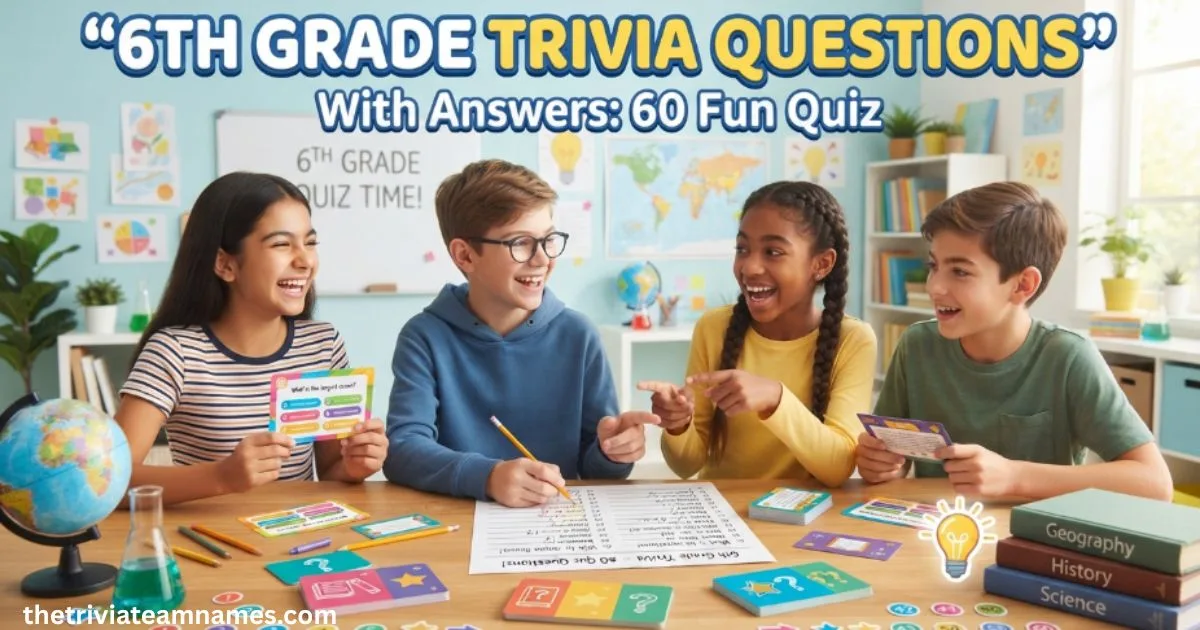
6th Grade Trivia Questions With Answers: 60 Fun Quiz
The best 6th grade trivia questions with answers combine school subjects with fun facts, giving students a chance to test knowledge without making learning feel like another assignment. This collection covers general knowledge, mathematics, science, social studies, geography, history, literature, and everyday facts in an age-appropriate format.
Sixth grade can be an exciting transition into middle school, but students can also face more challenging coursework and new expectations. A good quiz creates a lighter way to review what they know. The questions below are designed for students, parents, teachers, families, and classroom game sessions, with answers provided immediately for easy checking.
6th Grade Trivia Questions With Answers General 6th Grade Trivia Questions and Answers
General knowledge is an excellent starting point because it connects geography, science, history, language, mathematics, and everyday information. Competitor research shows that successful sixth-grade quizzes commonly use questions about continents, capitals, planets, animals, the human body, U.S. landmarks, and basic mathematical concepts.
These questions are intentionally mixed rather than arranged like a formal test. That makes them useful for a classroom warm-up, family quiz, study break, or friendly competition. Students may discover that one question they thought was difficult becomes easy simply because they remember a fact from another subject.
1. How many continents are there on Earth?
Answer: 7
The seven continents are Africa, Antarctica, Asia, Australia, Europe, North America, and South America.
2. What is the capital of Spain?
Answer: Madrid
Madrid is Spain’s capital and one of Europe’s major cultural and political centers.
3. Which city is known as the Windy City?
Answer: Chicago
Chicago is located along Lake Michigan and is the third-largest city in the United States by population as of recent census estimates.
4. What is the smallest prime number?
Answer: 2
Two is special because it is the only even prime number. Every other even number can be divided by 2.
5. How many chambers does the human heart have?
Answer: 4
The heart has two atria and two ventricles, which work together to circulate blood throughout the body.
6. Which ocean is the smallest?
Answer: Arctic Ocean
The Arctic Ocean surrounds the North Pole and is the smallest and shallowest of Earth’s five recognized oceans.
7. What did Alexander Graham Bell become famous for inventing?
Answer: The telephone
Bell is widely associated with the invention and development of the practical telephone, although the history of telephone invention involved multiple contributors.
8. What is a letter that is not a vowel called?
Answer: A consonant
In English, the five traditional vowels are A, E, I, O, and U, while the other letters are generally classified as consonants.
9. Which U.S. state contains the Grand Canyon?
Answer: Arizona
The Grand Canyon is one of the world’s most recognizable natural landmarks and is located in northern Arizona.
10. Which planet is the largest in our solar system?
Answer: Jupiter
Jupiter is the largest planet in the solar system and is a gas giant with a mass greater than all the other planets combined.
6th Grade Trivia Questions With Answers Mathematics 6th Grade Trivia Questions and Answers
Mathematics is one of the clearest areas where sixth-grade trivia can become useful academic review. Competitor coverage includes ratios, decimals, fractions, percentages, geometry, arithmetic, sequences, and square roots.
The questions below range from straightforward calculations to mathematical vocabulary. The goal is not to turn trivia into a worksheet, but to give students quick opportunities to recall concepts they are expected to understand during middle school.
11. What is 56 + 87?
Answer: 143
Adding the ones gives 13, carrying 1 ten, and then adding the tens produces a total of 143.
12. What is one-third of 60?
Answer: 20
Dividing 60 by 3 gives 20.
13. What is 8/10 written as a decimal?
Answer: 0.8
Eight-tenths equals 0.8. The fraction can also be simplified to 4/5.
14. What is the simplest form of 16/24?
Answer: 2/3
Both 16 and 24 can be divided by 8, giving 2/3.
15. What is the square root of 81?
Answer: 9
Nine multiplied by nine equals 81, so 9 is the principal square root of 81.
16. What is the bottom number of a fraction called?
Answer: Denominator
The denominator tells you how many equal parts make up the whole.
17. What is the perimeter of a circle called?
Answer: Circumference
Circumference is the distance around a circle. One common formula is C = 2πr.
18. What is the place value of 3 in 4,398?
Answer: Hundreds
The 3 represents 300 because it occupies the hundreds position.
19. What is the ratio of 500 milliliters to 2 liters?
Answer: 1:4
Two liters equals 2,000 milliliters. Therefore, 500:2,000 simplifies to 1:4. This type of unit conversion appears in sixth-grade math practice.
20. What is the mathematical term for a number divisible only by 1 and itself?
Answer: Prime number
Examples include 2, 3, 5, 7, 11, and 13.
6th Grade Trivia Questions With Answers Science 6th Grade Trivia Questions and Answers
Science provides some of the most memorable 6th grade trivia questions with answers because students can connect classroom concepts to the world around them. Competitor pages cover states of matter, rocks, forces, earthquakes, photosynthesis, evolution, chemistry, astronomy, and human biology.
A strong science trivia round should reward understanding rather than obscure memorization. Questions about planets, animals, plants, matter, weather, and the human body are particularly useful because students encounter these concepts in everyday life.
21. What gas do plants use during photosynthesis?
Answer: Carbon dioxide
Plants use carbon dioxide, water, and light energy to produce glucose during photosynthesis, releasing oxygen as a byproduct.
22. What gas do plants release during photosynthesis?
Answer: Oxygen
Oxygen is released during photosynthesis and becomes part of the atmosphere that supports aerobic life.
23. What are the three common states of matter?
Answer: Solid, liquid, and gas
Solids have a definite shape and volume, liquids have a definite volume but take the shape of their container, and gases expand to fill available space.
24. What does a petrologist study?
Answer: Rocks
Petrology is the branch of geology concerned with the origin, composition, structure, and classification of rocks.
25. What force slows a rolling ball across grass?
Answer: Friction
Friction acts between surfaces and opposes motion. Grass creates more resistance than a very smooth surface.
26. What is the process by which plants make food using light?
Answer: Photosynthesis
Photosynthesis allows plants to convert light energy into chemical energy stored in glucose.
27. Which scientist proposed the theory of evolution by natural selection?
Answer: Charles Darwin
Charles Darwin developed the theory of evolution by natural selection and published On the Origin of Species in 1859.
28. How many elements are currently recognized in the periodic table?
Answer: 118
The modern periodic table contains 118 officially recognized chemical elements.
29. What scale is traditionally associated with measuring earthquake magnitude?
Answer: Richter scale
The Richter scale is historically associated with earthquake magnitude, although modern seismology commonly uses the moment magnitude scale for significant earthquakes.
30. What scientist is famous for the theory of relativity?
Answer: Albert Einstein
Einstein developed the special and general theories of relativity, which transformed modern physics.
6th Grade Trivia Questions With Answers Social Studies 6th Grade Trivia Questions and Answers
Social studies brings history, geography, culture, government, and ancient civilizations together. Competitor research shows sixth-grade material commonly includes Ancient Egypt, Ancient China, Vikings, Rome, cultural diffusion, geography, and historical societies.
For U.S. students, these questions also provide an opportunity to connect world history with American history and geography. Rather than focusing only on dates, good social-studies trivia asks students to identify people, places, civilizations, documents, and historical developments.
31. Who issued the Emancipation Proclamation?
Answer: Abraham Lincoln
President Abraham Lincoln issued the Emancipation Proclamation in 1863 during the American Civil War.
32. Which ancient civilization built Machu Picchu?
Answer: The Inca
Machu Picchu was constructed by the Inca civilization in what is now Peru.
33. Which river is Rome traditionally associated with?
Answer: The Tiber River
The ancient city of Rome developed along the Tiber River in Italy.
34. What ancient civilization is famous for building pyramids at Giza?
Answer: Ancient Egyptians
The pyramids at Giza were built in ancient Egypt and include the Great Pyramid of Giza.
35. What was the Magna Carta?
Answer: A historic charter limiting the power of the English king
The Magna Carta was sealed by King John in 1215 and became an important historical document in the development of ideas about law and government.
36. What people from Scandinavia became known for exploration during the Viking Age?
Answer: Vikings
Viking explorers traveled widely across Europe and the North Atlantic, reaching places including Iceland, Greenland, and parts of North America.
37. What is cultural diffusion?
Answer: The spread of cultural ideas, practices, and items between societies
Food, music, language, technology, clothing, and traditions can all spread through cultural interaction.
38. Which country is home to Mount Fuji?
Answer: Japan
Mount Fuji is Japan’s highest mountain and an important cultural and geographical symbol.
39. What is the largest U.S. state by area?
Answer: Alaska
Alaska is the largest U.S. state by total area, followed by Texas.
40. Which famous document begins with “We the People”?
Answer: The U.S. Constitution
The opening words of the Constitution introduce the document’s preamble and emphasize the role of the people in establishing the government.
6th Grade Trivia Questions With Answers 6th Grade Trivia Questions
A well-rounded sixth-grade quiz can extend beyond four core subjects. EduTalkToday’s competitor page demonstrates this approach by incorporating astronomy, literature, art, world languages, chemistry, environmental science, cultural studies, ancient civilizations, and physics.
That broader mix is valuable because students have different strengths. One student may remember Shakespeare, another may know planets, and another may be excellent at geography. Trivia becomes more enjoyable when every participant gets a chance to shine.
41. Which planet is known as the Red Planet?
Answer: Mars
Mars appears reddish because iron minerals in its surface rocks and dust have oxidized, creating iron oxides.
42. Who wrote Romeo and Juliet?
Answer: William Shakespeare
Shakespeare wrote Romeo and Juliet, one of the world’s best-known tragedies.
43. Who painted the Mona Lisa?
Answer: Leonardo da Vinci
Leonardo da Vinci painted the Mona Lisa, which is displayed at the Louvre Museum in Paris.
44. What is the chemical symbol for gold?
Answer: Au
The symbol Au comes from the Latin word aurum, meaning gold.
45. What is the capital of Japan?
Answer: Tokyo
Tokyo is Japan’s capital and one of the world’s major metropolitan areas.
46. What is the smallest country in the world by area?
Answer: Vatican City
Vatican City is an independent city-state located within Rome, Italy.
47. Which ocean is the largest?
Answer: Pacific Ocean
The Pacific Ocean is the largest ocean on Earth by surface area.
48. Which famous ship sank after hitting an iceberg in 1912?
Answer: RMS Titanic
The Titanic sank in the North Atlantic Ocean during its maiden voyage in April 1912.
49. What is the main language spoken in Brazil?
Answer: Portuguese
Brazil is the largest Portuguese-speaking country in the world by population.
50. What is the hardest natural substance?
Answer: Diamond
Diamond ranks at the top of the traditional Mohs hardness scale for naturally occurring minerals.
51. Which planet is famous for its prominent ring system?
Answer: Saturn
Saturn’s spectacular rings consist primarily of ice particles mixed with rocky material.
52. What is the main ingredient in guacamole?
Answer: Avocado
Traditional guacamole commonly combines mashed avocado with ingredients such as lime, onion, cilantro, and salt.
53. What does HTTP stand for?
Answer: Hypertext Transfer Protocol
HTTP is a foundational protocol used for communication between web clients and servers.
54. What is the largest mammal on Earth?
Answer: Blue whale
The blue whale is the largest known animal ever to have lived.
55. What is the capital of France?
Answer: Paris
Paris is France’s capital and is famous for landmarks including the Eiffel Tower and Louvre Museum.
56. What is the chemical formula for water?
Answer: H₂O
Each water molecule contains two hydrogen atoms and one oxygen atom.
57. What organ pumps blood around the human body?
Answer: The heart
The heart’s chambers contract rhythmically to circulate blood through the pulmonary and systemic circulations.
58. Which natural satellite causes most of Earth’s ocean tides?
Answer: The Moon
The Moon’s gravitational pull is the primary driver of Earth’s tides, with the Sun also contributing.
59. What is the largest organ of the human body?
Answer: Skin
Skin covers and protects the body and performs important roles in sensation and temperature regulation.
60. Which branch of mathematics studies shapes, sizes, angles, and space?
Answer: Geometry
Geometry examines properties and relationships involving points, lines, angles, shapes, surfaces, and space.
Quick Score Guide
Use this simple scoring system if you’re playing with classmates, family, or a classroom group:
| Score | Result |
| 0–15 | Keep exploring! |
| 16–30 | Good start |
| 31–40 | Strong knowledge |
| 41–50 | Excellent |
| 51–56 | Outstanding |
| 57–60 | Sixth-grade trivia champion! 🏆 |
Remember that a score is only part of the fun. A missed question can actually become the most useful one if it sparks curiosity and leads to another fact.
Conclusion
The best 6th grade trivia questions with answers do more than test memory they turn learning into a small adventure. From mathematics and science to history, geography, literature, technology, and everyday facts, the 60 questions above give students plenty of opportunities to discover what they know and identify what they want to learn next.
Whether you’re a teacher preparing a classroom activity, a parent looking for an educational family game, or a student testing your own knowledge, keep the experience encouraging rather than stressful. A wrong answer is not a failure; it is often the beginning of a better question. Mix easy and challenging topics, celebrate curiosity, and let every quiz become another reason to keep learning.
FAQ Section
SERP/PAA note: The search results I could reliably access did not expose a stable Google “People Also Ask” block specifically for this exact keyword, so I am not presenting invented questions as verified PAA results. The FAQ below targets closely related questions reflected by the competing pages and the search intent.
What subjects are included in 6th grade trivia?
Common subjects include math, science, history, geography, social studies, literature, biology, chemistry, physics, astronomy, and general knowledge. The competing pages use a broad subject mix rather than limiting sixth-grade trivia to one school discipline.
Are these questions suitable for 6th graders?
Yes. The questions are designed around general sixth-grade knowledge and middle-school concepts, with a mixture of straightforward recall and slightly more challenging questions. However, exact curriculum expectations can vary between U.S. states, districts, schools, and teachers.
How can I use 6th grade trivia questions in the classroom?
Teachers can use them as bell-ringers, review activities, team competitions, exit activities, warm-ups, or informal knowledge checks. Trivia can also lead into a larger lesson when a question creates curiosity about a subject.
What are good sixth-grade math trivia questions?
Good choices include questions about fractions, ratios, decimals, percentages, geometry, square roots, arithmetic, sequences, and mathematical vocabulary. These concepts are represented strongly in competitor content.
What are good sixth-grade science trivia questions?
Useful topics include photosynthesis, states of matter, force, rocks, earthquakes, human biology, evolution, chemistry, astronomy, and environmental science. These topics appear repeatedly across the researched competitors.
Can adults play sixth-grade trivia?
Absolutely. In fact, adults often find school-level trivia surprisingly challenging because it tests basic knowledge they may not have used for years. It can work well as a family game or “Are You Smarter Than a Sixth Grader?” challenge.

Helping trivia lovers discover funny, clever, and unforgettable team names for every quiz night.