Bible Trivia Jeopardy Free Questions, Rules, Categories & Game Ideas
Bible trivia Jeopardy turns Scripture knowledge into a lively quiz game where players choose categories, answer Bible questions, and earn points according to difficulty. Whether you’re planning a church game night, Sunday school activity, youth group challenge, or family Bible quiz, the format gives ordinary Bible study a more interactive feel.
After researching current Bible Jeopardy games and trivia resources, the pattern is clear: people want more than random questions. They want usable categories, clear rules, answers they can verify, team play, scoring, and questions that work for different knowledge levels. This guide brings those pieces together in one practical Bible trivia Jeopardy resource.
What is Bible Jeopardy and Why Should You Play?
Bible Jeopardy is a Scripture-based version of the familiar category-and-points quiz format. Players select a Bible category and point value before responding to a clue. Higher-value clues generally require deeper biblical knowledge, creating a natural progression from easy Bible trivia to challenging questions.
The format works particularly well for family game nights, church groups, youth activities, Sunday school, and Bible study because players can learn while competing. Current Bible Jeopardy resources commonly use topics such as Jesus, Bible books, prophets, miracles, Exodus, Psalms, and Revelation.
A good game also creates those memorable moments when one player suddenly remembers a detail everyone else has forgotten. Someone knows the answer about David, another remembers a Gospel detail, and a difficult clue becomes a short conversation about Scripture rather than simply another point on a scoreboard.
Life Of Jesus
The life of Jesus is one of the strongest categories for Bible trivia Jeopardy because it offers familiar stories alongside deeper questions. Build clues around His birth, ministry, miracles, parables, disciples, teachings, crucifixion, resurrection, and encounters with individuals in the Gospels.
For a balanced round, begin with recognizable facts and gradually move toward details requiring closer Bible reading. This lets children or newer Bible readers participate while giving experienced players opportunities to demonstrate deeper Scripture knowledge without making every clue intimidating.
Books of the Bible
Books of the Bible make an excellent category because players can be tested on names, order, authorship traditions, themes, locations within Scripture, and memorable passages. Easy clues can ask about Genesis or Revelation, while harder clues can focus on less frequently studied books.
When writing these questions, distinguish between facts directly stated in Scripture and traditional scholarly or denominational interpretations. That small editorial distinction improves trust and prevents an otherwise enjoyable trivia round from turning into an argument over an answer that depends on interpretation.
Exodus and wilderness wandering
The Exodus and wilderness period provides a rich collection of Bible trivia material involving Moses, Pharaoh, the Israelites, the plagues, the Red Sea, manna, the Ten Commandments, Mount Sinai, the tabernacle, and the journey toward the Promised Land.
A strong Jeopardy board can move chronologically through these events, helping players connect individual questions into one larger biblical narrative. That approach makes the game feel less like memorizing isolated facts and more like revisiting a story they may remember from Bible study.
Complete the verse – Old Testament
A complete-the-verse category can test familiarity with Old Testament passages without requiring players to memorize every line perfectly. Use carefully selected passages and identify the Bible translation when wording matters, because English translations can differ.
For example, instead of treating a wording variation as automatically wrong, the host can accept equivalent wording when the intended biblical idea is unmistakable. This makes the game more welcoming and keeps the emphasis on Scripture knowledge rather than accidental differences between translations.
Prophets of God – From Isaiah to Malachi
The prophetic books provide excellent material for medium and difficult Bible trivia because they include historical settings, prophetic messages, kings, cities, warnings, promises, and memorable visions. Questions can cover Isaiah, Jeremiah, Ezekiel, Daniel, Hosea, Amos, Jonah, Micah, and the other prophetic books.
For youth groups and mixed-age teams, avoid making every prophet question dependent on obscure details. Combine recognizable figures with progressively harder clues so participants can build confidence before encountering the questions that require more extensive Bible study.
Revelation – The Apocalypse of John
Revelation can supply a challenging final category because its imagery, churches, symbols, letters, and visions require careful reading. Questions should be written precisely, particularly when discussing symbolic passages that have different interpretations among Christian traditions.
For trivia purposes, focus on facts clearly presented in the textsuch as the seven churches addressed in Revelationrather than presenting one disputed interpretation as an unquestionable answer. That approach keeps the game educational and respectful of legitimate differences in interpretation.
Bible Jeopardy How to Play (and How to Score the Most Points!)
Start by creating a board with several Bible categories and multiple point values. Current Bible Jeopardy games commonly organize clues by increasing difficulty, with higher-value questions requiring more detailed knowledge. Players or teams select a category and value before the host reveals the clue.
For team play, divide participants into balanced groups and designate one person as host or scorekeeper. After a correct response, award the appropriate points and continue with the next selection. For incorrect responses, establish the rules before beginning so every team understands whether points are deducted or another team may answer.
A Simple Bible Trivia Jeopardy Board
| Category | 100 | 200 | 300 | 400 | 500 |
| Jesus | Easy | Medium | Medium | Hard | Expert |
| Bible Books | Easy | Medium | Medium | Hard | Expert |
| Exodus | Easy | Medium | Medium | Hard | Expert |
| Old Testament Verses | Easy | Medium | Medium | Hard | Expert |
| Prophets | Easy | Medium | Hard | Hard | Expert |
| Revelation | Easy | Medium | Hard | Hard | Expert |
This six-category structure reflects the kind of topical organization currently visible in leading Bible Jeopardy resources, while the questions themselves should be original and independently checked.
Sample Bible Trivia Jeopardy Questions
100 points: What is the first book of the Bible?
Answer: Genesis.
200 points: Who led the Israelites out of Egypt?
Answer: Moses.
300 points: Which disciple famously denied knowing Jesus three times?
Answer: Peter.
400 points: Which prophet challenged the prophets of Baal on Mount Carmel?
Answer: Elijah.
500 points: Which New Testament book describes a vision involving seven churches in Asia?
Answer: Revelation.
These examples demonstrate the intended progression: recognizable Bible facts at lower values and increasingly specific knowledge at higher values.
How Team Play Changes the Experience
Team play gives Bible trivia Jeopardy an advantage over a simple question-and-answer worksheet. One person may remember a prophet, another may know the Gospel detail, and someone else may recognize a verse. The discussion itself becomes part of the learning experience.
For larger groups, teams also reduce the pressure on individual players. A participant who does not know one answer may still contribute to another category. That makes the game suitable for mixed levels of biblical familiarity rather than only experienced Bible readers.
Scoring and the Daily Double
A traditional-style game can increase point values as clues become harder. Some online Bible Jeopardy implementations also use Daily Double mechanics, allowing a player to risk points on a special clue. Mashup Math’s current game includes a Daily Double, while other digital implementations offer additional round mechanics.
If you create your own version, explain the wagering rules before the game begins. A simple house rule can work well: the player or team chooses a wager within an agreed limit, answers privately or aloud, and then receives or loses the wager according to the result.
Bible Trivia Jeopardy for Different Ages
For children, emphasize familiar Bible stories, major people, animals, places, and basic Bible-book questions. Teenagers can handle more detailed passages and character relationships, while adults or advanced study groups can tackle chronology, prophetic books, lesser-known figures, and specific textual details.
The important principle is balance. A board where every clue is extremely difficult can discourage newer players, while a board filled only with basic facts becomes boring for experienced participants. A gradual difficulty curve keeps everyone involved.
Bible Jeopardy: Tips for Doing Your Best
The best preparation is active Bible reading rather than memorizing random trivia lists. Focus on major narratives, Bible books, important people, places, teachings, parables, miracles, and recurring themes. A strong trivia game rewards broad familiarity while occasionally testing close reading.
For hosts, accuracy matters as much as entertainment. Check potentially ambiguous questions against a reliable Bible translation before publishing or using them. When wording differs between translations, mention the version being used. This prevents unnecessary disputes and gives players confidence in the answer key.
Build Categories Around Knowledge, Not Just Difficulty
A useful board combines subject categories with increasing point values. For example, “Books of the Bible” can contain simple identification questions at lower values and more specialized questions at higher values. This makes the board predictable enough to understand but varied enough to remain interesting.
Keep Questions Specific
Avoid clues with multiple possible answers. Instead of asking something vague such as “Who was a great king?”, identify the biblical context clearly enough that only one response fits.
Specific wording also makes answer verification easier. A good host should be able to open the relevant passage and explain why the accepted answer is correct. That small habit substantially improves the credibility of a Bible trivia game.
Use Scripture References When Helpful
Adding a Scripture reference after an answer can turn trivia into a miniature study activity. Players who miss a question can immediately look up the passage and discover the surrounding context.
This is particularly useful for youth groups and Bible studies. Instead of ending the learning process when someone gives the wrong answer, the host can say, “Let’s look at the passage,” transforming the missed point into an opportunity to learn.
Make the Game Welcoming
Friendly competition works best when participants feel comfortable making mistakes. Bible knowledge varies widely, and a trivia game should encourage curiosity rather than embarrass people who do not know an answer.
A warm host can celebrate correct answers while treating wrong answers as learning moments. The result is a game that feels energetic without turning Bible study into a test of who knows the most.
More Fun Jeopardy Games
Bible trivia Jeopardy can also become the starting point for other Scripture-based game formats. A group might follow a Jeopardy round with a rapid-fire Bible quiz, verse-completion activity, picture round, Bible-book challenge, or team trivia round.
Current Bible game resources demonstrate that the format can be adapted for online play, printable materials, PowerPoint-style presentations, and interactive boards. Some resources provide ready-made games, while others allow hosts to edit questions and categories for a particular group.
Original Bible Trivia Jeopardy Round
Here is a compact original round you can adapt for a family or church game:
| Points | Category | Question | Answer |
| 100 | Jesus | In which town was Jesus born? | Bethlehem |
| 200 | Bible Books | What is the final book of the New Testament? | Revelation |
| 300 | Exodus | Who received the Ten Commandments? | Moses |
| 400 | Prophets | Which prophet was swallowed by a great fish? | Jonah |
| 500 | Bible People | Who interpreted Pharaoh’s dreams in Genesis? | Joseph |
For a full event, expand each category to five clues and increase difficulty gradually. Six categories with five questions each produces a 30-clue board, a format also reflected in current Bible Jeopardy game resources.
Final Jeopardy-Style Question
For a final round, choose one question that rewards broad biblical knowledge rather than an obscure fact.
Final clue: This Old Testament leader succeeded Moses and led Israel into the Promised Land.
Correct response: Who is Joshua?
The final question should be difficult enough to create suspense but fair enough that players can reason from what they have studied.
Free Online Bible Jeopardy Options
Several current websites provide playable Bible Jeopardy experiences. Mashup Math offers an interactive board with six Bible categories and difficulty-based scoring; BibleChallenger provides a separate interactive game with 55 unique clues and 11 categories; Christianity.com provides another free Bible Jeopardy board organized around six Bible topics.
Because online games can change their question pools, categories, translations, or interfaces, hosts should review the current game before using it for an event. If a group follows a particular Bible translation or denominational curriculum, check the questions beforehand for wording and interpretation.
Why Bible Trivia Jeopardy Works for Groups
The strongest reason to use this format is that it combines recall, discussion, competition, and learning. A player remembers a detail, teammates compare memories, the host confirms the answer, and everyone moves on to the next clue.
That rhythm is what makes a good Bible game memorable. It does not replace Bible study, but it can reinforce what people have already learned and encourage them to open Scripture when a question exposes a knowledge gap.
Bible Trivia Jeopardy for Church and Family Nights
For church events, consider categories that match what the group is currently studying. A youth ministry studying the Gospels could emphasize Jesus, disciples, miracles, and parables. A family night could use easier categories covering Bible people, animals, places, and familiar stories.
The same board can often be adjusted simply by changing question difficulty. That flexibility is one reason Jeopardy-style Bible trivia works across different ages and group sizes.
What is Bible Jeopardy and Why Should You Play?
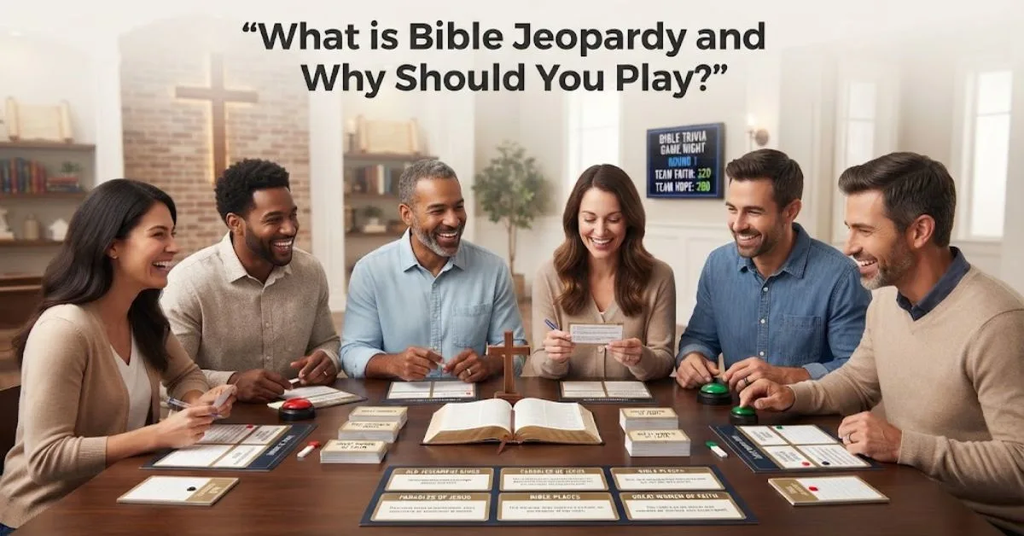
A well-designed Bible trivia Jeopardy game can do something a normal worksheet cannot: it creates conversation. One clue may remind a player of a Sunday school lesson, while another sends the whole team back to a familiar Bible story. That combination of competition, memory, Scripture, and laughter makes the format especially engaging.
The game can also be adjusted to suit almost any audience. A family can use simple Bible facts, a youth group can introduce medium-level questions, and an experienced Bible study group can work through challenging passages. The underlying format stays familiar while the content changes according to the players’ knowledge.
Making Bible Trivia Jeopardy More Interactive
Instead of having players simply shout answers, the host can create a more structured experience. Teams can discuss clues quietly, write responses on small cards, or use a scoreboard. A short time limit keeps the pace moving and prevents one difficult question from slowing the entire game.
Another useful approach is to mix straightforward knowledge with questions requiring connections between biblical people, places, and events. For example, a question about Moses can connect to Egypt, the Exodus, Pharaoh, Mount Sinai, and the Ten Commandments. Those connections reinforce knowledge rather than testing isolated memorization.
Creating a Balanced Game Board
A strong board should contain a mixture of easy, moderate, and challenging clues. If every question is obscure, new players may quickly disengage. If every clue is obvious, experienced players may lose interest. Increasing point values can communicate difficulty while giving teams a reason to attempt harder categories.
Hosts should also avoid making the highest-value questions unnecessarily obscure. A difficult question should ideally test meaningful Bible knowledge rather than an insignificant detail that most readers could only know through memorization of a trivia list.
Bible Jeopardy How to Play (and How to Score the Most Points!)
Before beginning, explain the complete rules so every team understands how points, incorrect answers, turns, and special clues will work. A simple setup might use six categories with five clues each. Teams choose a category and point value, hear the clue, and submit or announce an answer.
For a classroom, church, or family event, the host can keep a visible scoreboard. This gives players a clear sense of progress and makes the competition exciting without requiring complicated equipment. Online Bible Jeopardy games demonstrate that the same basic category-and-value structure can also work digitally.
A 30-Question Bible Trivia Jeopardy Format
| Round | Number of Categories | Questions Per Category | Total Questions |
| Main Round | 6 | 5 | 30 |
| Bonus Round | 1 | 5 | 5 |
| Final Round | 1 | 1 | 1 |
| Total | 36 |
This format gives a host enough material for a substantial game while leaving room for discussion, Scripture references, and occasional bonus questions.
Easy Bible Trivia Questions
Question: Who built the ark?
Answer: Noah.
Question: Who was the mother of Jesus?
Answer: Mary.
Question: What is the first book of the Bible?
Answer: Genesis.
Question: Who led the Israelites out of Egypt?
Answer: Moses.
Question: What is the final book of the New Testament?
Answer: Revelation.
These questions are useful as opening clues because players can enter the game confidently. They also work well for children, new Bible readers, and mixed-age family groups.
Medium Bible Trivia Questions
Question: Which judge of Israel was known for extraordinary strength?
Answer: Samson.
Question: Which prophet confronted the prophets of Baal on Mount Carmel?
Answer: Elijah.
Question: Who interpreted Pharaoh’s dreams in Genesis?
Answer: Joseph.
Question: Which Gospel begins with a genealogy connecting Jesus to earlier biblical figures?
Answer: Matthew.
Question: Which disciple was known for initially doubting Jesus’ resurrection?
Answer: Thomas.
Medium questions create the middle layer of the game. They are familiar enough to be solvable but require more detailed Bible knowledge than basic identification questions.
Difficult Bible Trivia Questions
The hardest clues should reward careful Bible study. They can involve less frequently discussed people, historical settings, specific passages, relationships between events, or details found in particular books.
For example, rather than asking an obscure question simply to make the game difficult, connect the clue to a meaningful biblical narrative. A difficult question about a prophet, king, or New Testament figure becomes more satisfying when players understand why the answer matters.
Handling Incorrect Answers
Decide before the game whether an incorrect response loses points, ends the team’s turn, or allows another team to answer. Different groups may prefer different systems.
For younger players, avoiding harsh penalties can keep the activity encouraging. For competitive adult groups, negative scoring can create additional strategy. The important point is consistency: explain the rule once and apply it equally throughout the game.
Bible Jeopardy Tips for Doing Your Best
Preparation does not have to mean studying hundreds of random facts. Players can improve by reviewing the major biblical narratives and understanding how important people, places, books, and events connect.
A useful study approach is to review the Bible by broad sections: creation and early Genesis, patriarchs, Exodus, Israel’s kings, prophets, the life and ministry of Jesus, Acts, the letters, and Revelation. This gives players a framework that helps them recall individual facts during the game.
Study the Big Stories First
Players should begin with major narratives before focusing on obscure details. Creation, Noah, Abraham, Joseph, Moses, David, Solomon, the prophets, Jesus’ ministry, the apostles, Paul’s journeys, and Revelation provide a broad foundation.
Once those stories are familiar, smaller details become easier to remember because they have somewhere to fit. This is especially helpful for younger participants who may find a long list of disconnected facts overwhelming.
Connect People With Events
A useful memory technique is to associate every major biblical person with several connected facts. Moses connects with Egypt, Pharaoh, the Exodus, Sinai, and the Ten Commandments. David connects with Goliath, Saul, Jerusalem, kingship, and the Psalms.
This relational approach mirrors the way a knowledge graph works: people are connected to events, places, books, and themes. It can make Bible trivia preparation more meaningful than memorizing isolated answers.
Watch for Similar Names
Bible trivia sometimes becomes difficult because several people have similar or repeated names. A carefully written clue should provide enough context to distinguish them.
For example, identifying the book, historical period, relationship, or event associated with a person can prevent ambiguity. Hosts should review questions before the game and make sure the intended answer is genuinely identifiable from the clue.
More Fun Jeopardy Games
Once players enjoy Bible trivia Jeopardy, the same concept can inspire additional themed rounds. A group might create a Jesus-focused board, an Old Testament challenge, a New Testament round, a Bible-books competition, or a rapid-fire Scripture quiz.
These variations can also help a recurring Bible study avoid becoming repetitive. Each meeting can introduce a different theme while preserving familiar gameplay, scoring, and team mechanics.
Bible People Challenge
Create categories around major biblical figures and ask players to identify the person from several clues. For example, a clue might mention a person’s family, occupation, major event, and biblical book without immediately revealing the name.
This format encourages players to connect multiple facts. It can also create excellent team discussions because different players may recognize different parts of the clue.
Bible Places Challenge
A geography-focused round can feature Egypt, Jerusalem, Bethlehem, Nazareth, Galilee, the Jordan River, Mount Sinai, and other significant biblical locations.
Where appropriate, maps can make this round more visual. Players can identify a location from a description, connect a biblical event to a place, or determine which person or story is associated with a particular location.
Bible Books Challenge
A Bible-books round can test order, classification, themes, and recognition. Beginners might identify whether a book belongs to the Old or New Testament, while advanced players might identify a book from a description of its central themes.
This category works particularly well for church groups because it can encourage participants to become more comfortable navigating Scripture.
Bible Trivia Jeopardy for Youth Groups
Youth groups can use shorter rounds, team discussion, and visual clues to keep the game moving. Questions should cover material participants are likely to have encountered while gradually introducing more challenging Scripture knowledge.
A youth leader can also connect the trivia game to the group’s current Bible-study lesson. That creates a natural bridge between entertainment and learning instead of treating the quiz as a completely separate activity.
Bible Trivia Jeopardy for Family Game Night
Family games work best when several generations can contribute. Include easy clues that younger players can answer alongside medium and challenging questions that give adults an opportunity to participate.
One simple approach is to create mixed teams rather than separating players by age. A child may know a familiar story while a parent remembers a specific detail. That shared knowledge can make the game feel cooperative even when teams are competing.
Bible Trivia Jeopardy for Sunday School
Sunday school teachers can use trivia as a review activity after completing a lesson or Bible unit. Questions can reinforce names, events, Scripture references, vocabulary, and major themes already introduced during class.
Keep the focus on learning rather than simply identifying the winning team. After a difficult clue, briefly explain the answer or read the relevant passage. That turns each question into a small teaching opportunity.
Bible Trivia Jeopardy for Bible Study Groups
Adult Bible study groups can use more advanced questions that encourage participants to look closely at the text. Questions can focus on context, chronology, biblical characters, passages, and relationships between books.
When an answer is disputed, the best response is to return to the relevant passage and examine the wording together. This keeps the atmosphere thoughtful and prevents trivia from becoming an argument over personal assumptions.
Extended Bible Trivia Jeopardy Question Bank
Here is another original set that can be incorporated into a larger game.
| Category | Question | Answer |
| Jesus | In which river was Jesus baptized? | Jordan River |
| Genesis | Who was Isaac’s wife? | Rebekah |
| Exodus | What food appeared for the Israelites in the wilderness? | Manna |
| Kings | Who became king after Saul? | David |
| Prophets | Which prophet was sent to Nineveh? | Jonah |
| Gospels | Who baptized Jesus? | John the Baptist |
| Apostles | Which disciple was a tax collector before following Jesus? | Matthew |
| Acts | Who was known for persecuting early Christians before his conversion? | Saul/Paul |
| Bible Books | Which book follows the four Gospels? | Acts |
| Revelation | How many churches receive messages in Revelation? | Seven |
These questions cover multiple areas of Scripture so that one category does not dominate the entire game. For publication, every answer should still be checked against the chosen Bible translation and the precise wording of the question.
Building an Excellent Bible Trivia Jeopardy Experience
The strongest game is not necessarily the one with the most questions. It is the one where players understand the rules, questions are accurate, difficulty feels fair, categories are varied, and the host keeps the pace comfortable.
Think about the atmosphere as much as the scoreboard. A church hall, living room, classroom, or youth room can become a lively game environment with nothing more complicated than a board, questions, teams, paper, and a person willing to host.
A memorable game often includes moments that have nothing to do with winning. Someone confidently gives the wrong answer, an entire team suddenly remembers a verse, or a difficult clue sparks a discussion about a Bible story. Those moments are part of what makes trivia enjoyable.
Conclusion
Bible trivia Jeopardy works because it brings together something people already enjoyfriendly competition with something many groups want to reinforce: Bible knowledge. A well-built board can move from simple questions about familiar stories to challenging clues about prophets, Scripture passages, Jesus, Revelation, and lesser-known biblical details.
The strongest version is not simply a collection of random questions. It has clear categories, carefully checked answers, balanced difficulty, transparent scoring, and a format that encourages players to learn from questions they miss. Whether you’re preparing a family game night, church event, youth activity, or Bible study review, that combination can turn an ordinary quiz into a memorable Scripture-focused experience.
FAQs
What is Bible trivia Jeopardy?
Bible trivia Jeopardy is a Bible-themed quiz format where players select categories and point values before answering Scripture-based clues. It can be played individually or in teams and adapted for families, churches, youth groups, Sunday school, and Bible study gatherings.
How do you play Bible Jeopardy?
Create several Bible categories with different point values, divide players into teams or individuals, and let players select a clue. The host reads the clue, awards points for correct answers, and applies whatever incorrect-answer rules were agreed upon before the game.
Can Bible Jeopardy be played online?
Yes. Current Bible Jeopardy resources include interactive online boards that allow players to select clues and track scores. Mashup Math and BibleChallenger are examples of currently available online Bible Jeopardy experiences.
What Bible categories work well for Jeopardy?
Popular categories include the life of Jesus, Books of the Bible, Exodus, Old Testament verses, prophets, Revelation, miracles, parables, Bible people, and biblical places. Current Bible Jeopardy boards use several of these themes.
How many questions should a Bible Jeopardy game have?
A practical full board can contain 25–30 clues, depending on the number of categories. A six-category board with five questions per category provides 30 clues and gives hosts enough material for a substantial group game.
Can children play Bible trivia Jeopardy?
Yes. Use simpler Bible stories, people, animals, books, and familiar events for younger players. More advanced groups can receive harder questions involving prophets, chronology, specific passages, and less commonly studied biblical figures.
Should Bible Jeopardy questions include Bible verses?
Including Scripture references is useful when the question depends on a particular passage. References also let players verify answers and turn a missed trivia question into a short Bible-study opportunity.
What Bible translation should a Jeopardy game use?
There is no single translation required for every Bible trivia game. However, the host should identify the translation when exact wording matters. BibleChallenger, for example, currently states that its quiz uses the New King James Version.

Helping trivia lovers discover funny, clever, and unforgettable team names for every quiz night.