100+ Trivia for 7 Year Olds Fun Questions and Answers
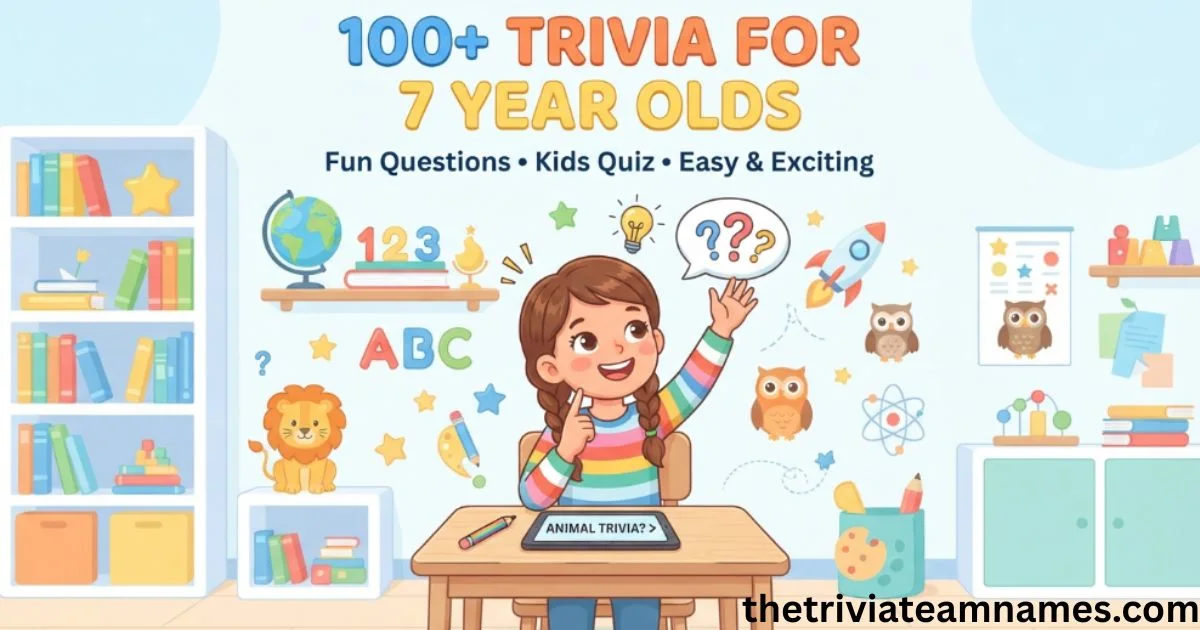
Trivia for 7 year olds works best when questions feel like a game rather than a test. This collection mixes kids trivia, general knowledge, animals, science, math, space, history, movies, and games so children can answer familiar questions while discovering something new. The goal is simple: encourage curiosity without making learning feel like homework.
After creating and reviewing age-focused quiz content, I’ve found that seven-year-olds respond especially well to short questions, clear answers, fun facts, confidence-building challenges, and familiar subjects. Whether you’re a parent planning family game night or a teacher looking for an engaging classroom activity, these questions give you an easy starting point for learning, laughter, and friendly competition.
Animals trivia for kids
Animals are a natural starting point for trivia because seven-year-olds usually have strong connections with pets, wildlife, zoo animals, and creatures they see in books or videos. These animal questions, kids quizzes, nature facts, and wildlife trivia range from very easy to mildly challenging.
Try letting children answer before revealing the solution. That tiny pause makes a big difference: instead of simply reading facts, they begin making predictions, remembering experiences, and explaining what they know. This makes animal trivia, science learning, animal facts, and family games feel much more interactive.
- What animal is known as man’s best friend?
Answer: Dog. - How many legs does a spider have?
Answer: Eight. - What is a baby cat called?
Answer: A kitten. - Which animal has a long trunk?
Answer: Elephant. - What animal says “moo”?
Answer: Cow. - Which bird cannot fly and lives in Antarctica?
Answer: Penguin. - What is the largest animal on Earth?
Answer: Blue whale. - Which animal is famous for black-and-white stripes?
Answer: Zebra. - What do caterpillars turn into?
Answer: Butterflies or moths. - Which animal is known for carrying its baby in a pouch?
Answer: Kangaroo.
General Knowledge trivia for kids
General knowledge gives a seven-year-old the exciting feeling of knowing a little bit about everything. This section combines geography, everyday facts, famous places, numbers, food, nature, and common knowledge rather than focusing on one school subject.
Some children will know an answer immediately; others may discover it for the first time. That’s exactly what makes general knowledge questions valuable. A missed answer isn’t a failure—it becomes a new fact that may stick because the child encountered it during a playful quiz, family challenge, learning activity, or conversation.
- How many days are in a week?
Answer: Seven. - What planet do we live on?
Answer: Earth. - How many colors are traditionally named in a rainbow?
Answer: Seven. - What is the capital of the United States?
Answer: Washington, D.C. - How many months are in a year?
Answer: Twelve. - What is the largest ocean on Earth?
Answer: Pacific Ocean. - How many sides does a triangle have?
Answer: Three. - What do bees make from nectar?
Answer: Honey. - Which season usually follows summer in the United States?
Answer: Fall, or autumn. - What do we use to tell time?
Answer: A clock or watch.
Science trivia for kids
Science trivia turns ordinary things into little mysteries. Plants, weather, the human body, matter, gravity, animals, Earth science, and scientific observations give seven-year-olds plenty of opportunities to connect questions with the world around them.
The best questions at this age don’t require advanced vocabulary. They invite children to notice something familiar and explain it. Why does ice melt? Why do plants need sunlight? What makes rain? Those connections help science facts, experiments, curiosity, and classroom learning feel meaningful.
- What gas do humans need to breathe?
Answer: Oxygen. - What force pulls objects toward Earth?
Answer: Gravity. - What is frozen water called?
Answer: Ice. - What instrument measures temperature?
Answer: Thermometer. - What organ pumps blood around your body?
Answer: Heart. - What part of a plant usually absorbs water from the soil?
Answer: Roots. - What do plants use sunlight to help make?
Answer: Food. - What happens when water gets cold enough to become solid?
Answer: It freezes. - What body part helps you smell?
Answer: Nose. - What do fish use to breathe underwater?
Answer: Gills.
Space trivia for kids
Space is almost tailor-made for seven-year-old curiosity. The Sun, Moon, planets, stars, Earth, solar system, astronauts, and space exploration provide questions that feel enormous while remaining understandable.
Children often remember space facts because they can picture them. Asking whether the Sun is a star or which planet is called the Red Planet can quickly turn into a conversation about the night sky. That makes space trivia, astronomy, planets, and science questions excellent choices for home or school.
- What star is at the center of our solar system?
Answer: The Sun. - Which planet is called the Red Planet?
Answer: Mars. - What is Earth’s natural satellite?
Answer: The Moon. - Which planet is the largest in our solar system?
Answer: Jupiter. - Which planet is famous for its large rings?
Answer: Saturn. - How many planets are in our solar system?
Answer: Eight. - What do we call a person who travels into space?
Answer: Astronaut. - What is the name of our galaxy?
Answer: The Milky Way. - Is the Sun a star or a planet?
Answer: A star. - What planet is closest to the Sun?
Answer: Mercury.
History trivia for kids
History questions introduce children to famous people, inventions, landmarks, presidents, important events, and the stories behind places they may already recognize. For seven-year-olds, short factual questions work particularly well because they provide a doorway into larger stories.
Instead of treating history as a list of dates, use these questions as conversation starters. After answering one, ask a child what they would have seen, eaten, built, or experienced during that time. Suddenly history trivia, American history, famous people, and historical landmarks become imaginative.
- Who was the first president of the United States?
Answer: George Washington. - Who was the 16th president of the United States?
Answer: Abraham Lincoln. - What famous American landmark is in New York Harbor?
Answer: The Statue of Liberty. - Who was known for the “I Have a Dream” speech?
Answer: Martin Luther King Jr. - What document begins with “We the People”?
Answer: The U.S. Constitution. - Who was the first person to walk on the Moon?
Answer: Neil Armstrong. - Which ancient people built the pyramids at Giza?
Answer: Ancient Egyptians. - What famous ship sank in 1912 after hitting an iceberg?
Answer: Titanic. - Who painted the Mona Lisa?
Answer: Leonardo da Vinci. - What famous structure stands in Paris and was built for the 1889 World’s Fair?
Answer: The Eiffel Tower.
Maths trivia for kids
Math questions can be playful when they use numbers, shapes, multiplication, division, patterns, measurement, time, and simple problem solving. At seven, children benefit from seeing mathematics outside worksheets for example, figuring out how many slices are left or how many minutes remain.
Keep the numbers manageable and celebrate the reasoning as much as the answer. A child who explains how they reached a solution is practicing mathematical thinking, not simply memorizing a fact. That’s why math trivia, number games, mental math, and logic questions work well together.
- What is 5 + 5?
Answer: 10. - What is 10 − 3?
Answer: 7. - What is 2 × 6?
Answer: 12. - What is 20 ÷ 4?
Answer: 5. - How many sides does a square have?
Answer: Four. - How many sides does a hexagon have?
Answer: Six. - How many minutes are in one hour?
Answer: 60. - How many inches are in one foot?
Answer: 12. - What number comes next: 2, 4, 6, 8,?
Answer: 10. - If you have 3 groups of 4 apples, how many apples do you have?
Answer: 12.
Language trivia for kids
Language questions make reading and wordplay feel like a puzzle. Vocabulary, spelling, synonyms, antonyms, punctuation, sentence structure, and word meanings are useful areas for children who are developing stronger reading and writing skills.
Try asking the question aloud before showing the answer. Seven-year-olds often enjoy discovering that words can have several meanings or that two different words can mean almost the same thing. This turns language trivia, vocabulary games, reading practice, and wordplay into an enjoyable challenge.
- What is the opposite of “hot”?
Answer: Cold. - What is a word that means the same or nearly the same as another word called?
Answer: Synonym. - What is a word with the opposite meaning called?
Answer: Antonym. - What punctuation mark ends a question?
Answer: Question mark. - What punctuation mark shows strong excitement?
Answer: Exclamation point. - What is the plural of “child”?
Answer: Children. - What is the opposite of “up”?
Answer: Down. - What do we call a word that names a person, place, animal, or thing?
Answer: Noun. - What do we call an action word?
Answer: Verb. - What is the past tense of “run”?
Answer: Ran.
Games trivia for kids
Games are familiar territory for many seven-year-olds, so board games, card games, playground games, video games, puzzles, and game rules make excellent trivia subjects.
These questions can also create a nice transition between academic rounds. After several science or math questions, a child may suddenly light up when the subject changes to something they play at home. That emotional shift is useful: games, fun facts, entertainment, family activities, and quiz rounds should feel varied rather than repetitive.
- In chess, which piece can move in an L shape?
Answer: Knight. - How many suits are in a standard deck of playing cards?
Answer: Four. - What color are Mario’s classic overalls?
Answer: Blue. - What game uses a board with squares and pieces including kings and queens?
Answer: Chess. - What game involves knocking down pins with a heavy ball?
Answer: Bowling. - What game uses a racket and a ball over a net?
Answer: Tennis. - In Jenga, what are players trying not to do?
Answer: Knock over the tower. - What game uses numbered cards and colors and includes cards such as Skip and Reverse?
Answer: UNO. - What game involves jumping over a rope repeatedly?
Answer: Jump rope. - What do you call the person who leads or runs a quiz game?
Answer: Quizmaster or host.
Movies / TV trivia for kids
Movies and television can make a quiz feel instantly familiar. Animated movies, children’s shows, cartoon characters, fictional characters, and family entertainment provide memorable questions that children can often answer from personal experience.
The trick is to keep screen-based questions balanced with educational subjects. A strong children’s quiz shouldn’t become only a pop-culture test. Mixing movies, TV, science, animals, history, and geography gives different children different opportunities to shine.
- What is the name of the cowboy in Toy Story?
Answer: Woody. - What is the name of Woody’s space-ranger friend?
Answer: Buzz Lightyear. - What is the name of the snowman in Frozen?
Answer: Olaf. - What is the name of Simba’s father in The Lion King?
Answer: Mufasa. - What kind of animal is Mickey Mouse?
Answer: Mouse. - What is SpongeBob’s pet snail called?
Answer: Gary. - What is the name of the young lion in The Lion King?
Answer: Simba. - What is the name of the little mermaid in Disney’s The Little Mermaid?
Answer: Ariel. - What kind of animal is Nemo?
Answer: Clownfish. - What color is Elmo from Sesame Street?
Answer: Red.
Music trivia for kids
Music adds another kind of memory to a children’s quiz. Songs, instruments, rhythm, famous performers, musical sounds, and children’s rhymes give children opportunities to answer through recognition rather than textbook knowledge.
You can make these questions more interactive by humming a tune, clapping a rhythm, or showing pictures of instruments. That small change transforms ordinary music trivia, children’s songs, instruments, rhythm games, and family entertainment into an activity involving listening as well as memory.
- Which instrument has black and white keys?
Answer: Piano. - Which instrument usually has six strings and is commonly strummed?
Answer: Guitar. - What instrument is commonly played by hitting it with sticks?
Answer: Drums. - What do singers use to make music with their voices?
Answer: Singing. - How many strings does a standard violin have?
Answer: Four. - What do we call the steady beat in music?
Answer: Rhythm. - Which family of instruments includes the trumpet?
Answer: Brass. - Which instrument is commonly associated with a bow and four strings?
Answer: Violin. - What do we call a person who writes music?
Answer: Composer. - What do people often clap along with in a song?
Answer: The beat.
General Knowledge Questions for Kids: Easy Mode
An easy round is important because confidence changes the entire mood of a children’s quiz. The first few questions should let a seven-year-old experience quick wins before the difficulty increases. Current kids’ quiz resources similarly emphasize approachable questions and confidence-building rather than making every question a head-scratcher.
Start with familiar animals, colors, numbers, body parts, food, weather, school, and everyday objects. Once children realize they can answer successfully, they’re more willing to attempt unfamiliar questions later. That’s particularly helpful for family groups where children may have different strengths.
- What color is grass usually?
Answer: Green. - How many legs does a dog have?
Answer: Four. - What do you drink when you are thirsty?
Answer: Water. - What color is a ripe banana usually?
Answer: Yellow. - How many fingers are on one hand?
Answer: Five. - What do cows give us that people commonly drink?
Answer: Milk. - What do you wear on your feet?
Answer: Shoes or socks. - What season comes after winter?
Answer: Spring. - What animal says “woof”?
Answer: Dog. - What do you use to erase pencil marks?
Answer: An eraser.
Common Knowledge Trivia Questions for Kids: Advanced Level
Once a child is comfortable with easy questions, add a few that require memory, comparison, vocabulary, or simple reasoning. “Advanced” for a seven-year-old should not mean adult-level trivia; it should mean one extra step of thinking.
For example, instead of asking what planet we live on, ask which planet is known as the Red Planet. Instead of asking how many sides a square has, ask how many sides two squares have altogether. The goal is challenge without frustration.
- Which planet is known as the Red Planet?
Answer: Mars. - Which is larger: an elephant or a mouse?
Answer: Elephant. - What is the capital of France?
Answer: Paris. - Which ocean is the largest?
Answer: Pacific Ocean. - What is half of 20?
Answer: 10. - What comes next: 5, 10, 15, 20,?
Answer: 25. - Which is a mammal: shark, dolphin, or trout?
Answer: Dolphin. - What do we call molten rock after it reaches Earth’s surface?
Answer: Lava. - Which continent is the United States located in?
Answer: North America. - What is the name of the process plants use to make food using light?
Answer: Photosynthesis.
How to Use These Questions With a 7-Year-Old
For the best experience, don’t rush through all 120 questions in one sitting. A short round of 10–20 questions usually gives children enough variety without making the activity feel like homework.
Try three simple rounds:
| Round | Questions | Difficulty |
| Warm-up | 1–10 | Easy |
| Challenge | 11–20 | Medium |
| Final round | 21–30 | Mixed |
You can award one point for a correct answer and an optional bonus point when a child explains how they knew it. For a family game, let children take turns being the quizmaster. For classrooms, split students into small teams so a child who isn’t confident in one subject can contribute another way.
The most important rule is simple: keep the atmosphere positive. A seven-year-old should finish a trivia game feeling curious and proud, not worried about getting every answer right.
Conclusion
Trivia for 7 year olds can be much more than a list of questions and answers. When you combine animals, science, space, math, history, language, games, movies, and music, children get opportunities to use memory, reasoning, curiosity, and conversation in a relaxed setting. The best questions create a small moment of discovery: “I knew that!” or “I didn’t know that!”
Whether you’re preparing a classroom activity, planning family game night, filling a rainy afternoon, or simply looking for a screen-free learning idea, these questions give you plenty of ways to start. Keep the first round easy, increase the challenge gradually, celebrate effort, and let children explain their answers. At seven, learning sticks especially well when it feels like play.
FAQ Section
What are good trivia questions for a 7-year-old?
Good questions for a seven-year-old are short, understandable, age-appropriate, and interesting. Strong topics include animals, science, space, math, geography, history, language, games, movies, music, and everyday knowledge.
How hard should trivia be for a 7-year-old?
Start with easy questions and gradually introduce questions requiring one extra step of reasoning. A good quiz should contain enough familiar questions to build confidence while including a few challenges that encourage children to think.
What topics do 7-year-olds enjoy for trivia?
Popular topics include animals, dinosaurs, space, superheroes, cartoons, movies, video games, sports, science, geography, food, and general knowledge. Children’s individual interests matter, so a mixed-category quiz usually works well.
Is trivia educational for children?
Yes. Trivia can reinforce factual knowledge, vocabulary, memory, reading comprehension, and simple reasoning. It can also encourage children to ask follow-up questions and explore subjects they find interesting.
How many trivia questions should I ask a 7-year-old?
For a short activity, 10–20 questions is a comfortable starting point. For a classroom or family game, you can use several short rounds rather than asking all the questions continuously.
Can I use these questions in a classroom?
Yes. Teachers can use them as warm-ups, review activities, team competitions, early-finisher activities, or informal knowledge checks. The format can also be converted into multiple-choice questions.
What if my child gets many questions wrong?
Keep the tone positive and treat incorrect answers as discoveries. Give hints, explain the answer briefly, and move to a question the child is more likely to know. The goal is curiosity and confidence not a perfect score.
Can these questions be used for family game night?
Absolutely. Family trivia works especially well when children and adults answer together. Give younger players age-appropriate questions while allowing adults to answer more challenging bonus questions.

Helping trivia lovers discover funny, clever, and unforgettable team names for every quiz night.