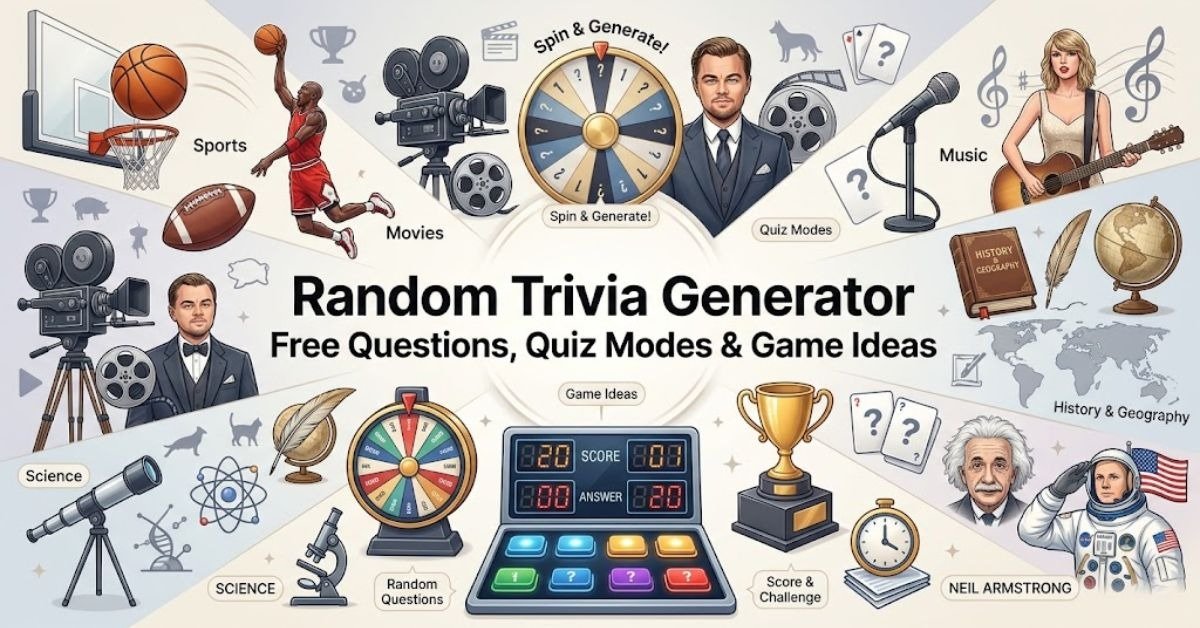
Random Trivia Generator Free Questions, Quiz Modes & Game Ideas
A random trivia generator gives you an instant question without the usual scramble to find a quiz, choose a category, or write answers yourself. Whether you’re looking for general knowledge, history, science, sports, movies, music, geography, or funny facts, the right generator turns a quiet moment into a quick challenge.
The best experience goes beyond randomness. A useful trivia tool should offer clear questions, reliable answers, sensible difficulty, category controls, and flexible ways to play. From a solo knowledge check to a family game night or classroom activity, a well-designed generator can remove preparation stress while keeping the fun of guessing, revealing, learning, and moving to the next question.
How the random trivia generator works
A random trivia generator typically selects a question from a question bank or library, displays it without immediately revealing the answer, and lets you make a guess before checking the result. Depending on the tool, you may also choose categories, difficulty, question format, scoring, or a host mode.
That simple sequencegenerate, think, answer, reveal, repeatis what makes trivia generators useful. You don’t need to prepare a complete quiz before starting. A category such as history or science can create a focused round, while an all-category setting creates the surprise and variety many players expect from general knowledge trivia.
Pick your questions
The first decision is usually whether you want a completely mixed question pool or a specific trivia category. A mixed pool can jump from geography to entertainment to science, while a focused category makes more sense for a themed quiz, classroom review, sports gathering, or movie night.
A good question selection process also considers difficulty. Easy questions create momentum, medium questions keep most players involved, and harder questions provide the satisfying moments when nobody at the table immediately knows the answer. The best rounds usually balance these levels rather than making every question equally difficult.
Make it yours in the editor
A generator becomes more useful when you can turn a random question into part of a larger quiz. Editing lets a host remove questions that don’t fit the audience, change wording, organize rounds, adjust scoring, or add explanations without rebuilding everything from scratch.
This matters because a question that works for a solo player may not work equally well for a classroom or family group. Audience knowledge, age, interests, available time, and question difficulty all influence the experience. A flexible quiz editor gives the host room to make those practical adjustments.
Share and score
Once your questions are selected, sharing and scoring determine whether the experience feels like a real game. Digital quizzes can use links, screens, or individual devices, while traditional trivia can simply involve one host reading questions aloud and teams recording their answers.
Scoring adds another layer of motivation. A simple point system is often enough: one point for each correct answer, with optional bonus questions or a final tiebreaker. For larger groups, an automatic leaderboard can save the host from spending the entire evening checking answer sheets.
Filter by categories
Category filtering is one of the most useful controls in a trivia generator because “random” does not always mean “anything imaginable.” A category filter lets you narrow the question pool to subjects such as history, geography, science, entertainment, sports, food, movies, music, or general knowledge.
Leaving the category broad is ideal when you want surprise. Narrowing it is better when you’re preparing a themed round. Imagine hosting a basketball watch party: a sports filter gives you relevant questions immediately, while an all-category generator might suddenly jump from NBA history to chemistry.
What is in the question library
The quality of a generator depends heavily on its underlying question library. A large database sounds impressive, but quantity alone does not guarantee a good trivia experience. Questions should be understandable, answers should be defensible, and the collection should contain enough variety to avoid repetitive rounds.
A strong library also benefits from different difficulty levels and subject areas. General knowledge might include geography, history, science, culture, entertainment, sports, and everyday facts. A broad semantic range makes random selection feel genuinely unpredictable while still keeping questions recognizable enough to be playable.
Easy Trivia Questions and Answers
Easy trivia questions are useful for opening a round because they help players settle in before the difficulty rises. Familiar subjects such as basic geography, popular culture, common science facts, famous landmarks, and widely known historical events can create early confidence without making the game feel effortless.
For example, an opening question might ask which planet is known as the Red Planet. Most players who know basic astronomy will recognize Mars quickly. The point of an easy question is not to embarrass anyone; it is to establish rhythm, encourage participation, and get the room engaged.
Funny Trivia Questions and Answers
Funny trivia works because the reaction matters almost as much as the score. Strange animal facts, unusual historical events, surprising language details, and unexpected cultural facts can produce the memorable “wait, really?” moment that ordinary questions sometimes lack.
The strongest funny questions still need a reliable answer. Humor should come from the fact itself or the way the question is presented, not from confusing wording. When players laugh and learn something at the same time, the question becomes easier to remember and more likely to be shared later.
Weird Trivia Questions
Weird trivia is especially effective when the audience already knows the basics and wants something less predictable. Unusual biology, obscure historical details, strange inventions, rare natural phenomena, and surprising everyday facts can transform a standard general-knowledge round into a curiosity-driven challenge.
The important distinction is between “weird” and “made-up.” A bizarre fact may sound unbelievable, but the host should still be able to verify the answer. When a question has a credible explanation behind it, the reveal becomes part of the entertainment rather than simply a surprising claim.
Obscure and Hard Trivia Questions
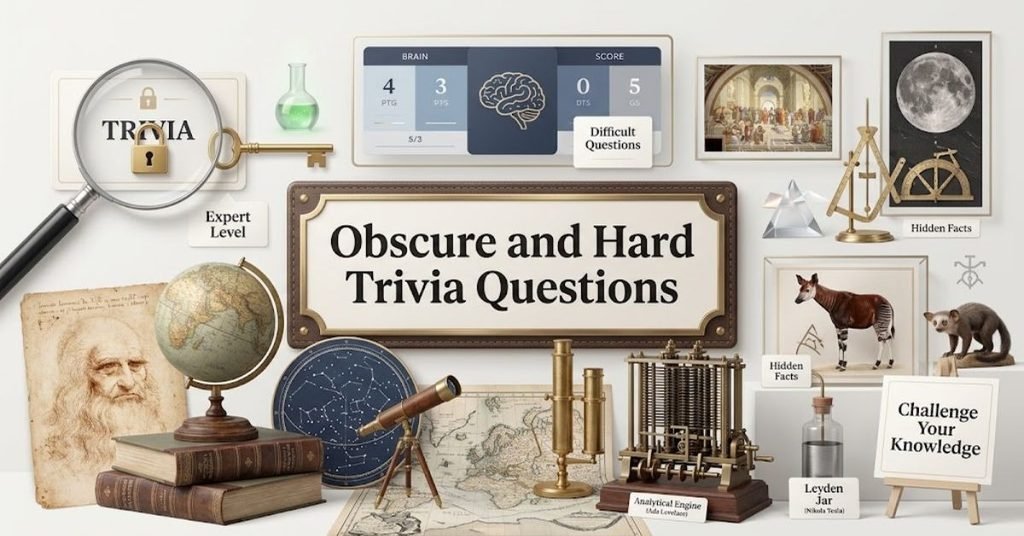
Hard trivia should test knowledge without becoming arbitrary. The difference is important: an obscure question can be difficult because the information is rarely encountered, while a good hard question can also reward careful reasoning, cultural knowledge, historical awareness, or connections between familiar facts.
For advanced players, difficult rounds can focus on lesser-known people, historical dates, scientific terminology, international geography, literature, or specialized sports records. Difficulty works best when players feel that the answer was discoverable rather than impossible.
Bar Trivia Questions and Answers
Bar-style trivia usually works best when categories are mixed and the pacing stays lively. A round might move from sports to music, then history, geography, movies, science, and current culture. That variety gives different players opportunities to contribute instead of allowing one specialist to dominate every question.
A practical round can contain roughly ten questions, with enough time for teams to discuss each answer. Hosts should keep wording concise, repeat important names when necessary, and reveal answers clearly. The goal is a social experience where the room stays engaged between questions.
General Knowledge Trivia Questions
General knowledge is the natural home of a random question generator because it supports broad subject coverage. Instead of staying inside one fandom or academic field, questions can move across science, history, geography, sports, entertainment, literature, technology, food, and world culture.
The advantage is unpredictability. You might know the answer to a geography question but miss the next sports question. Someone else may have the opposite experience. That uneven distribution of knowledge is what makes general trivia work particularly well for groups with different interests.
Final Round Hard Trivia Questions That Stump Experts
A final hard round can give an ordinary quiz a memorable finish. The questions should be challenging enough to separate strong teams without relying on obscure details that nobody could reasonably know. Historical connections, specialist terminology, lesser-known records, and carefully chosen cultural questions can work well.
For a final round, answer verification becomes especially important. A disputed question can overshadow an entire game, particularly when teams are close in score. If a question has multiple defensible answers, rewrite it before using it rather than waiting for an argument after the reveal.
Random Trivia Generator
A random trivia generator is most useful when it reduces preparation without reducing the quality of the game. The best experience combines immediate questions with practical controls: categories, difficulty, answer reveal, different quiz modes, and enough variety to keep the next question genuinely interesting.
It also helps to think of the generator as a starting point rather than a substitute for judgment. If you’re hosting a serious trivia event, quickly verify questionable facts, remove poorly worded questions, and adapt the round to your audience. Random selection creates variety; human judgment creates a great quiz.
Turn these questions into a live game
The easiest way to turn generated questions into a live game is to establish a simple rhythm. The host reads one question, teams discuss quietly, answers are recorded, and the host reveals the correct response before moving forward. A consistent rhythm prevents the game from becoming chaotic.
For larger groups, a digital setup can make the process smoother. Players can answer from their own devices while the host controls the pace. For a small family gathering, however, nothing more complicated than one screen and a person willing to read questions aloud may be necessary.
Ways people use it
Trivia generators are useful far beyond traditional pub quizzes. A teacher can use a question as a classroom warm-up, a family can play during game night, friends can use questions to fill a quiet moment, and a team can begin a meeting with a quick knowledge challenge.
They can also help quiz writers overcome the blank-page problem. Instead of staring at an empty document wondering what to ask next, a host can generate several possibilities, keep the strongest questions, verify the answers, and arrange them into a coherent round.
Playing with a group
Group trivia works best when the technology stays in the background. Players should be thinking about the questions rather than struggling with complicated controls. For a small group, one shared screen may be enough; larger groups can benefit from individual devices, automatic scoring, and a visible leaderboard.
Audience size also affects question selection. A mixed group benefits from varied subjects and moderate difficulty, while a specialist club may enjoy much harder questions. The generator provides the raw material, but the host should still decide what belongs in the final round.
How to run a trivia night
A successful trivia night needs more than a pile of questions. Start by choosing the audience, deciding how many rounds you want, setting a reasonable time limit, and mixing categories or themes. Keep instructions simple so players understand the scoring before the first question begins.
A useful structure is several short rounds rather than one enormous list. This gives teams opportunities to recover after a difficult category and creates natural breaks for scoring. A final tiebreaker can resolve a close game without forcing an entire extra round.
Sample trivia questions
A good random question should be clear enough to understand on the first reading and specific enough to have a defensible answer. For example: Which planet is famous for its visible rings? The answer is Saturn. Another: What sport is played at Wimbledon? The answer is tennis.
The best samples also demonstrate variety. A question about geography can be followed by science, then entertainment, history, sports, or language. This variety is what makes a random trivia session feel fresh rather than like a worksheet with a predictable subject order.
| Category | Sample question | Answer |
| Geography | What is the world’s largest ocean? | Pacific Ocean |
| Science | What gas makes up most of Earth’s atmosphere? | Nitrogen |
| Sports | What sport is played at Wimbledon? | Tennis |
| History | In what year did the Berlin Wall fall? | 1989 |
| Food | Which country is traditionally associated with pizza? | Italy |
| Language | What does “serendipity” describe? | A fortunate discovery |
Frequently asked questions
The most useful FAQ topics for a trivia generator revolve around practical decisions: whether the tool is free, whether categories can be selected, whether difficulty can be changed, whether answers are included, whether questions repeat, and whether the output can be used for a group game.
These questions appear repeatedly across competing pages because they reflect real user concerns. People searching for a generator generally want to know what happens after they click the button. Clear answers reduce uncertainty and help visitors decide whether the tool fits their particular trivia session.
Who uses the trivia generator
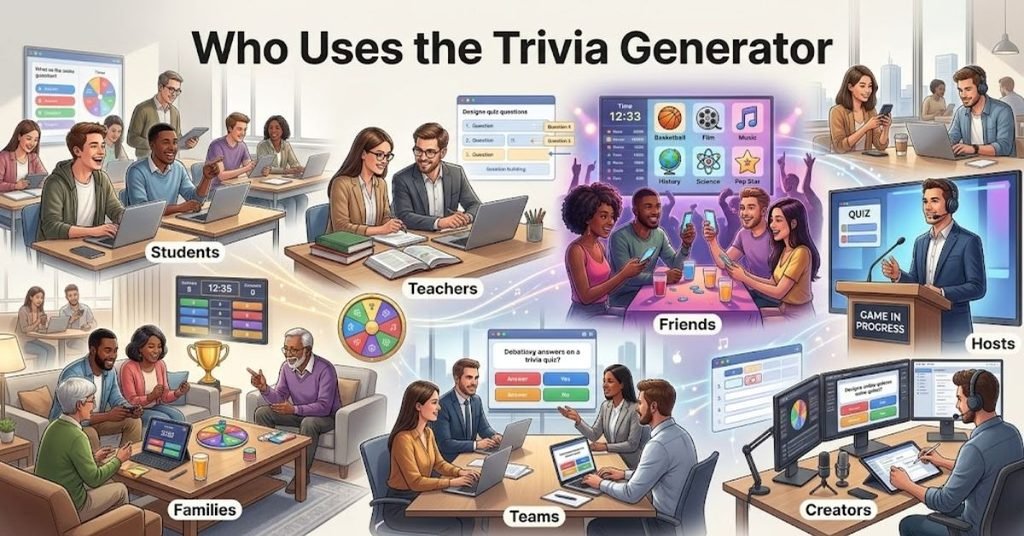
Different audiences use random trivia for different reasons. Trivia hosts need fast questions, teachers may want low-stakes review, students can use questions for self-testing, and party hosts may need an easy activity that requires little preparation.
That variety explains why flexible generators perform well. One person might want a single question, another might need ten questions for a round, and someone else might want enough material to build a full quiz. The same underlying question library can support all three situations.
Conclusion
A random trivia generator is more than a quick way to pull a question from a databaseit can turn an ordinary moment into a fun knowledge challenge. Whether you’re preparing a trivia night, playing with friends and family, creating a classroom activity, or simply testing yourself, the right generator saves preparation time while keeping every round fresh and unpredictable.
The best results come from combining randomness with good judgment. Choose useful categories, balance easy and difficult questions, verify important answers, and organize generated questions into a format that suits your audience. With the right mix of general knowledge, history, science, sports, entertainment, geography, and unusual facts, you can create engaging quizzes without spending hours writing every question yourself.
If your goal is to make trivia faster, easier, and more enjoyable, a random trivia generator gives you a practical starting point. Generate a question, make your guess, reveal the answer, keep score, and let the next question decide who really knows their trivia.
FAQs
Is a random trivia generator free?
Many generators offer free access, although features differ between platforms. Some provide free questions without an account, while advanced quiz-building, hosting, analytics, or customization may have separate limitations.
Can I choose my own trivia topic?
Usually, yes. Depending on the tool, you may be able to select categories such as history, science, sports, geography, entertainment, food, movies, or music.
Can I change the difficulty level?
Many generators provide easy, medium, hard, or mixed difficulty settings. If a tool does not offer a difficulty control, you can manually select questions after generating them.
Are random trivia questions always accurate?
No generator should be treated as infallible. Important or disputed facts should be checked against reliable sources, especially before using questions in a competitive public quiz.
Can I use generated questions for a classroom?
Yes. General knowledge questions can work as warm-ups, review activities, discussion starters, or low-stakes knowledge checks. Teachers should adapt difficulty and subject matter to the learners.
Can I use generated questions for a trivia night?
Yes. A generator can provide the raw questions, while the host organizes them into rounds, checks answers, sets the scoring rules, and chooses questions appropriate for the audience.
What makes a good trivia question?
A good question is clear, answerable, interesting, and supported by a defensible answer. The best questions often create a small moment of surprise without relying on misleading wording.
Will random questions repeat?
That depends on the generator. Some systems avoid repeats within a session, while others may eventually cycle through their available question pool.
What categories work best?
General knowledge is ideal for variety, while focused categories work well for themed events. History, geography, science, sports, entertainment, movies, music, food, and literature are reliable starting points.
How many questions should a trivia round have?
Ten questions is a practical starting point because it creates a manageable round without exhausting players. Longer events can use multiple rounds with breaks between them.
The real strength of a random trivia generator is not simply that it produces a question at random. It removes the friction between “we should play trivia” and actually having the first question in front of you. With good categories, sensible difficulty, reliable answers, and a simple reveal-and-score flow, even an ordinary evening can become a surprisingly memorable quiz.

Helping trivia lovers discover funny, clever, and unforgettable team names for every quiz night.

One Comment