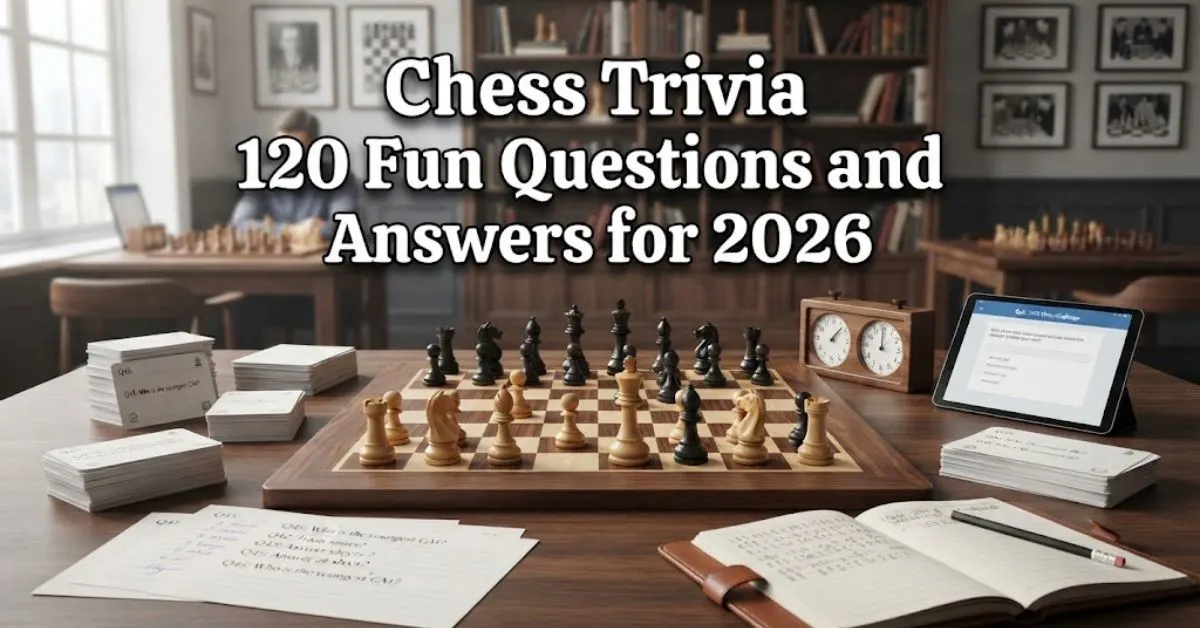
Chess Trivia 120 Fun Questions and Answers for 2026
Chess trivia turns a familiar board into a surprisingly deep journey through chess rules, chess history, famous players, openings, checkmate, tactics, champions, records, and computer chess. Whether you play casually at home or follow elite tournaments, the right question can reveal something you never noticed before.
I’ve always found the best chess trivia questions are the ones that make you pause before answering. They connect a chessboard, Grandmaster, World Chess Championship, FIDE, famous game, opening, or unusual rule to a memorable story. This collection is designed for family game nights, classroom activities, chess clubs, trivia nights, and solo quizzes, with easy questions first and deeper facts mixed throughout.
Chess Trivia Board and Starting Position
The standard chessboard contains 64 squares arranged in eight ranks and eight files, and each player begins with 16 pieces. White moves first, while the familiar starting arrangement places each queen on a square matching her color. These basics sound simple, but they form the foundation of every chess position.
Good chess trivia often starts with details beginners see every game without thinking about them. The board has 32 light and 32 dark squares, each side has eight pawns, and the opening position contains two kings, two queens, four rooks, four bishops, and four knights. Those numbers make excellent warm-up questions.
Chess Trivia Questions 1–12
1. How many squares are on a standard chessboard?
Answer 64.
2. How many pieces does each player start with?
Answer 16.
3. How many pieces are on the board at the beginning of a standard game?
Answer 32.
4. Which player moves first in chess?
Answer White.
5. How many pawns does each player start with?
Answer Eight.
6. How many kings are on the chessboard at the beginning of a game?
Answer Two.
7. What are the horizontal rows of a chessboard called?
Answer Ranks.
8. What are the vertical columns called?
Answer Files.
9. How many ranks are on a standard chessboard?
Answer Eight.
10. How many files are on a standard chessboard?
Answer Eight.
11. Which piece begins on its matching color?
Answer The queen.
12. What is the main objective of chess?
Answer To checkmate the opponent’s king.
Chess Trivia Questions 13–24
13. What colors are traditionally used to describe the two sides?
Answer White and Black.
14. How many queens does each player normally start with?
Answer One.
15. How many rooks does each player normally start with?
Answer Two.
16. How many bishops does each player normally start with?
Answer Two.
17. How many knights does each player normally start with?
Answer Two.
18. How many pawns are on the board at the start?
Answer 16.
19. What is the first rank for White?
Answer Rank 1.
20. What is the eighth rank from White’s perspective?
Answer Rank 8.
21. Which square is occupied by White’s king at the beginning?
Answer e1.
22. Which square is occupied by Black’s king at the beginning?
Answer e8.
23. Which square starts with White’s queen?
Answer d1.
24. Which square starts with Black’s queen?
Answer d8.
Chess Trivia How Every Piece Moves
Understanding how pieces move turns basic chess knowledge into practical game awareness. The rook moves along ranks and files, bishop moves diagonally, queen combines those movements, knight jumps in an L-shape, king moves one square, and pawns advance forward while capturing diagonally. Each movement creates distinctive tactical possibilities.
These movement rules also explain why chess positions become so complicated. A knight can jump over pieces, bishops remain tied to one color complex, rooks become powerful on open files, and the queen combines long-range movement. Pawn promotion adds another layer because a pawn reaching the final rank can become a stronger piece.
Chess Trivia Questions 25–36
25. Which chess piece moves diagonally?
Answer The bishop.
26. Which piece moves horizontally and vertically?
Answer The rook.
27. Which piece combines rook and bishop movement?
Answer The queen.
28. Which piece moves in an L-shape?
Answer The knight.
29. Which chess piece can jump over other pieces?
Answer The knight.
30. How many squares can a king normally move at once?
Answer One.
31. Can a pawn normally move backward?
Answer No.
32. How does a pawn normally capture?
Answer One square diagonally forward.
33. How many squares may a pawn move on its first move if unobstructed?
Answer One or two.
34. What happens when a pawn reaches the farthest rank?
Answer It promotes.
35. Which pieces can a pawn promote to?
Answer A queen, rook, bishop, or knight.
36. Can a promoted pawn become another queen even if the original queen is still on the board?
Answer Yes.
Chess Trivia Questions 37–42
37. Which piece is generally considered the most powerful in normal chess play?
Answer The queen.
38. Which piece is usually valued at about five pawns?
Answer The rook.
39. Which minor piece is usually valued at about three pawns?
Answer The bishop or knight.
40. What is a bishop’s special movement pattern?
Answer Diagonal movement.
41. What is a rook’s special movement pattern?
Answer Horizontal or vertical movement.
42. What makes the knight unusual compared with other standard pieces?
Answer It can jump over intervening pieces.
Chess Trivia Checkmate, Castling, and Special Moves
Special rules are among the most entertaining parts of chess trivia because they often surprise casual players. Castling moves the king and rook in one turn, en passant is a special pawn capture, and promotion changes a pawn into another piece. These rules are governed by specific legal conditions rather than personal preference.
FIDE’s Laws of Chess define these moves precisely. For example, castling is unavailable if the king has already moved, and the king cannot castle through an attacked square. En passant is available only immediately after the qualifying two-square pawn advance. These details make excellent challenge questions.
Chess Trivia Questions 43–54
43. What is check?
Answer A position in which the king is under attack.
44. What is checkmate?
Answer A position where the king is in check and has no legal way to escape.
45. What is stalemate?
Answer A draw where the player to move has no legal move but is not in check.
46. What special move involves both the king and a rook?
Answer Castling.
47. How many squares does the king move during normal castling?
Answer Two.
48. Can a player castle while their king is in check?
Answer No.
49. Can a king castle through an attacked square?
Answer No.
50. What is en passant?
Answer A special pawn capture available immediately after a qualifying two-square pawn advance.
51. What is pawn promotion?
Answer Replacing a pawn reaching the final rank with a queen, rook, bishop, or knight.
52. Can a pawn promote to a king?
Answer No.
53. What is Fool’s Mate?
Answer The fastest possible checkmate, occurring after Black’s second move.
54. What is Scholar’s Mate?
Answer A well-known four-move checkmate pattern targeting the f7 or f2 area.
Chess Trivia Questions 55–60
55. Can castling happen if pieces stand between the king and rook?
Answer No.
56. Can a player castle after moving the king and returning it to its starting square?
Answer No.
57. Can a player castle with a rook that has already moved and returned?
Answer No.
58. How long is an en passant opportunity available?
Answer Only on the immediately following move.
59. What symbol commonly represents check in algebraic notation?
Answer +.
60. What symbol commonly represents checkmate in modern notation?
Answer #.
Chess Trivia Draws, Clocks, and Tournament Rules

Not every chess game ends with checkmate. A game can finish by resignation, stalemate, agreement, repetition, the fifty-move rule, or other draw conditions. Tournament chess also introduces clocks, time controls, scoresheets, arbiters, and formal procedures that casual games may never use.
Chess clocks add another dimension to the game. A player may have a winning position but lose on time, while a theoretically drawn position can become complicated during time pressure. For trivia players, these rules provide memorable questions because they connect the intellectual side of chess with practical tournament competition.
Chess Trivia Questions 61–72
61. What does a chess clock measure?
Answer Each player’s remaining thinking time.
62. What normally happens when a player’s clock reaches zero?
Answer The player normally loses on time unless the opponent cannot possibly checkmate under the applicable rules.
63. What is resignation?
Answer Voluntarily conceding the game.
64. What is a draw by agreement?
Answer When both players agree to end the game drawn.
65. What is threefold repetition?
Answer A draw claim based on the same position occurring three times under the applicable rules.
66. What is the fifty-move rule?
Answer A draw may be claimed under the relevant conditions after 50 moves by each side without a pawn move or capture.
67. What is insufficient material?
Answer A situation where checkmate cannot legally be produced.
68. Can king versus king produce checkmate?
Answer No.
69. What is an illegal move?
Answer A move that violates the Laws of Chess.
70. What does touch-move mean?
Answer Under tournament rules, deliberately touching a movable piece generally obliges the player to move it when legally possible.
71. What is a time control?
Answer The amount of thinking time allocated under the rules of a chess game.
72. What is a chess scoresheet used for?
Answer Recording the moves played during a game.
Chess Trivia Material and the Three Phases
Chess players often describe positions through material, development, opening, middlegame, and endgame. Traditional piece values give a rough comparison pawn one, knight three, bishop three, rook five, and queen nine. These numbers are useful guidelines, not absolute laws, because positional factors can change a piece’s practical value.
The three broad phases also tell a story. In the opening, players develop pieces and prepare their kings. The middlegame usually contains tactical and strategic battles. In the endgame, fewer pieces remain and king activity often becomes much more important. This progression creates a natural sequence for chess trivia.
Chess Trivia Questions 73–84
73. What is material in chess?
Answer The pieces and pawns a player has.
74. What is the traditional value of a pawn?
Answer One point.
75. What is the traditional value of a knight?
Answer About three points.
76. What is the traditional value of a bishop?
Answer About three points.
77. What is the traditional value of a rook?
Answer About five points.
78. What is the traditional value of a queen?
Answer About nine points.
79. What is the opening?
Answer The early phase when players develop pieces and establish their positions.
80. What is the middlegame?
Answer The phase where strategic and tactical battles commonly dominate.
81. What is the endgame?
Answer The later phase with fewer pieces remaining.
82. What does development mean?
Answer Bringing pieces from their starting squares into useful positions.
83. Why is king safety important in the opening?
Answer An exposed king can become vulnerable to tactical attacks.
84. Why can king activity become important in the endgame?
Answer With fewer attacking pieces remaining, the king can often participate actively in the position.
Chess Trivia Tactics and Positional Terms
Chess tactics explain many of the dramatic moments people remember from games. A fork attacks multiple targets, a pin restricts a piece because moving it exposes something valuable, a skewer attacks a valuable piece first, and a discovered attack appears when one piece moves away and reveals another attack.
Positional terms describe longer-term features rather than immediate combinations. Passed pawns, isolated pawns, open files, weak squares, and zugzwang can influence a position even when there is no spectacular checkmate. These concepts make chess trivia more interesting because they test understanding rather than simple memorization.
Chess Trivia Questions 85–96
85. What is a fork?
Answer A tactic in which one piece attacks two or more targets.
86. What is a pin?
Answer A situation where moving an attacked piece would expose a more valuable piece or king.
87. What is a skewer?
Answer A tactic where a valuable piece is attacked and moving it exposes another target behind it.
88. What is a discovered attack?
Answer An attack revealed when one piece moves away from the line of another attacking piece.
89. What is double check?
Answer A position where two pieces give check simultaneously after one move.
90. What is a gambit?
Answer An opening idea involving a voluntary material sacrifice for another form of compensation.
91. What is zugzwang?
Answer A position where having to make a move worsens the player’s position.
92. What is a passed pawn?
Answer A pawn with no opposing pawn able to stop it on its file or adjacent files under the relevant definition.
93. What is an isolated pawn?
Answer A pawn with no friendly pawn on either neighboring file.
94. What is an open file?
Answer A file containing no pawns of either color.
95. What is a discovered check?
Answer A check revealed when one piece moves out of the line of another piece.
96. What is a sacrifice?
Answer Voluntarily giving up material to gain a tactical, positional, or strategic benefit.
Chess Trivia Famous Openings
Chess openings are a huge source of trivia because many have distinctive names, histories, and move sequences. The Ruy Lopez, Sicilian Defense, Queen’s Gambit, French Defense, Caro-Kann Defense, Italian Game, King’s Indian Defense, and Réti Opening are among the recognizable names found in chess literature and databases.
Opening trivia can be easy or surprisingly difficult. A beginner may recognize the Queen’s Gambit by name, while a stronger player may identify an opening from only its first few moves. The important thing is remembering that opening names often describe families containing many variations rather than one fixed sequence.
Chess Trivia Questions 97–108
97. Which opening begins 1.e4 e5 2.Nf3 Nc6 3.Bb5?
Answer The Ruy Lopez, also called the Spanish Opening.
98. Which defense begins 1.e4 c5?
Answer The Sicilian Defense.
99. Which opening begins 1.d4 d5 2.c4?
Answer The Queen’s Gambit.
100. Which defense begins 1.e4 e6?
Answer The French Defense.
101. Which defense begins 1.e4 c6?
Answer The Caro-Kann Defense.
102. Which defense can begin 1.d4 Nf6 2.c4 g6 3.Nc3 Bg7?
Answer The King’s Indian Defense.
103. Which opening begins 1.e4 e5 2.Nf3 Nc6 3.Bc4?
Answer The Italian Game.
104. Which opening begins with 1.Nf3?
Answer The Réti Opening.
105. What is the first move of the English Opening?
Answer 1.c4.
106. What does 1.e4 represent?
Answer White moves the king’s pawn two squares forward.
107. What does 1.d4 represent?
Answer White moves the queen’s pawn two squares forward.
108. Why do opening names matter in chess?
Answer They provide shorthand for recognized families of positions and move orders.
Chess Trivia Champions and Chess Organizations
Competitive chess has an organized international structure built around FIDE, national federations, official titles, ratings, world championship events, and major team competitions. Wilhelm Steinitz became the first official World Chess Champion in 1886, while later champions such as Emanuel Lasker, Bobby Fischer, Garry Kasparov, Viswanathan Anand, Magnus Carlsen, and Gukesh D shaped different eras.
Current trivia should be updated carefully because championship information changes. FIDE’s current 2025–2026 cycle lists Gukesh D as the winner of the 2024 World Championship Match and Javokhir Sindarov as the 2026 Candidates Tournament winner and challenger for the next world championship match.
Chess Trivia Questions 109–120
109. What does FIDE stand for?
Answer Fédération Internationale des Échecs, the International Chess Federation.
110. In what year was FIDE founded?
Answer 1924.
111. Who became the first official World Chess Champion?
Answer Wilhelm Steinitz.
112. Who was the American world champion who won the 1972 match against Boris Spassky?
Answer Bobby Fischer.
113. Who defeated Garry Kasparov in their 2000 world championship match?
Answer Vladimir Kramnik.
114. Which Indian player became world champion in 2000?
Answer Viswanathan Anand.
115. Who became world champion in 2013 after defeating Viswanathan Anand?
Answer Magnus Carlsen.
116. Who became the 18th FIDE World Champion in 2024?
Answer Gukesh D.
117. Who won the 2026 FIDE Candidates Tournament?
Answer Javokhir Sindarov.
118. What major international team competition is known as the Chess Olympiad?
Answer The Chess Olympiad.
119. What title is commonly abbreviated GM?
Answer Grandmaster.
120. What title is commonly abbreviated IM?
Answer International Master.
Chess Trivia Chess History and Technology
Chess has traveled through centuries of cultural and technological change. Its direct historical ancestor is generally associated with Chaturanga in India, while the game developed through Persian and later European traditions. The modern queen became dramatically more powerful during the late medieval period, transforming the character of the game.
Technology created another extraordinary chapter. Chess engines evolved from early computer experiments to systems capable of defeating world champions. IBM’s Deep Blue famously defeated Garry Kasparov in their 1997 match, while modern engines have reached a level far beyond the machines of that era.
More Chess Trivia Questions
121. What early Indian game is widely regarded as an ancestor of chess?
Answer Chaturanga.
122. What Persian game is associated with the development of chess?
Answer Shatranj.
123. Which game is famous for Adolf Anderssen’s 1851 victory over Lionel Kieseritzky?
Answer The Immortal Game.
124. Who played the famous Evergreen Game against Adolf Anderssen?
Answer Jean Dufresne.
125. Who created the Elo rating system?
Answer Arpad Elo.
126. What was the name of the computer that defeated Garry Kasparov in 1997?
Answer IBM Deep Blue.
127. What computer defeated Grandmaster Bent Larsen in 1988?
Answer Deep Thought.
128. What is Chess960 also called?
Answer Fischer Random Chess.
129. What is algebraic notation used for?
Answer Recording chess moves.
130. What is the name of the famous 1972 Fischer–Spassky world championship match?
Answer It is often called the “Match of the Century.”
131. In which city was the 1972 Fischer–Spassky match played?
Answer Reykjavík, Iceland.
132. Which country is traditionally associated with the origin of chess’s direct predecessor?
Answer India.
133. What was the medieval predecessor of the modern queen called in Persian chess traditions?
Answer The ferz or vizier.
134. Which chess piece became dramatically stronger during the evolution of modern chess?
Answer The queen.
135. What is blindfold chess?
Answer Chess played without directly viewing the board.
136. What is correspondence chess?
Answer Chess played remotely, traditionally through postal communication and now commonly through electronic systems.
137. What is a chess engine?
Answer Software that analyzes chess positions and calculates candidate moves.
138. What is a tablebase?
Answer A database containing perfect-play information for certain limited-piece endgames.
139. What does “Elo” measure in chess?
Answer A player’s relative playing strength through a rating system.
140. Why are chess records difficult to keep permanently current?
Answer New games, tournaments, formats, and updated historical research can change which record applies.
Bonus Chess Trivia Questions
141. What is the longest known tournament chess game commonly cited in modern trivia?
Answer The 269-move game between Ivan Nikolić and Goran Arsović in Belgrade in 1989.
142. How many squares are on a chessboard if all square sizes are counted, including larger geometric squares?
Answer 204 total squares.
143. How many legal first moves does White have from the standard starting position?
Answer 20.
144. What is the fastest possible checkmate?
Answer Fool’s Mate, on Black’s second move.
145. What is a “brilliant move” generally intended to describe?
Answer An exceptionally strong, creative, or difficult move, depending on the analysis system or context.
146. What does FIDE regulate?
Answer International chess competition, titles, ratings, rules, and related chess activities.
147. What is the Chess Olympiad?
Answer A major international team chess competition organized under FIDE.
148. What does “GM” mean after a chess player’s name?
Answer Grandmaster.
149. What does “FM” mean in chess titles?
Answer FIDE Master.
150. What does “CM” mean in chess titles?
Answer Candidate Master.
A Quick Chess Trivia Scorecard
If you want to use these questions as a game, divide them into rounds instead of revealing every answer immediately.
| Score | Suggested Result |
| 0–30 | Casual chess fan |
| 31–60 | Chess learner |
| 61–90 | Strong chess knowledge |
| 91–120 | Serious chess enthusiast |
| 121–150 | Chess trivia specialist |
For a group game, read the questions aloud and give players 15–30 seconds to answer. For harder questions, allow players to write their answers instead of shouting them out. This makes the experience feel more like a proper chess quiz night and reduces accidental answer-sharing.
How to Make Chess Trivia More Fun
Mix straightforward rules with unexpected history. A question about the 64-square board is an easy opener, while a question about the Immortal Game, Deep Blue, Fischer–Spassky, Chess960, blindfold chess, or an unusual tournament record can raise the difficulty.
Another useful approach is to create rounds by skill level. Start with beginner questions about pieces and rules, move into openings and tactics, then finish with champions, records, history, and computer chess. That progression gives everyone a chance to score before the difficult questions arrive.
Chess Trivia for Families and Beginners
For family play, avoid making every question dependent on opening theory or advanced notation. Instead, combine piece movement, famous players, board facts, checkmate, chess history, and surprising records. A child who knows how a knight moves can compete with an adult who knows a famous world championship fact.
This format also works well for classrooms and chess clubs. Teachers or club organizers can use short rounds as warm-ups, while players can use the answers to discover topics worth studying later. The strongest trivia question is often the one that creates a new chess question afterward.
Chess Trivia for Chess Clubs and Trivia Nights
A chess club can turn this material into themed rounds Rules Round, Famous Players Round, Opening Round, History Round, Records Round, and Computer Chess Round. Give each round a different difficulty and keep the final section noticeably harder than the opening questions.
For a general trivia night, emphasize facts that non-players can recognize. Bobby Fischer, Magnus Carlsen, Deep Blue, the Queen’s Gambit, the 64-square board, and the concept of checkmate are accessible entry points. More technical questions can then reward experienced players without dominating the entire game.
Chess Trivia and Current World Championship Facts
Current championship questions should always be checked before publication because chess titles and qualification cycles change. As of the current 2025–2026 FIDE cycle, Gukesh D is listed as the winner of the 2024 World Championship Match, while Javokhir Sindarov is listed as the 2026 Candidates Tournament winner and challenger for the next world championship match.
That makes a chess trivia page more trustworthy when it distinguishes historical records from current facts. A question such as “Who is the current world champion?” should be updated when the championship changes, while questions such as “Who was the first official world champion?” remain historical facts.
Chess Trivia as a Learning Tool
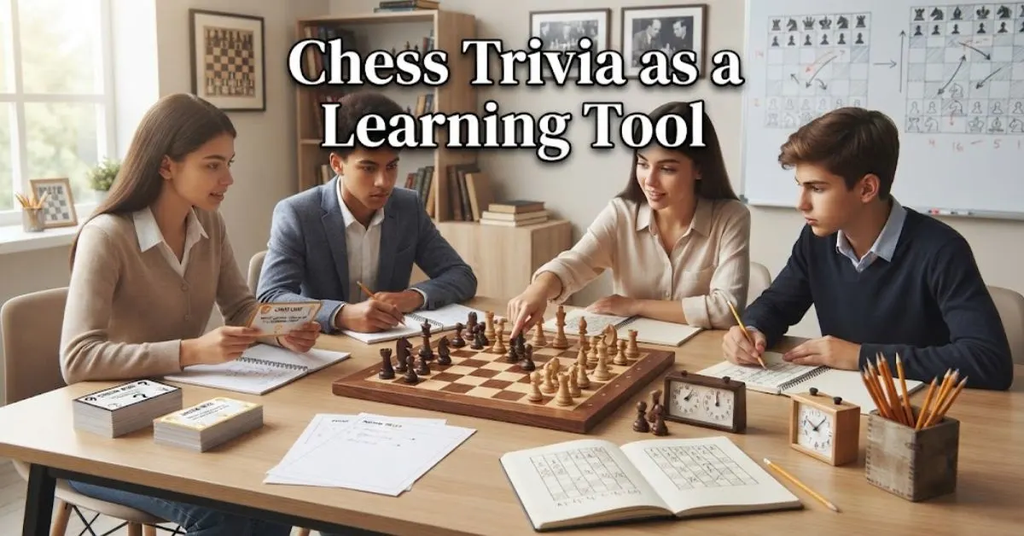
The best chess trivia does more than test memory. A question about en passant can send a beginner toward the Laws of Chess. A question about the Sicilian Defense can introduce opening theory. A question about Deep Blue can open the door to computer chess, while a question about Fischer can lead into the history of competitive chess.
That is why a well-designed quiz can become a gateway to deeper learning. Instead of treating every answer as an isolated fact, connect it to the broader chess ecosystem rules, strategy, tactics, openings, players, tournaments, history, technology, and culture.
Closing Chess Trivia Challenge
Chess trivia becomes most memorable when the questions tell stories. The 64-square board, a perfectly timed checkmate, an unusual opening, a legendary champion, a historic match, or a computer defeating a world champion can each reveal another side of the game.
Whether you’re hosting a family quiz, running a chess-club activity, planning trivia night, or simply testing yourself, these chess trivia questions give you a flexible starting point. Keep the easy questions moving, save the surprising facts for later rounds, and let the answers inspire the next game you play.
Conclusion
Chess trivia is a fun way to explore far more than the 64 squares on a chessboard. From checkmate, castling, openings, tactics, and famous games to legendary champions, FIDE, chess history, and computer breakthroughs, every question can reveal another fascinating part of the game. Whether you are a casual player or a dedicated chess enthusiast, these facts can make the next game even more interesting.
Use these chess trivia questions for a family game night, classroom activity, chess club, trivia competition, or a friendly challenge with fellow players. Mix easy questions with tougher history and strategy facts, keep track of the score, and use surprising answers as opportunities to learn. The best trivia doesn’t just test what you already know it gives you a reason to look at chess differently the next time you sit down at the board.
FAQs
These FAQs target the major natural-language questions surrounding chess trivia, chess quizzes, chess facts, rules, history, and famous players.
What are some good chess trivia questions?
Good chess trivia questions cover a mixture of board basics, chess rules, famous players, openings, championships, history, records, and computer chess. Questions should vary in difficulty so beginners can participate while experienced players still encounter challenging facts.
What is the most famous chess trivia fact?
One widely known chess fact is that a standard chessboard has 64 squares, arranged across eight ranks and eight files. Other famous trivia includes the historical importance of Chaturanga, the 1972 Fischer–Spassky match, and IBM Deep Blue’s 1997 victory over Garry Kasparov.
Who was the first official World Chess Champion?
Wilhelm Steinitz became the first official World Chess Champion after winning the 1886 match against Johannes Zukertort. Chess.com also identifies Steinitz as the first official champion.
Where did chess originate?
The direct historical predecessor of modern chess is generally associated with Chaturanga in India, after which chess developed through Persian, Islamic, and European traditions.
What is the fastest checkmate in chess?
The fastest possible checkmate is Fool’s Mate, which occurs after Black’s second move. It requires a specific sequence of weak early pawn moves by White.
How many pieces are in chess?
Each player begins with 16 pieces, giving the standard starting position a total of 32 pieces.
What is the hardest chess trivia question?
Difficulty depends on the audience. For beginners, questions about opening names or historical champions may be difficult. For experienced players, questions involving obscure records, historical games, unusual tournament facts, or precise opening sequences are more challenging.
What are the main types of chess trivia?
Common categories include chess rules, pieces, openings, tactics, famous games, world champions, chess history, records, FIDE, Chess Olympiad, computer chess, and famous players.
Is chess considered a sport?
Chess is formally organized as a competitive sport by international sporting organizations and FIDE. It has structured tournaments, official rules, ratings, titles, arbiters, and international championships.
Who is the current World Chess Champion?
As of the current FIDE 2025–2026 cycle, Gukesh D is listed by FIDE as the winner of the 2024 World Championship Match. The next challenger is listed as Javokhir Sindarov, winner of the 2026 Candidates Tournament.

Helping trivia lovers discover funny, clever, and unforgettable team names for every quiz night.