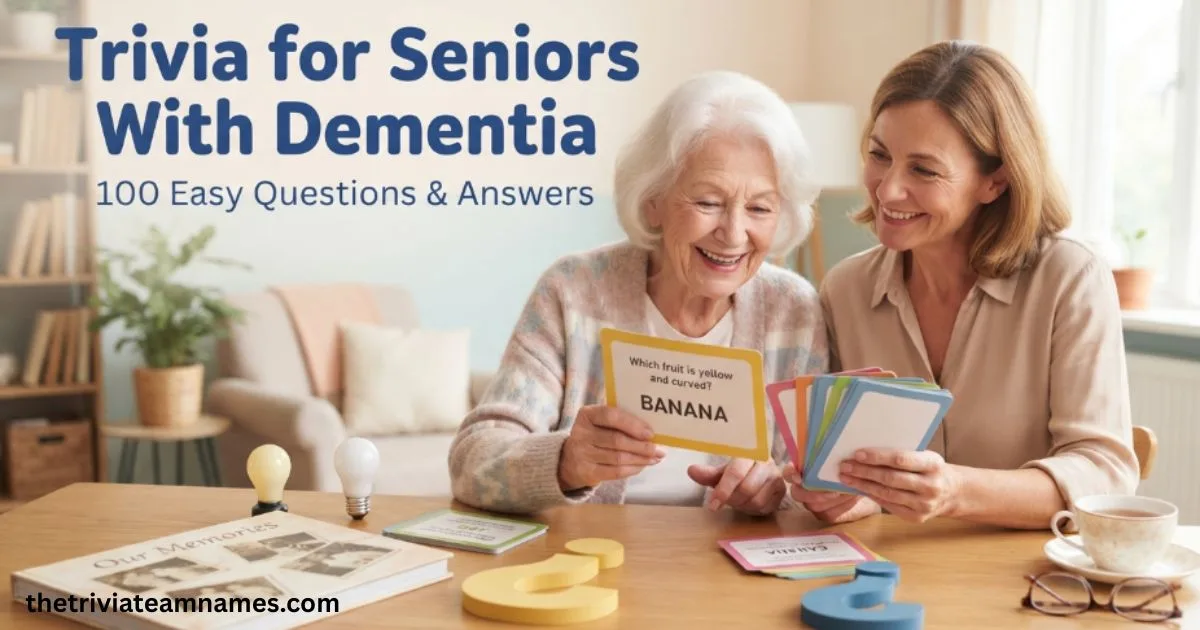
Trivia for Seniors With Dementia 100 Easy Questions and Answers
Trivia for seniors with dementia with answers can be a gentle way to encourage conversation, recognition, laughter, and meaningful connection. The best questions use familiar music, classic movies, childhood memories, household items, famous people, and everyday experiences rather than difficult facts or recent events.
For caregivers and families, the goal isn’t to prove what someone remembers. It is to create a comfortable moment where a familiar name, song, or object may open the door to a story. The Alzheimer’s Association recommends following the person’s lead during reminiscence and focusing on connection rather than testing memory.
Important: Trivia is a recreational activity, not a dementia treatment or diagnostic test. Dementia affects people differently, so adapt questions to the individual’s abilities, interests, hearing, vision, and mood.
Trivia for Seniors with Dementia Why Trivia Helps Seniors with Dementia
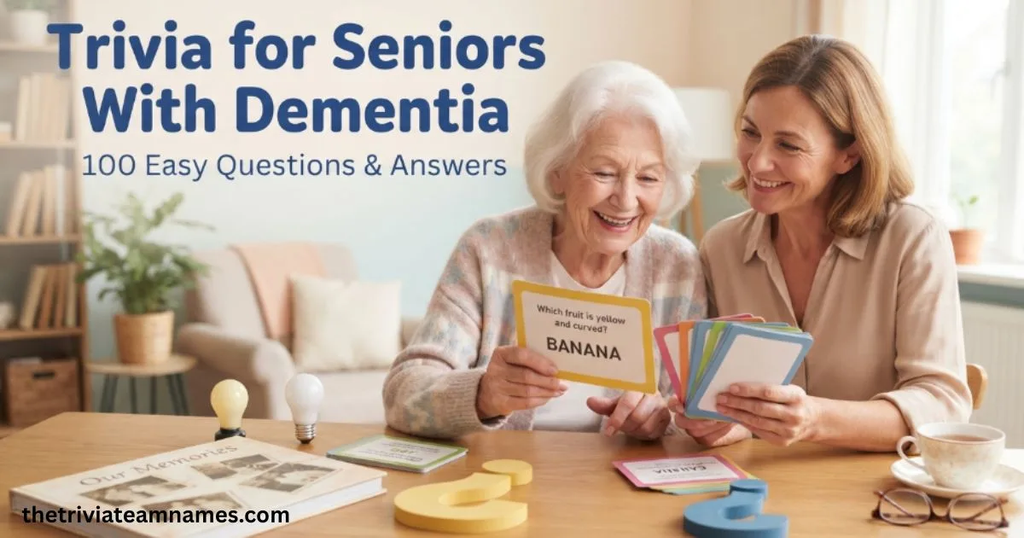
Good dementia-friendly trivia, memory prompts, familiar questions, and conversation starters can create an enjoyable social activity without making someone feel examined. Questions about music, childhood, classic television, or everyday objects may naturally lead to stories and personal memories.
The biggest benefit is often connection rather than correct answers. The National Institute on Aging recommends adapting activities to a person’s abilities and watching for frustration, while the Alzheimer’s Association similarly emphasizes enjoyment rather than achievement.
Memory Stimulation
A question about Elvis Presley, an old television program, a favorite meal, or a childhood neighborhood may feel much more accessible than a question about something that happened yesterday. Familiar music, photographs, and objects can also act as reminiscence cues.
Social Engagement
Trivia works particularly well as a family activity, caregiver activity, senior-center game, or small-group conversation. The Alzheimer’s Association notes that meaningful activities and social interaction can help people with dementia stay engaged and connected.
Emotional Well-Being
A successful answer can create a smile, but an unexpected answer can be valuable too. If someone remembers a different detail, invite the story instead of immediately correcting it. The activity should feel warm, respectful, familiar, and enjoyable, never like an examination.
Trivia for Seniors with Dementia Tips for Asking Trivia Questions to Seniors with Dementia
The strongest memory-friendly trivia, simple questions, familiar topics, and gentle prompts are delivered slowly. Ask one question at a time and allow enough time for the person to respond. Current dementia-care guidance recommends matching activities to ability and adapting them when they become difficult.
A caregiver can also provide a clue instead of immediately giving the answer. For example, instead of asking, “Who sang this song?” try, “Was it Elvis Presley or Frank Sinatra?” Multiple-choice options can reduce the pressure of retrieving an answer from scratch.
Keep the conversation more important than the score
If someone answers incorrectly, you don’t need to turn the moment into a correction. Try responding with curiosity: “That’s interesting did you enjoy that singer?” This can move naturally from trivia into reminiscence.
Use familiar topics
The Alzheimer’s Association recommends activities connected with what the person already enjoys. Favorite music, photographs, sports, cooking, family traditions, television, and hobbies can all become useful conversation prompts.
Trivia for Seniors with Dementia Easy Trivia Questions for Seniors with Dementia
These easy dementia trivia questions, simple facts, familiar objects, everyday knowledge, and memory-friendly prompts are intentionally straightforward. They are designed to create opportunities for recognition and conversation rather than difficult competition.
Use them one at a time. If a question doesn’t work, simply move to another. There is no requirement to finish the entire list. A short, enjoyable session is often preferable to pushing through fatigue or frustration.
1. What color is a ripe banana?
Answer: Yellow
2. How many days are in a week?
Answer: Seven
3. What animal says “meow”?
Answer: Cat
4. What do bees make?
Answer: Honey
5. What color is grass?
Answer: Green
6. How many wheels does a bicycle have?
Answer: Two
7. What do cows produce that people commonly drink?
Answer: Milk
8. What do you use to brush your teeth?
Answer: A toothbrush
9. What season comes after spring?
Answer: Summer
10. What do you wear on your feet?
Answer: Shoes
11. What do you use to unlock a door?
Answer: A key
12. What color is a typical stop sign?
Answer: Red
13. What do chickens lay?
Answer: Eggs
14. What appliance keeps food cold?
Answer: A refrigerator
15. What do you use to sweep a floor?
Answer: A broom
16. What do you drink from a cup?
Answer: Many possible answers, such as water, coffee, or tea
17. What fruit is commonly used to make applesauce?
Answer: Apples
18. What animal is known as man’s best friend?
Answer: Dog
19. What shape is a basketball?
Answer: Round
20. What do you call frozen water?
Answer: Ice
Trivia for Seniors with Dementia Music Trivia Questions for Seniors with Dementia
Music trivia, familiar songs, classic singers, oldies, musical instruments, and memorable performers are especially useful conversation starters. The Alzheimer’s Association notes that music can remain meaningful even as dementia progresses and recommends familiar, enjoyable music chosen around the person’s preferences.
Rather than treating music questions as a memory examination, let the song become the activity. If someone cannot name the singer, play a familiar recording and ask whether they recognize it. Music may sometimes communicate what words cannot.
21. Who was known as the “King of Rock and Roll”?
Answer: Elvis Presley
22. Which famous band recorded “Hey Jude”?
Answer: The Beatles
23. Who was known as “Ol’ Blue Eyes”?
Answer: Frank Sinatra
24. Who sang “What a Wonderful World”?
Answer: Louis Armstrong
25. Who was known as the “Queen of Soul”?
Answer: Aretha Franklin
26. Which instrument has black and white keys?
Answer: Piano
27. Which instrument commonly has six strings?
Answer: Guitar
28. Who sang “Respect”?
Answer: Aretha Franklin
29. Who recorded “I Walk the Line”?
Answer: Johnny Cash
30. Which group recorded “My Girl”?
Answer: The Temptations
31. Which musical group included John, Paul, George, and Ringo?
Answer: The Beatles
32. What dance became famous through Chubby Checker?
Answer: The Twist
33. Which singer was called “The Man in Black”?
Answer: Johnny Cash
34. Which group recorded “Stop! In the Name of Love”?
Answer: The Supremes
35. Who sang “Mack the Knife” as a major popular hit?
Answer: Bobby Darin
36. Which music style became strongly associated with the 1970s?
Answer: Disco
37. Who performed “Jailhouse Rock”?
Answer: Elvis Presley
38. Which group recorded “Rock Around the Clock”?
Answer: Bill Haley & His Comets
39. Who performed at Woodstock with a famous version of “The Star-Spangled Banner”?
Answer: Jimi Hendrix
40. Which Motown group recorded “I Heard It Through the Grapevine”?
Answer: Marvin Gaye
Trivia for Seniors with Dementia Classic Movies & TV Trivia Questions
Classic movies, television shows, actors, characters, Hollywood, and familiar entertainment provide another strong category. Competitor research repeatedly uses The Wizard of Oz, Casablanca, Star Trek, MASH*, Bonanza, and other recognizable titles.
Keep the questions recognizable. A person doesn’t have to remember a release year to enjoy remembering a character. If a question sparks a story about a favorite actor, let the conversation continue rather than immediately moving to the next question.
41. Who played Dorothy in The Wizard of Oz?
Answer: Judy Garland
42. What color were Dorothy’s famous slippers?
Answer: Ruby red
43. Who played Lucy Ricardo on I Love Lucy?
Answer: Lucille Ball
44. What was the name of Popeye’s girlfriend?
Answer: Olive Oyl
45. What famous collie was a television and movie star?
Answer: Lassie
46. What was the name of the cowboy in Toy Story?
Answer: Woody
47. Who was the famous nanny who traveled with an umbrella?
Answer: Mary Poppins
48. Which film starred Humphrey Bogart and Ingrid Bergman?
Answer: Casablanca
49. What television show featured the spaceship USS Enterprise?
Answer: Star Trek
50. What sitcom was set around an army hospital during the Korean War?
Answer: MASH*
51. What television series featured Adam, Hoss, and Little Joe?
Answer: Bonanza
52. What game show tells contestants to “Come on down”?
Answer: The Price Is Right
53. Which famous character lived with his family in Mayberry?
Answer: Andy Taylor
54. Who played Norman Bates in Psycho?
Answer: Anthony Perkins
55. What Disney character is a famous talking mouse?
Answer: Mickey Mouse
56. Who starred as the title character in Mary Poppins?
Answer: Julie Andrews
57. Which movie features the line “There’s no place like home”?
Answer: The Wizard of Oz
58. What classic TV show starred Andy Griffith?
Answer: The Andy Griffith Show
59. Which show featured a character named Columbo?
Answer: Columbo
60. What famous actress starred in Breakfast at Tiffany’s?
Answer: Audrey Hepburn
Trivia for Seniors with Dementia History Trivia Questions for Seniors
American history, space exploration, major events, famous leaders, historical places, and familiar dates can make excellent trivia categories. The key is choosing recognizable events rather than obscure facts. Competitor pages commonly focus on well-known events and people from earlier decades.
History questions can also become storytelling prompts. Someone who hears “Neil Armstrong” may remember watching the moon landing, talking about it with family, or seeing the event on television. That personal memory is more important than achieving a perfect score.
61. Who was the first U.S. president?
Answer: George Washington
62. Who was the first person to walk on the Moon?
Answer: Neil Armstrong
63. What space program landed people on the Moon?
Answer: Apollo
64. Who delivered the “I Have a Dream” speech?
Answer: Martin Luther King Jr.
65. Who refused to give up her bus seat in Montgomery, Alabama?
Answer: Rosa Parks
66. Which ship famously sank after hitting an iceberg in 1912?
Answer: Titanic
67. Which country gave the Statue of Liberty to the United States?
Answer: France
68. What wall divided East and West Berlin?
Answer: The Berlin Wall
69. Who was president when the Watergate scandal led to his resignation?
Answer: Richard Nixon
70. What major war ended in 1945?
Answer: World War II
71. What satellite did the Soviet Union launch in 1957?
Answer: Sputnik
72. What U.S. city is associated with the Declaration of Independence?
Answer: Philadelphia
73. Who was the first American to orbit Earth?
Answer: John Glenn
74. What year did Apollo 11 land on the Moon?
Answer: 1969
75. What civil-rights leader was assassinated in 1968?
Answer: Martin Luther King Jr.
Trivia for Seniors with Dementia Household Items & Everyday Life Trivia
Everyday-life questions are particularly useful because household objects, old technology, cooking, family routines, shopping, school memories, and daily chores can connect trivia with lived experience. Competitor content includes iceboxes, TV dinners, soda fountains, old clocks, household products, and other familiar objects.
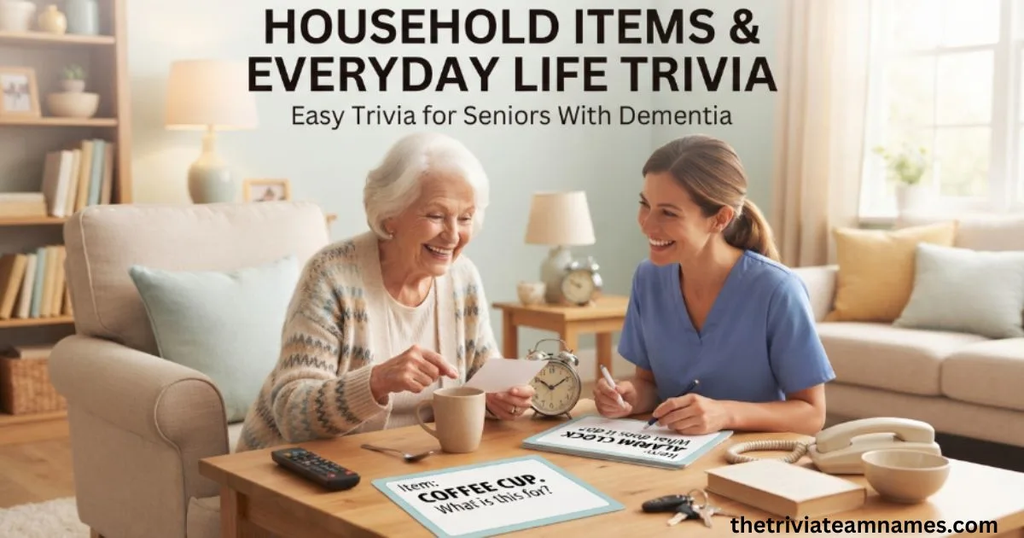
The Alzheimer’s Association also recommends meaningful activities involving familiar household tasks and conversation. The National Institute on Aging similarly suggests adapting familiar activities so they remain enjoyable and manageable.
76. What did people use before modern refrigerators to keep food cool?
Answer: An icebox
77. What type of telephone had a circular dial?
Answer: Rotary telephone
78. What were popular frozen meals called in the 1950s?
Answer: TV dinners
79. Where might teenagers go for a malt or ice-cream float?
Answer: A soda fountain or diner
80. What appliance was used to wash clothes?
Answer: Washing machine
81. What did people use to find telephone numbers before the internet?
Answer: A telephone book
82. What did many families watch together before streaming services?
Answer: Television programs
83. What type of machine was commonly used to type letters and documents?
Answer: Typewriter
84. What household item was used to iron clothes?
Answer: An iron
85. What did people use to listen to records?
Answer: A record player
86. What did people commonly use to take photographs before smartphones?
Answer: A camera
87. What did children commonly play with outside before video games?
Answer: Many possible answers balls, bicycles, jump ropes, etc.
88. What store was famous for its large mail-order catalog?
Answer: Sears
89. What did people use to correct typing mistakes before modern editing software?
Answer: Correction fluid or correction tape
90. What appliance was used to make toast?
Answer: Toaster
Trivia for Seniors with Dementia Handling Frustration with Grace
With dementia-friendly activities, caregivers, memory questions, reminiscence, and conversation, frustration is a signal to adapt not a reason to push harder. The National Institute on Aging recommends watching for frustration and changing or simplifying an activity when necessary.
If a question creates discomfort, skip it. You can offer a clue, switch to multiple choice, play a familiar song, show a photograph, or simply talk about something else. The Alzheimer’s Association advises following the person’s lead during reminiscence and keeping the focus on connection.
If they give the wrong answer
Don’t turn the moment into a correction session. Try: “That’s a good one. Tell me about that.” The answer may be inaccurate while the story surrounding it is meaningful.
If they cannot answer
Offer two or three choices. For example: “Was it Elvis Presley, Frank Sinatra, or Johnny Cash?” If none feels comfortable, provide the answer and continue naturally.
If they become frustrated
Stop the trivia. A quiet conversation, favorite song, family photograph, or familiar object may be more appropriate. Activities should remain enjoyable and matched to the person’s current abilities.
If music works better than questions
Use music. The Alzheimer’s Association notes that familiar music can remain accessible even in later stages and can support connection and self-expression.
Conclusion
Trivia for seniors with dementia with answers works best when it feels like a warm conversation rather than a test. Familiar music, classic movies, historical events, household objects, favorite foods, and childhood memories can provide gentle prompts for recognition and storytelling.
The most important answer isn’t necessarily the one printed beside the question. Sometimes it’s the smile, the story, the song someone suddenly remembers, or the connection created between a caregiver and an older adult. Keep questions simple, offer clues, respect wrong answers, watch for frustration, and let the person lead. That approach makes trivia more dignified, accessible, and genuinely enjoyable.
FAQ Section
What are the best trivia questions for seniors with dementia?
The best questions are usually simple, familiar, and connected to earlier-life experiences, such as classic music, movies, television, food, household objects, holidays, famous people, and childhood memories. The goal is engagement rather than testing memory.
Can trivia help someone with dementia?
Trivia should not be presented as a treatment for dementia. However, enjoyable activities such as reminiscence, music, conversation, and appropriately adapted games can support engagement and well-being. Evidence for lasting cognitive benefits from recreational “brain training” is not definitive.
What type of questions are easiest for people with dementia?
Questions involving familiar songs, famous people, classic television, household objects, food, childhood experiences, and major historical events can be easier because they rely on recognition and familiar associations.
Should you correct someone with dementia when they give a wrong answer?
Not necessarily. If the purpose is social connection, immediately correcting every mistake can create pressure. Instead, acknowledge their contribution and use it as a conversation bridge. If factual accuracy genuinely matters, provide the correct answer gently and move on.
Is music good for dementia activities?
Music can be an especially meaningful activity for people living with dementia. The Alzheimer’s Association recommends familiar and enjoyable music and notes that music can remain a means of connection even when verbal communication becomes difficult.
How long should a dementia trivia session last?
There is no universal ideal duration. Start with a short session and watch the person’s energy, attention, and mood. The NIA recommends adapting activities and allowing rest rather than forcing someone to continue when an activity becomes tiring or frustrating.
Can trivia be used in assisted living?
Yes. Trivia can be adapted for one-on-one visits, small groups, senior centers, memory-care communities, and family gatherings. Smaller groups may make conversation easier, while large-print materials can improve accessibility.
What if my loved one doesn’t want to answer?
Don’t pressure them. You can simply provide the answer, tell a related story, play a familiar song, look at photographs, or switch activities. The Alzheimer’s Association recommends taking cues from the person’s interests, abilities, and mood.

Helping trivia lovers discover funny, clever, and unforgettable team names for every quiz night.

One Comment