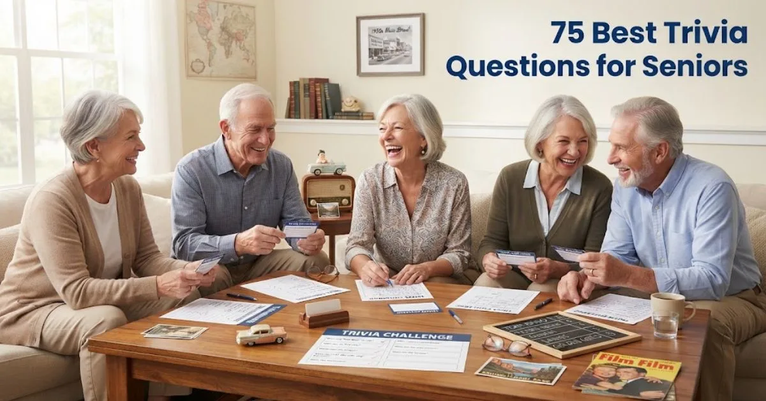
![Alt text: A group of four happy older adults and a friendly female facilitator are gathered around a warm, light-wood table in a comfortable living room setting, engaged in a trivia activity with large-print question cards, a clock, and flowers. The bold title, "Trivia for Seniors With Dementia: 100 Easy Questions & Answers," is clearly displayed in the upper-left corner against a soft cream and pale blue wall [cite: 4].](https://thetriviateamnames.com/wp-content/uploads/2026/09/image-107.png)
Trivia for Seniors With Dementia100 Easy Questions & Answers
SEO Title: Trivia for Seniors With Dementia: 100 Easy Questions
Meta Description: Enjoy gentle trivia for seniors with dementia, featuring 100 easy questions about music, movies, history, and everyday memories.
URL Slug: /trivia-for-seniors-with-dementia/
Trivia for Seniors with Dementia Why Trivia Helps Seniors with Dementia
Trivia for seniors with dementia can turn a quiet afternoon into a gentle opportunity for conversation, recognition, laughter, and connection. Familiar music, classic movies, childhood memories, everyday objects, famous people, and simple facts can make an activity feel welcoming rather than demanding. The goal is participation, not perfection.
For a caregiver, family member, or activity leader, the best approach is flexible and personal. Memory care activities, reminiscence, conversation starters, senior trivia, and familiar topics can create meaningful moments without making someone feel tested. Current dementia-care guidance emphasizes adapting activities to the person’s abilities, interests, mood, and preferences.
Memory Stimulation
A familiar question can sometimes open the door to a much larger memory. Asking about a favorite singer, childhood game, old television show, family meal, or familiar household item may encourage recognition and storytelling. The activity should remain simple, patient, and enjoyable rather than becoming a test of recall.
Social Engagement
Trivia can work one-on-one, with family, in a senior center, or within a memory-care community. Music, movies, history, hobbies, and everyday-life questions naturally invite conversation. Even when someone does not know an answer, another person’s response can create a shared story, laugh, or pleasant connection.
Emotional Well-Being
A correct answer is only one possible measure of a successful session. A smile, familiar song, remembered person, or personal story may matter more. Gentle trivia can provide a sense of participation and belonging, especially when the facilitator celebrates effort, accepts different responses, and avoids unnecessary pressure.
Trivia for Seniors with Dementia Tips for Asking Trivia Questions to Seniors with Dementia
The best trivia for seniors with dementia is delivered slowly and clearly. Ask one question at a time, allow extra response time, and keep the wording short. Easy questions, multiple-choice options, familiar topics, visual cues, and gentle hints can make participation more comfortable for someone experiencing memory loss.
Pay attention to the person rather than the question list. If music works better than history, use music. If photographs create more conversation than trivia, follow that lead. If the person seems tired, distracted, or frustrated, pause or change activities. Flexibility is more important than completing every question.
Keep the conversation more important than the score
Avoid turning an easy trivia activity into a competition. If an answer is incorrect, you can acknowledge it warmly and ask whether the topic reminds the person of something. This approach changes the focus from scoring to reminiscence, storytelling, social engagement, and a comfortable shared experience.
Use familiar topics
Choose topics that belong to the person’s own world whenever possible. Favorite songs, former jobs, cooking, sports, television, holidays, pets, school memories, family traditions, and household routines can all become useful conversation prompts. Personal relevance often makes a simple question more meaningful than a difficult one.
Trivia for Seniors with Dementia Easy Trivia Questions for Seniors with Dementia
Start with recognition-based questions that have familiar answers. Everyday knowledge, food, animals, seasons, household objects, colors, family life, and common routines are useful warm-up categories. These questions are intentionally gentle, giving the participant many opportunities to respond without needing detailed recent-memory recall.
You can read these questions aloud or place them on large-print cards. If someone hesitates, offer two choices, give a clue, or simply reveal the answer. There is no need to finish all 20 questions in one sitting. Choose the ones that feel natural for the person.
Easy Questions 1–20
- What color is a ripe banana?
Answer: Yellow - How many days are in a week?
Answer: Seven - What animal says “meow”?
Answer: A cat - What do bees make?
Answer: Honey - What color is grass usually?
Answer: Green - How many wheels does a bicycle have?
Answer: Two - What do chickens lay?
Answer: Eggs - What do you use to brush your teeth?
Answer: A toothbrush - What season comes after spring?
Answer: Summer - What do you wear on your feet?
Answer: Shoes - What do you use to unlock a door?
Answer: A key - What color is a typical stop sign?
Answer: Red - What appliance keeps food cold?
Answer: A refrigerator - What do you use to sweep the floor?
Answer: A broom - What fruit is used to make applesauce?
Answer: Apples - What animal is commonly called man’s best friend?
Answer: Dog - What shape is a basketball?
Answer: Round - What do you call frozen water?
Answer: Ice - What do people commonly drink from a cup at breakfast?
Answer: Coffee, tea, water, or another drink - What do you use to cut paper?
Answer: Scissors
Trivia for Seniors with Dementia Music Trivia Questions for Seniors with Dementia
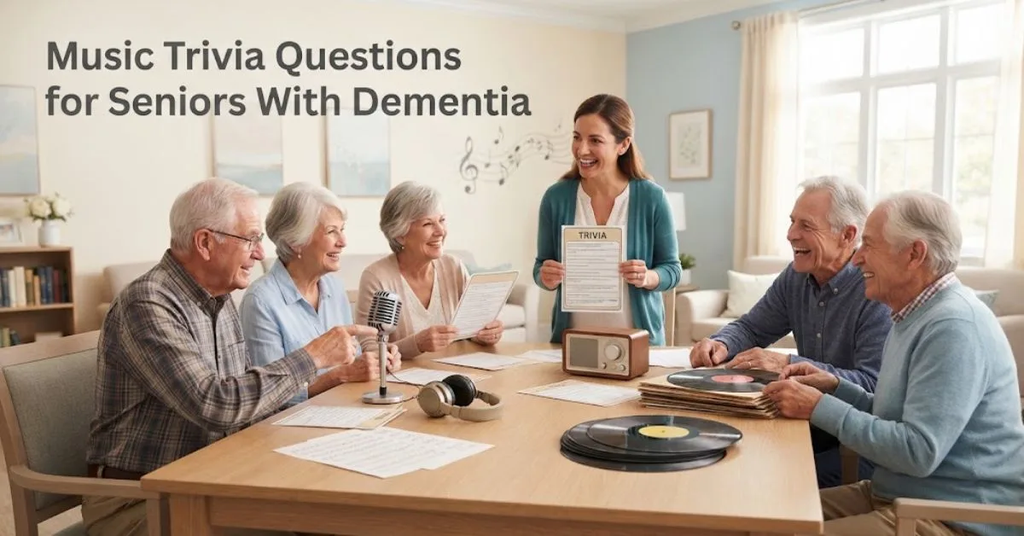
Music is a particularly useful theme for reminiscence because familiar songs and artists can carry strong personal associations. The Alzheimer’s Association recommends familiar, enjoyable music selected around the person’s preferences, while the NIA notes that music can be meaningful for older adults with memory problems. Let recognition matter more than perfect recall.
Try playing a familiar recording before asking the question. Someone may recognize the voice, melody, or rhythm without immediately naming the performer. You can also ask, “Do you remember this one?” instead of requiring an exact answer. That small change can make music trivia feel more like sharing than testing.
Music Questions 21–40
- Who was known as the “King of Rock and Roll”?
Answer: Elvis Presley - Which famous band included John, Paul, George, and Ringo?
Answer: The Beatles - Who was nicknamed “Ol’ Blue Eyes”?
Answer: Frank Sinatra - Who recorded “What a Wonderful World”?
Answer: Louis Armstrong - Who was known as the “Queen of Soul”?
Answer: Aretha Franklin - Which instrument has black and white keys?
Answer: Piano - Which common string instrument usually has six strings?
Answer: Guitar - Which singer became famous for the song “Respect”?
Answer: Aretha Franklin - Who was known as “The Man in Black”?
Answer: Johnny Cash - Which group recorded “My Girl”?
Answer: The Temptations - Which dance became a major hit associated with Chubby Checker?
Answer: The Twist - Which group was associated with “Stop! In the Name of Love”?
Answer: The Supremes - Who had a major hit with “Mack the Knife”?
Answer: Bobby Darin - What musical style became especially associated with the 1970s?
Answer: Disco - Who recorded “Jailhouse Rock”?
Answer: Elvis Presley - Which group recorded “Rock Around the Clock”?
Answer: Bill Haley & His Comets - Which guitarist performed a famous version of “The Star-Spangled Banner” at Woodstock?
Answer: Jimi Hendrix - Which singer was strongly associated with Motown and “I Heard It Through the Grapevine”?
Answer: Marvin Gaye - What instrument would you normally play with a bow and four strings?
Answer: Violin - What do you call a group of singers performing together?
Answer: Choir
Trivia for Seniors with Dementia Classic Movies & TV Trivia Questions
Classic movies and television can create especially recognizable conversation points for older adults who enjoy entertainment from earlier decades. Instead of emphasizing obscure release dates, choose well-known actors, characters, shows, and stories. The question itself can become a doorway to a favorite memory.
If a question about a movie leads someone into a story about going to the theater with a spouse, watching television with children, or following a favorite actor, let the conversation breathe. For dementia-friendly activities, the story can be more valuable than moving quickly to the next question.
Classic Movies & TV Questions 41–60
- Who played Dorothy in The Wizard of Oz?
Answer: Judy Garland - What was Dorothy’s dog named?
Answer: Toto - Who played Lucy Ricardo on I Love Lucy?
Answer: Lucille Ball - What was Popeye’s girlfriend named?
Answer: Olive Oyl - What famous collie appeared in movies and television?
Answer: Lassie - What was the cowboy’s name in Toy Story?
Answer: Woody - Which famous nanny arrived with an umbrella in Mary Poppins?
Answer: Mary Poppins - Which movie starred Humphrey Bogart and Ingrid Bergman?
Answer: Casablanca - Which television series featured the USS Enterprise?
Answer: Star Trek - What sitcom was set around a military hospital during the Korean War?
Answer: MASH* - Which television series featured Adam, Hoss, and Little Joe?
Answer: Bonanza - Which game show is famous for the phrase “Come on down”?
Answer: The Price Is Right - Which television character lived in Mayberry?
Answer: Andy Taylor - Who played Norman Bates in Psycho?
Answer: Anthony Perkins - Which famous Disney mouse is one of the company’s best-known characters?
Answer: Mickey Mouse - Who played Mary Poppins in the 1964 film?
Answer: Julie Andrews - Which movie is associated with Dorothy’s journey to the Emerald City?
Answer: The Wizard of Oz - Which classic sitcom starred Andy Griffith?
Answer: The Andy Griffith Show - Which television detective was known simply as Columbo?
Answer: Columbo - Who starred in Breakfast at Tiffany’s?
Answer: Audrey Hepburn
Trivia for Seniors with Dementia History Trivia Questions for Seniors
History trivia can be especially engaging when it focuses on major events, familiar leaders, space exploration, landmarks, and moments that became part of everyday American conversation. Avoid obscure dates unless the person specifically enjoys them. Recognizable history provides more opportunities for reminiscence and storytelling.
You can also turn a historical question into an open conversation. After asking about the first Moon landing, for example, ask whether the person remembers watching it on television. The answer to the trivia question may take only a second; the personal memory that follows may last much longer.
History Questions 61–80
- Who was the first president of the United States?
Answer: George Washington - Who was the first person to walk on the Moon?
Answer: Neil Armstrong - What space program carried astronauts to the Moon?
Answer: Apollo - Who delivered the famous “I Have a Dream” speech?
Answer: Martin Luther King Jr. - Who became famous for refusing to give up her bus seat in Montgomery, Alabama?
Answer: Rosa Parks - Which famous ship sank after striking an iceberg in 1912?
Answer: Titanic - Which country gave the Statue of Liberty to the United States?
Answer: France - What wall divided East and West Berlin?
Answer: The Berlin Wall - Who was president when the Watergate scandal resulted in his resignation?
Answer: Richard Nixon - Which major war ended in 1945?
Answer: World War II - What was the name of the Soviet satellite launched in 1957?
Answer: Sputnik - Which U.S. city is strongly associated with the Declaration of Independence?
Answer: Philadelphia - Who was the first American to orbit Earth?
Answer: John Glenn - In what year did Apollo 11 land on the Moon?
Answer: 1969 - Which civil-rights leader was assassinated in 1968?
Answer: Martin Luther King Jr. - What famous document begins with “We the People”?
Answer: The U.S. Constitution - What holiday celebrates U.S. independence?
Answer: Independence Day - What city is home to the Liberty Bell?
Answer: Philadelphia - Which ocean did Amelia Earhart attempt to cross during her final flight?
Answer: The Pacific Ocean - What famous American landmark stands in South Dakota with four presidential faces?
Answer: Mount Rushmore
Trivia for Seniors with Dementia Household Items & Everyday Life Trivia
Everyday-life trivia can feel less like a quiz and more like a walk through familiar experiences. Old telephones, kitchen appliances, shopping catalogs, household chores, school supplies, food, and family routines can all become useful reminiscence cues. These questions are particularly easy to personalize around someone’s own history.
Consider asking follow-up questions after an answer. If the answer is “rotary phone,” you might ask whether the person remembers having one at home. If the answer is “record player,” ask which music they enjoyed. Everyday trivia works best when it opens a conversation rather than closes it.
Household & Everyday-Life Questions 81–100
- What type of telephone had a circular dial?
Answer: Rotary telephone - What did people commonly use before refrigerators to keep food cool?
Answer: An icebox - What were popular frozen meals often called in the 1950s and 1960s?
Answer: TV dinners - Where might someone go for a milkshake or ice-cream float?
Answer: A soda fountain or diner - What machine was commonly used to wash clothes?
Answer: Washing machine - What did people use to find telephone numbers before the internet?
Answer: A telephone book - What machine was used to type letters before modern word processors?
Answer: Typewriter - What household item was used to press wrinkles out of clothing?
Answer: An iron - What device was commonly used to play vinyl records?
Answer: Record player - What did people commonly use to take photographs before smartphones?
Answer: A camera - What store was famous for its large mail-order catalog?
Answer: Sears - What did people use to correct typing mistakes before computer editing?
Answer: Correction fluid or correction tape - What appliance makes bread slices crisp and brown?
Answer: Toaster - What household appliance is commonly used to cook food with microwave energy?
Answer: Microwave oven - What did families commonly gather around to watch programs before streaming services?
Answer: Television - What vehicle did children often ride for fun using pedals?
Answer: Bicycle - What kitchen tool is commonly used to stir soup?
Answer: Spoon - What appliance keeps milk and other foods cold?
Answer: Refrigerator - What traditional item might a person use to wake up before relying on a smartphone alarm?
Answer: Alarm clock - What familiar object might hold photographs of family members?
Answer: A photo album
Trivia for Seniors with Dementia Handling Frustration with Grace
A difficult moment does not mean the activity has failed. Dementia can affect attention, communication, recall, mood, and the ability to process information. If someone becomes uncomfortable, confused, tired, or frustrated, simplify the question or move to another activity. NIA guidance emphasizes adapting activities and avoiding situations that create unnecessary frustration.
The Alzheimer’s Association similarly recommends following the person’s lead during reminiscence. A favorite song, family photograph, familiar object, or simple conversation may work better than another question. The goal is a meaningful experience, not completion of a 100-question list.
If they give the wrong answer
Avoid making every incorrect response into a correction. You can say, “That reminds me of…” or ask a gentle follow-up about the person’s answer. If the correct fact matters, give it kindly without making the moment feel like a failure. Conversation, dignity, and participation should remain central.
If they cannot answer
Give a clue or offer two choices. For example, instead of asking someone to recall a singer from nothing, you might ask, “Was it Elvis Presley or Frank Sinatra?” Recognition can be easier than free recall. If neither choice works, simply provide the answer and continue.
If they become frustrated
Stop or change the activity. Reduce background noise, offer a familiar song, look at photographs, talk about a favorite meal, or take a quiet break. NIA guidance notes that being pushed to remember something that has become difficult can contribute to distress, so flexibility matters.
If music works better than questions
Let music become the activity. Choose familiar, enjoyable songs and keep the environment comfortable without competing noise. You can ask whether the person recognizes the singer, rhythm, or melody, but you do not have to require an answer. Sometimes listening together is enough.
What are the best trivia questions for seniors with dementia?
The most useful questions are usually simple, familiar, and connected to meaningful experiences. Classic music, movies, television, food, household objects, holidays, famous people, childhood activities, and everyday life can all provide approachable conversation starters.
Can trivia help someone with dementia?
Trivia should not be described as a treatment or cure for dementia. It can be used as an enjoyable recreational activity that encourages interaction, reminiscence, attention, conversation, and participation. Current evidence does not justify promising that ordinary trivia will prevent or reverse dementia.
What type of questions are easiest for people with dementia?
Recognition-based questions are often a useful starting point. Yes/no questions, multiple-choice questions, familiar objects, recognizable songs, famous people, classic television, food, and everyday routines can reduce the pressure of producing an answer from scratch.
Should you correct someone with dementia when they give a wrong answer?
Not every mistake needs correction. If the purpose is conversation, immediately correcting someone can add unnecessary pressure. Acknowledge the response and explore the story behind it. When accuracy is important, provide the correct information gently and move forward without criticism.
Is music good for dementia activities?
Music can be a meaningful activity for people living with dementia, particularly when the music is familiar and enjoyable to that individual. The Alzheimer’s Association recommends choosing music around personal preferences and reducing competing noise.
How long should a dementia trivia session last?
There is no single duration that works for everyone. Start with a short session and watch the person’s attention, energy, mood, and comfort. The Alzheimer’s Association recommends adapting activities and allowing flexibility and rest rather than trying to fill every minute with activities.
Can trivia be used in assisted living?
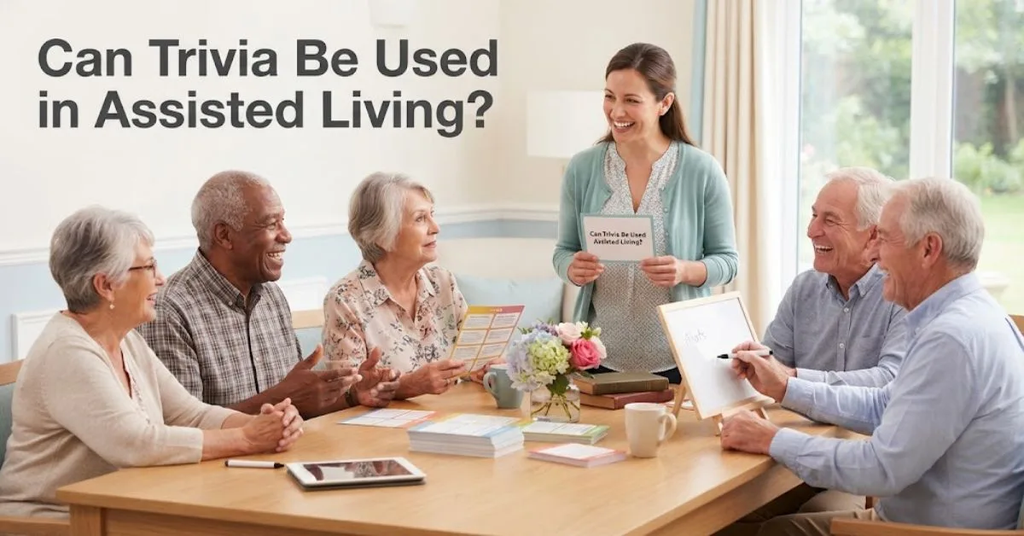
Yes. Trivia can be adapted for one-on-one visits, small groups, senior centers, assisted-living communities, and memory-care settings. Large-print materials, simple wording, familiar themes, and flexible pacing can make the activity easier to participate in.
What if my loved one doesn’t want to answer?
Don’t pressure them. You can give the answer, tell a related story, play familiar music, look through photographs, or switch to another activity. Following the person’s interests and mood is more important than completing a predetermined trivia list.
For families and caregivers, the heart of trivia for seniors with dementia is not a perfect score. A familiar song, an old movie, a favorite food, or a simple question can sometimes lead to a story that has been waiting to be shared. Keep the experience gentle, respectful, flexible, and personal, and let connection not correctness be the measure of a good session.
Conclusion
Trivia for seniors with dementia is most meaningful when it creates an opportunity to connect rather than simply measure how many questions someone can answer. Familiar music, classic movies, historical events, household objects, favorite foods, and everyday memories can turn a simple question into a conversation or cherished story.
Keep the experience relaxed, patient, and flexible. Offer clues when needed, accept different answers, celebrate participation, and change activities when someone becomes tired or frustrated. Whether you are a family member, caregiver, or activity leader, the most important result is not a perfect score it is a comfortable moment of connection, recognition, laughter, and shared memories.
FAQs
What are the best trivia questions for seniors with dementia?
The best trivia questions for seniors with dementia are simple, familiar, and connected to meaningful memories. Music, classic movies, television, history, food, household objects, childhood experiences, and everyday life can provide comfortable conversation starters.
Can trivia help people with dementia?
Trivia can be a pleasant recreational activity that encourages conversation, participation, reminiscence, and social interaction. However, it should not be presented as a treatment or cure for dementia. The goal is enjoyment and connection rather than testing memory.
What type of trivia is easiest for seniors with dementia?
Recognition-based questions are often a good starting point. Multiple-choice questions, yes-or-no questions, familiar songs, famous people, classic television, common foods, and everyday household objects can make participation less demanding.
Should you correct a senior with dementia when they give the wrong answer?
Not necessarily. If the activity is primarily for enjoyment and conversation, avoid making mistakes feel like failures. Offer a gentle clue, share the correct answer, or ask a related question without creating unnecessary pressure.
Is music a good trivia topic for seniors with dementia?
Yes. Familiar music can provide meaningful opportunities for recognition and conversation. Choose songs and performers that match the person’s interests and memories, and allow listening itself to be part of the activity.
How long should a trivia session for seniors with dementia last?
There is no universal time limit. Start with a short session and adjust according to the person’s attention, mood, energy, and comfort. Taking breaks or ending early is completely appropriate when someone becomes tired or frustrated.
Can these trivia questions be used in memory-care communities?
Yes. The questions can be adapted for one-on-one visits, family gatherings, senior centers, assisted-living communities, and memory-care activities. Large-print cards, simple wording, and familiar topics can make group participation easier.
What should you do if someone becomes frustrated during trivia?
Pause the questions and change the activity. Try familiar music, photographs, a favorite topic, or a simple conversation. The person’s comfort and dignity should always be more important than finishing the trivia round.

Helping trivia lovers discover funny, clever, and unforgettable team names for every quiz night.